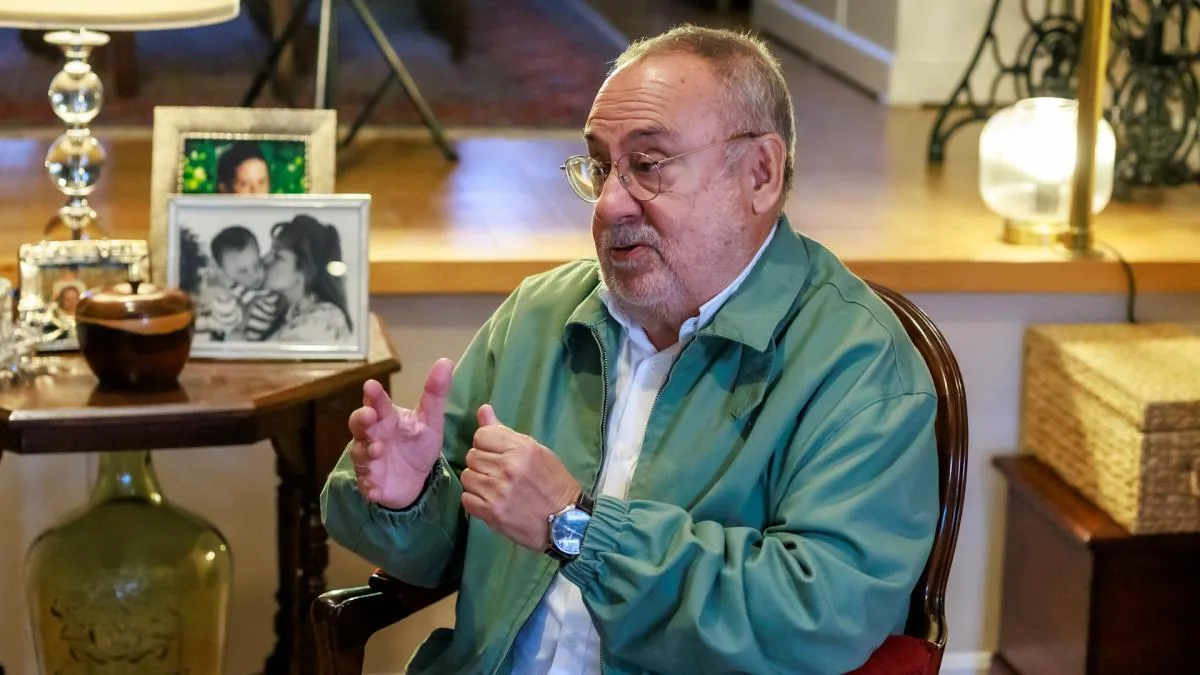
Alfredo Relaño (1951) welcomes La Vanguardia to his home in Aravaca, a haven of peace amid the informational whirlwind of Madrid, an atmosphere that accompanies him in a pioneering professional life (Canal+), of ‘guerrillas’ (AS) and multimedia: he now collaborates with Cadena Cope, Marca, and El Mundo. “I am on the other side of the mirror,” he says. He has just published his new book ‘366 footballers’. And he is one of Florentino Pérez’s targets.
Read more ‘Health maxxing’: the new obsession with longevity and immortality
Do you remember your first encounter with Florentino?
We had a good relationship at first. It seems that he got upset with my criticisms. The main ones came because of Mourinho. I didn’t think he was a bad coach, but he was a bad citizen. Especially when he poked Tito Vilanova in the eye, and Madrid allowed a banner: “Your finger shows us the way,” I thought it was the height of absurdity. I said: “You should have told that guy either to apologize or leave Madrid.” And instead, they backed him. “No, he represents the values of Madridism.”
Did you expect his return if Florentino remained president?
I understand it and expected it. Florentino had a curious problem, that he disliked seeing there was no strict boss and that the players were doing well. But they are the ones who won the Champions League. They are Del Bosque, Zidane, and Ancelotti, from that line. When he looked for someone stricter or tougher, he failed. He failed with Benítez, who told Modrić not to shoot with the outside of the foot. Xabi Alonso came with those ideas about pressing and was expelled.
Mourinho has detractors.
At first, Mourinho was accepted well, as if by a state of exception. I had never seen Madrid so disconcerted as with that Barça that seemed to have definitive solutions: many from the youth academy, very beautiful play, they fed the national team, Messi, Guardiola’s good speech and method. Then it was like bringing a rustler to see if he could steal the ranch’s cows. But as he made bigger blunders, he lost sectors of Madridism. And he ended up with the ultras.
What did you think of Florentino’s interventions?
The first one seemed like a mess. I saw a man affected by age. It’s ugly to say because we all have age, but I saw him already lost, erratic. People who have seen stretches were surprised to see a man with the image of a royal house, so to speak, being so aggressive. Those of us who know him closely already know he is like that, outspoken and rude. I had the impression that him being like this explains why Madrid is like this.
In what aspects?
He has been off for two or three years. There is a lot of discomfort in Madrid: no one understood the Xabi Alonso thing. That the club gave itself so much to Vinícius, that was already a sign. When instead of giving him the Ballon d’Or they gave him the Silver… Look, they gave the Ballon d’Or to Ancelotti and Real Madrid. Those whims were already strange things.
Is the election thing a masterstroke or something poisoned?
He called them with village cunning. I understand, this is my interpretation through the information I have, that he urgently needs money. So he has to launch that plan for members to sell part of the club, something he has never explained well, but he is very trapped. To do that, he didn’t have moral strength now.
I understand that Madrid urgently needs money”
Because of the Bernabéu?
Essentially. Besides the runaway race of signings, which Madrid also suffers. On one hand, Mbappé costs a lot. As soon as Mbappé came, Vinicius already asks for as much as Mbappé to renew. Then on the other hand, the stadium, which was initially going to cost 500 million, skyrocketed because of the idea of the hypogeum, and went over 1300. And the operation doesn’t work well.
Was that the biggest blow?
Yes, and they are surprised that concerts make noise. They can’t be done. Just as you can’t have mass with sex and violence, you can’t have concerts without noise. And he is in that trouble. And that’s why he needs income, and income means making members allow or sell part. The stadium has screwed him. Besides being a big inconvenience for the city. He is doing botched jobs. They haven’t allowed that huge parking lot either. He has had ugly complicities with the city council and the community. These causes have even put the mayor and the community in trouble, who have allowed things to be done that can’t be done.
The latest ruling blames the promoter and not the club for the noise at the criminal level. Does that pave the way for concerts?
One thing is to have exceptional permission because the Pope comes or Frank Sinatra sings, and another is that an activity other than sport is the majority, which was the intention. That doesn’t work to start with. Madrid has come out well from a ruling that has been biased. It has come out well from a ruling that says it’s not Madrid’s crime, but the promoter’s. Which means concerts still can’t be done. But that can’t be done there. Unless the law changes, which would be extraordinary, saying that noise can be made at a concert with neighbors in front because it suits Madrid.
Riquelme, the now official candidate, talks about Madrid’s lack of democracy. How did Florentino achieve that?
Yes, he has managed to have undeniable influence in the city. He has controlled the box. I make that caricature, from the movie Escopeta Nacional: that Catalan industrialist wants to sell automatic doors to Latin America. That kind of hunting that was done then, that’s the box right now. He also does things so banks don’t give credit. Besides, he set such difficult requirements.
How do you see these elections?
It’s a challenge. First because, if Florentino wins, he won’t be president until quite late. He is not in an easy position to withstand a campaign or a debate with this man. I heard his name about six or seven years ago in a restaurant in Alicante. And I hadn’t paid much more attention to the matter. He is a man who doesn’t even live around here. Riquelme’s businesses are mostly in Mexico, he will pass by here just enough, I didn’t know about him. Whether or not he is an important rival, he is a friend of Galán (president of Iberdrola), who is Florentino’s great enemy. The thing is maybe he built a ghost. But now he has a big challenge. Changing the statutes at that point, in principle, surely requires the yes of 51% of the members, not of those who vote, of the members. And Madrid has about 100,000 members, roughly. For 51,000 to go and vote yes for that, which most wouldn’t like… It’s not easy at all and that’s the predicament he’s in.
Read more The “Nein” returns to Europe
What would Di Stéfano say to Mbappé or Vinícius?
Di Stéfano had a huge personality and was the best. Puskás came here, and Puskás was a sensational player. Puskás submitted because Di Stéfano was generous, he was demanding but generous. When Puskás came, he started taking penalties. Di Stéfano thought: “He took them better than me,” and stopped being top scorer. I think, what we have learned these years, that galácticos have to be one by one. Last time there were four and they are four with whims, four missing training when they want, four not running like the others… And now I know, now there are two, but Bellingham already says: Why should I run if these…? In fact, Neymar left Barça because he saw and said: “Here, what am I doing?” And when there are two… Madrid’s headliner is Mbappé since he came. And in fact, he has scored many goals despite… But Vinícius wanted to stand next to him and there are already two cliques. One would be with Vinícius, with Bellingham and Valverde. With Mbappé, obviously, the French, who benefit from being in his shadow for the national team and everything, and by proximity. And then there is a little cloud of unhappy Spaniards who already relate their grievances to all this. One ended with Xabi Alonso, another has put Arbeloa in question saying: “We lost the structure when…” I suppose Di Stéfano would put these two in line and if not, they would leave. Didí left before the season ended. Didí didn’t run and was an exquisite player, had been the best player of the 58 World Cup, where Pelé appeared, and was a player with a sensational long pass and shots… But he didn’t run, and also when winter came with those fields… Didí didn’t play a minute in the European Cup. I imagine Di Stéfano said: “No, in the European Cup this one doesn’t play, because there are much more serious matches.” You risked the European Cup at any minute
Mbappé is Madrid’s headliner, Vinícius wants to be next to him and there are two cliques”
You coined the term ‘Villarato’ to talk about favors to Barça. What do you think of Negreira?
I noticed, after some difficult elections Villar (president of the RFEF) had, that his former secretary general, Gerardo González, opposed him, and Laporta broke the La Liga voting agreement. La Liga got everyone to agree: “Let’s all vote for Gerardo.” And he broke it. From then on, I started to see very pronounced favors to Barça, errors against Madrid and, above all, the kind of consequences one thing or another had.
Do you think, then, that Barça benefited from Negreira?
That Barça paid the vice president of the referees for 17 years and stopped paying him just when he ceased to be vice president seems to me sufficient evidence for that. I know people in Barcelona find it hard to accept this, so they look for explanations… It’s not proven that any referee was paid. Surely no referee was paid. But he did what he could in that position.
Will you still think that even if there is no ruling proving it?
“Even if it’s to balance,” as they said; there is no other reason. Besides, I saw strange things happening before knowing about the payments. Some even prefer to look for the excuse in Barcelona that the presidents (directors) kept it. But well, where is that? And one of those presidents is the current one. And now we vote for him knowing money was stolen. I think there is a kind of pact; it spoils the nicest moment… It’s like being told the Kings are the parents.
You have already given your opinion on Florentino, what do you think of Laporta, does he have a nose for coaches?
I like Laporta as president, he seems a bit of a rascal. But he is a football man and has good instinct. He wanted Flick, for example, from the start. What happens is that he saw a lot of wind in favor of Xavi, to see if Xavi was a second Guardiola, but he had the idea of Flick. And Flick has worked very well. I’m not saying Xavi hasn’t, but Flick has worked very well. He had the talent, gave credibility to the project by signing Lewandowski, who with him got by. And he has also been a very honest, committed player. And then Laporta is very bold. They were in ruin. He knew how to charm Florentino with “I stay with you until the end in the Super League,” so at least Florentino could pretend he hadn’t made such a fool of himself, and he has been getting favors. One was getting that in the Sports Law Laporta didn’t have to answer for the losses of the first year, which, as Florentino also controls the General Secretariat for Sport. And he helped with the Sixth Street levers, all that kind of thing. Without money, he has made a new stadium. Hey, slower, but it’s there, it will be finished when it’s finished. And he is very accurate. He reaches people and is accurate.
Laporta seems like a rascal to me, but he reaches people and is accurate”
You were one of the main ideologists of Canal + in the 90s. What innovations do you remember from those years?
I am proud of that. I think many things are still done, even presumptuously I would say little has improved since then. I had never done television before, I was very scared, and what I wanted was to show what I would have liked to see as a fan. I wanted broadcasts in the greatest possible detail. I found Víctor Santamaría for that. And then, ‘El día después’, was to see a comprehensive image of football, from the shocking to the chess. Chess has its part, but also when I went to football I saw everything was fun. As you arrive, the look one has, the other, the father who loses the son. All that was ‘What the eye doesn’t see’. That was hard because we sent some first-job guys, one was Antonino, another was Maldini, another was Nico Abad. We hired a cameraman and told him: “Look at that man.” I remember a man who went to the bathroom and then couldn’t find his wife. It was a program many people watched because football is a full thing. Putting a microphone on Bilardo when he said: “Step on it, step on it, step on it.” I liked not to standardize people. I especially liked working with first-job people because unlearning is harder than learning. And I don’t remember when I left the direction and made a list of 10, which I have somewhere. Among them were Robinson and Valdano too. So to speak. Valdano started with me at El País, writing in El País.
You have now written a book about footballers, which two stories impacted you the most?
Well, one that caught my attention a lot is one called Monteglio, who was from Italy and played in Rome. He is a guy I would like to know more about. He was a friend of Mussolini, was the tennis coach of his children and his physical trainer, and also acted a bit as secretary. And when that collapsed and Mussolini was caught, he was free, he left, and there is a mystery. And in fact, he later coached teams. And there were people who complained, but then they left him alone. So the intrigue remains whether he bribed to be protected, whether he actually betrayed Mussolini at the last moment or whether he was in connivance with people against Mussolini, with the resistance that also existed in Italy. Whether he located or knew where the jewels or assets he had were hidden. He is a curious character. It is really strange that at that moment, right after the war, a person who was very well known, who was a right-hand man of Mussolini for many things and very close, had that happen to him. And without leaving Italy, the story of Di Bartolomei caught my attention a lot. He was a Roma player, a figure, an attacking midfielder, and played ten years at Roma, played in the European Cup final — precisely in Rome — against Robinson’s Liverpool. And that day he played badly and they lost on penalties. It is the great disappointment in Roma’s history. So he was left estranged. Between declarations, he signed for Milan, did badly in Milan, returned to Rome and some statements caused people to turn against him. He quit. He set up some businesses, tried to create a kind of football school, like several footballers have done later. At that time I think it must have been new, in those years. And exactly on the day that marked 10 years since the defeat, he went out to the terrace of his house in a small village, barefoot curiously, and shot himself in the head with a hunting rifle. The day that marked ten years since that. He had been what Totti later was. Those are the two stories that caught me the most. Then there are many very beautiful ones from South America.
Messi or Maradona?
For me, Di Stéfano or Puskás would be. We always like the one we saw at 15 years old. Between Messi and Maradona I would say… Maradona is the one who had God inside the most of all. There are six on the cover who are the ones I consider the best. Two I think are a bit behind, which are Cruyff and Cristiano. Cruyff was exquisite, but for his short duration as a player. At 27, which is the age Di Stéfano came to Madrid, Cruyff, in his second year at Barça, was already a bit of a joke. And Cristiano, on the contrary. Cristiano doesn’t have the virtuosity of the others, but he has durability. Nine years scoring 50 goals at Madrid every year, facing Messi, taking Ballon d’Ors from Messi, which you also have to dare. And he is on the way to a thousand goals. He says, all filmed, as if to say Pelé’s aren’t. But of the others, I still stick with Di Stéfano. Di Stéfano for a championship and Pelé for a match. Now, among these, I think Maradona has been the one who had the most inspiration of God inside. But he only trained for a month in his life, which was the month of the Mexico World Cup. If he had trained decently, not like Cristiano, like Messi, who was a bit lazier… Barça in general trained a bit less and the coaches knew how to win 95% of the matches. I liked Messi a lot, but I reproach him compared to all the others who are not Cruyff, which are the matches I have seen him receiving thrashings away in the Champions and him downcast, making a bad face, saying no. I couldn’t imagine Di Stéfano fighting like that. They lost matches. But that resignation, that faith. I couldn’t even imagine Maradona like that. Maradona was heroic hurting this, that…
Read more Lluïsa Moret: “More resources must be dedicated to municipal financing”