At 94 years old, Raúl Castro has to play hide and seek.
The shadow of Nicolás Maduro’s fate, who was kidnapped from his home in Caracas last January and who went from being president of Venezuela to being a prisoner in New York awaiting trial for alleged narcoterrorism, looms over the veteran revolutionary leader.
Read more How Beijing has managed to go from being a copycat of the West to being the one copied
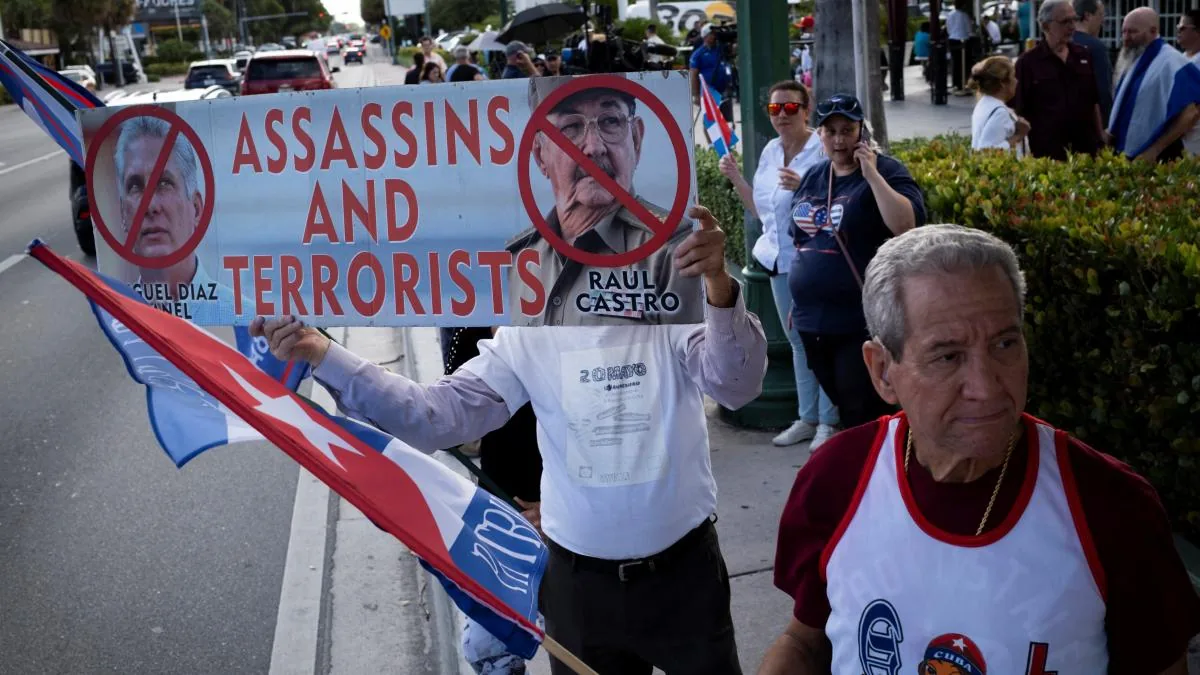
The Cuban-American community in Miami was very excited and emotional this Wednesday at the possibility of seeing one of the greatest tyrants of the Havana regime imprisoned in Florida. There is a desire to hold him accountable as the alleged responsible party, from his position as Minister of Defense, for the alleged murder of four Americans (of Cuban origin) who participated in 1996 as pilots in the humanitarian operations of the organization Brothers to the Rescue. Their planes were shot down.
U.S. legislator Carlos Giménez, born on the island and a member of the diaspora, encouraged a possible operation to forcibly bring Raúl, and President Donald Trump simply responded “I don’t want to talk about that” when reminded of the Maduro capture operation.
Faced with that option of military intervention – some experts even hinted that the indictment and arrest warrant could incite a war conflict – the former president of Cuba from 2008 to 2018 must study how Fidel, his older brother, protected himself from CIA attacks in the early decades of his administration.
It is documented that the great revolutionary leader, the main of the bearded ones, frequently changed residences and used multiple places to sleep and work for fear of suffering a blow from U.S. espionage.
But today, with extraordinary advances in detection and surveillance technology, which make those of Fidel’s era look like simple toys, Raúl Castro must take extreme precautions, as if he were a prisoner in his own home.
U.S. Acting Attorney General Todd Blanche did not rule out further charges while Secretary of State Marco Rubio (another with roots on the island) emphasized in a message this Wednesday to Cubans that Castro is not only an alleged murderer but also the real head of Gaesa (Business Administration Group S.A.), a company he described as the great plunderer of the Cuban economy, even more than the historic embargo or the recent oil blockade ordered by the White House.
“Thirty years ago, Raúl Castro founded a company called Gaesa. This company is owned and operated by the Armed Forces, and it has revenues three times greater than the budget of its current government,” Rubio denounced.
“Today, while you suffer, these businessmen have 18 billion dollars in assets and control 70% of Cuba’s economy. They profit from hotels, construction, banks, stores, and even from the money their relatives send them from the United States. Everything, absolutely everything, passes through their hands. They withhold a percentage of those remittances, but they receive nothing from Gaesa’s profits,” he denounced.
In reality, the most dominant entity in Cuba is not the Communist Party, but Gaesa, a secret business conglomerate controlled by the Cuban army, at the administrative top of which sits Raúl Castro. It is considered one of the most powerful economic structures in the country because it manages much of the sectors that generate foreign currency.
Originally established by Raúl Castro to strengthen Cuba’s defense sector, this company has evolved into a commercial empire, according to various analysts, and a central point of Washington’s campaign against the Havana regime. Several of its leaders and officials are on the U.S. sanctions list.
Read more Illa secures its first budgets after renewing and updating the agreement with Comuns
“This private company has more money than the government itself,” Rubio said last week during a trip to the Vatican. “None of these funds are used to build a single road, a single bridge, or to provide a single grain of rice to a single Cuban, except to the people who are part of Gaesa,” he assured.
Gaesa participates directly or indirectly in tourism (hotels and resorts), foreign currency stores, ports and logistics, free trade zones, real estate, remittances, banks and finance (especially the International Financial Bank, which gives the conglomerate absolute control over foreign currency reserves), imports, airports, associated telecommunications, maritime transport, gas stations, and supermarkets, all through a vast company called Cimex.
Although formally a business corporation, it operates with a mix of military structure, state administration, and corporate logic. The Cuban government grants it strategic sectors, and Gaesa manages companies, collects revenues in hard currency, and redistributes resources to the state and the military apparatus. Many believe it acts as the true financial center of the Cuban political system.
It is like a state within the state. Its finances are secret and do not appear anywhere in the government budget, making it unclear whether the state receives any part of its profits.
Gaesa was born out of the chaos generated after the fall of the Soviet Union in 1991, the special period era, although its roots go back to the 1980s. Raúl Castro, then Minister of Defense, convinced President Fidel to allow him to make changes in the business interests of the armed forces, Frank Mora, who served as Deputy Assistant Secretary of Defense in the Obama administration, explained to The New York Times.
When the USSR collapsed, the island lost its main trading partner and financial sponsor. The army was in ruins and had difficulty paying its troops. Fidel allowed the armed forces to take over sectors of the economy controlled by the state, such as tourism, in an attempt to save the country.
The experiment worked at first, experts agreed, and the military proved to be a more efficient business manager than other branches of the state. The economy recovered by the late 1990s, and the military reinvested its profits in the country to support hospitals, education, and food rations.
Its role was strengthened when Raúl took over the presidency from his brother and now controls much of the economy. Gaesa also has companies in Angola, generating hundreds of millions of dollars in annual profits in education, healthcare, construction, and other sectors.
Trump’s arrival at the White House in January 2017, which closed the flow of tourism and business that Obama had opened, and the pandemic, hit Cubans hard. But despite the crisis, Gaesa maintained its control, although it stopped reinvesting in citizens. Today, with other relatives of Raúl Castro also at the top, it is stronger than ever, analysts insist. However, poverty on the island has never been worse.
Read more How can Jonathan Andic defend himself against the charge of homicide?