
When China surpassed the U.S. in 2008 and became the leading country in terms of internet users, the tech sphere remained unfazed. This was mainly due to two fundamental facts: first, the internet penetration rate in China was only 23%, not even a third of the U.S. rate; second, internet use was heavily focused on consumption, and all the main players in various sectors were imitators of Western business innovations. Baidu is the Chinese Google, Tencent QQ is Messenger, Fanfou is the Chinese Twitter, Kaixin001 is the Chinese Myspace, and Zhihu is the Chinese LinkedIn. In short, the West set the trends, and China merely copied proven recipes and adapted them to the Chinese market.
Read more Illa secures its first budgets after renewing and updating the agreement with Comuns
As a result, when I started writing my thesis fifteen years ago on the topic Digital Creativity and Innovation in the Chinese Social Media Industry, the idea was immediately met with skepticism: is there any real innovation in the Chinese digital realm? And, more importantly, unlike the bottom-up business innovation model of the West, can the top-down technology diffusion driven by the Chinese government and the resulting business initiatives truly be considered a valid innovation model?
China may not be the strongest in radical innovation, but it is in incremental innovation and, even more so, in orthogonal innovation (the ability to rethink problems and better integrate things)
My analyses from fifteen years ago about the main digital entrepreneurs and the most popular social networks in China led me to three main conclusions.
- The top-down model is more common in importing new technologies and revolutionary aspects, which require strong support from central and local governments in terms of policies and funding; but when it comes to consumer-oriented digital platforms and tools, the dominant players follow the same bottom-up model as in the West. All the leading companies mentioned were founded by private sector individuals, university graduates with little experience in state-owned enterprises or government institutions. They created these digital companies because they were young and discovered the unmet need for social interaction or information exchange among their peers, not because the government identified these areas as fundamental for growth and sent a team to meet those needs.
- China may not be the strongest in radical innovation, but it is undoubtedly strong in terms of incremental innovation. And, more impressively, in orthogonal innovation, defined by Estriño (2009) as the ability to rethink the problems to be solved and better integrate things.
- The so-called American footprint in Chinese social media companies is limited to certain areas and a brief period of time. Marketing, technology, and human resources practices are deeply rooted in the national environment throughout the entire growth trajectory. As a unique advantage, the complexity of the Chinese market itself serves as an internal driver for the rapid evolution and adaptation of new product features among Chinese digital companies.
Amplification of Entrepreneurship and Networks

At that time, all these arguments were based on a small segment of the digital sector in China. However, over the past fifteen years, we have witnessed amplification across all sectors with growth in two facets of digital entrepreneurship. First, Wang Xing, the digital entrepreneur who carried out multiple rounds of financing and struggled with the censorship dilemma on his platform Fanfou, learned the hard lesson that his businesses were too far from the ultimate goal of the digital value chain: the monetary transaction. From that revelation, he founded Meituan, the Chinese Yelp+Uber. After fifteen years of effort and work, Meituan has become an internet industry giant, one of the four main digital companies in China. Its tentacles have extended beyond the original territory, adding models like GrubHub+Fandango+Netflix and becoming an important player in film distribution and financing. The film element grew rapidly to become an undisputed sector leader and separated from the parent company, Meituan. This growth pattern further reinforced my third argument: the fertile ground of Chinese digital industries benefits from the rapid and deep penetration of the internet, the supply chain and logistics nexus, and digital platforms, which transform them into the central node of people’s daily lives and inevitably make them centers of predominant social and technological power.
Disruptive Innovations
From the first facet, more and more disruptive innovations are emerging that transcend China’s national scope and become a new standard or paradigm worldwide. When an unknown private fund called DeepSeek surprised the entire AI community in 2024 with a proprietary algorithm that dramatically increased efficiency and reduced costs, the threat of the barbarians became real for the first time in the eyes of the Western world. Apparently, the Chinese digital entrepreneurial spirit can turn financial tools into infrastructure productivity and constitute the best example of orthogonal innovation. Similarly, the social platform TikTok has swept the world and won the hearts of young people. It surpassed all the originals in that field, such as Facebook and Instagram, because it quickly crowned itself as the most used social app among 18 to 24-year-olds.
Read more How can Jonathan Andic defend himself against the charge of homicide?
Amazon and Walmart have for the first time resorted to applying the reverse strategy of copying a Chinese competitor, TikTok Shop, with live shopping broadcasts on their platforms
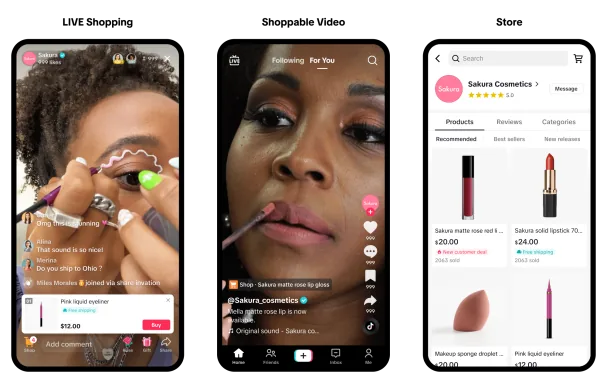
In line with my second point, TikTok is not content with being the top social app or the leading short video platform. Its ultimate ambition is to copy the successful marketing model existing in China and reshape the entire world of social commerce with the launch of TikTok Shop in the U.S. and major countries worldwide. In response, competitors in the traditional e-commerce space, such as Amazon and Walmart, have for the first time resorted to applying the reverse strategy of copying a Chinese competitor, because they have started live shopping broadcasts on their respective platforms… but they quickly discovered they had not inherited the same gene as TikTok. While the U.S. remains stuck in the old QVL tele-sales chain model applied to live broadcasts, TikTok China has already reached the level of Saturday Night Live and turned live broadcasts into a sensational variety show and the go-to place for all current topics and trends. On China’s biggest sales day, November 11, more than 69 live broadcasts achieved over 100 million yuan in sales.
Impact of TikTok Shop
Similar to how digital distributions made the long tail theory famous, TikTok Shop is also democratizing digital entrepreneurship in three main ways:
- It has significantly reduced the cost of market research and product development for sellers, thus saving time and resources in trial and error to launch a new line.
- It allows small and medium sellers to compete on equal footing with big brands thanks to affordable and cost-effective marketing and promotion materials.
- Content creators and, technically, anyone with a good understanding of how social commerce works on TikTok Shop can quickly become digital entrepreneurs. In fact, many content creators have left their jobs to dedicate themselves full-time to creation and finally enjoy a work-life balance with more rewarding income.
With the rise of AI and techno-intelligent agents, we have witnessed faster and more diversified application of innovation among digital entrepreneurs in China. In certain areas, they have outperformed Western companies on their own turf. The classic law of supply and demand has favored China, with its large and diverse population and its growing desire to own the most advanced and sophisticated tools, applications, and products in the world. This imminent challenge from China may serve as healthy pressure for the business ecology and innovation to reach new heights globally. There is already speculation about whether Sam Altman’s Sora 2 can become TikTok’s biggest competitor as an AI-focused counterpart. The next fifteen years promise the spectacle of the new transformation of digital entrepreneurship in China.
Fan Dong is founder and CEO of CreatoRev Corporation.
How to read Vanguardia Dossier
PRINT VERSION
• Purchase of copy. The print edition of VANGUARDIA DOSSIER can be purchased at regular newsstands and bookstores for 12 euros.
• Subscription. Request your subscription by calling 933481482 and you will receive VANGUARDIA DOSSIER comfortably at your home.
DIGITAL VERSION
• Purchase of copy. The digital edition of VANGUARDIA DOSSIER is available for free in the “Vanguardia Dossier” app for iOS (App Store) and Android (Google Play Store). Each issue costs 8 euros.
• Subscription. Subscribe to La Vanguardia Premium and get unlimited access to all content from La Vanguardia and VANGUARDIA DOSSIER in its digital version.