
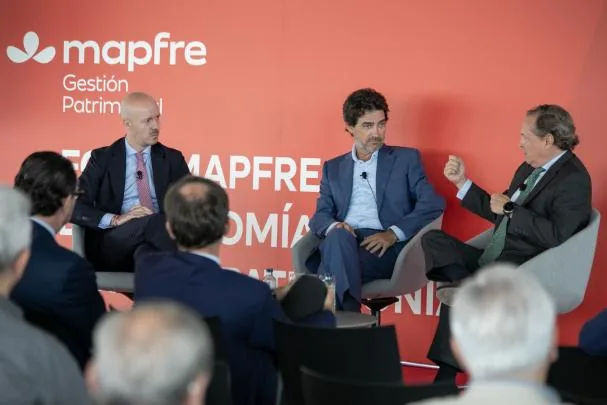
Barcelona strengthens its role as a space for economic reflection after hosting the first Mapfre Forum on Economy and Wealth Management in the city. The event, held on Tuesday, brought together experts from the legal and financial fields at the Torre Mapfre to address the major challenges of wealth management, from taxation to the behavior of global markets, with one premise: without planning, wealth is exposed to avoidable risks.
Read more Xavi Pascual makes the decision to leave Barça at the end of the season and will sign for Dubai
The regional director Barcelona – Southern Catalonia of Mapfre, Ramón Pujol, opened the meeting with a statement of intent: “There is no economic evolution without the insurance sector.” From there, he defined the company’s new positioning. “One of our objectives is to position ourselves and consolidate as a benchmark in financial advisory services,” he said, referring to the boost of Mapfre Wealth Management and the desire to bring financial knowledge closer to society.
Tax planning
Under the title “The importance of good tax planning in wealth advisory,” the first panel brought together Eduardo Ripollés, business development director of Mapfre Investment, and lawyer José María Cusí, founding partner of Legal Added Value. The debate made it clear that taxation is no longer an accessory element. Ripollés summarized it by highlighting: “Financial planning is important, but even more so financial tax planning.” In his view, many products lose appeal if not analyzed from their tax impact.
Along those lines, Cusí described a heterogeneous and unequal Spanish tax system. The expert reviewed the evolution of investment vehicles, with the replacement of SICAVs by venture capital companies, which he recommended stating that “they are a better option than venture capital funds given the problem of achieving exemption from wealth tax on 40% of free investment of an FCR due to its mandatory external management at the regulatory level, compared to the option of the self-managed SCR, given the requirement of the wealth tax law to participate in the management of the investee entity.”
Cusí emphasized the differences between autonomous communities, stating that “a 54% marginal rate in the Valencian Community contrasts greatly with the 44.5% in the Community of Madrid in IRPF,” and especially highlighted the difference in the inheritance tax location. “What we pay in life for wealth is not as quantitatively relevant as what our descendants will pay for inheritances after our death,” he warned.
In territories like Catalonia, “the ISD tax burden can approach 40% when the heir’s pre-existing wealth exceeds 4 million euros, while in other places like the Balearic Islands it can be zero.” This disparity conditions strategic wealth decisions, from notarial donations of the few assets that do not entail taxable capital gains for the donor, to changes in tax residence.”
Cusí concluded by stating that “proper tax planning is decisive, as it can legally maximize income and net wealth significantly.”
Resisting the noise
The second panel, titled “How major asset managers see the current landscape,” broadened the view to the global context. Ismael García, deputy director of Investment Strategy at Mapfre AM, opened the debate with an idea that set the tone: “There is always something.” Pandemic, inflation, or geopolitical conflicts have marked recent years, but the lesson, he pointed out, is to avoid impulsive decisions.
Alfonso del Moral, head of Relationship Management for Spain and Portugal at T. Rowe Price, provided a significant fact: despite tension in the Middle East, “the US stock market has continued to rise.” The explanation lies in the strength of its economy, supported by growth, employment, and technological momentum.
Read more Àlex Márquez suffers a brutal accident in the Montmeló race, interrupted twice
For his part, Javier Mallo, general director and head of the Iberia Client Group at Neuberger, insisted on the importance of perspective: “The important thing is to take distance and not overreact.” In his view, the scenario points to some stability, although without full normality, with effects on growth and inflation, especially in Europe.
Mapfre strengthens its financial commitment with taxation and advisory as key pillars
The United States concentrates investor interest. “We like companies of all sizes and styles, but being selective,” said Mallo, who highlighted the solidity of corporate profits. Europe, on the other hand, faces more uncertainty. Del Moral pointed to structural problems: “The crisis has revealed the disaster of energy policy.” Meanwhile, emerging markets gain weight due to their higher growth and lower inflation.
Artificial intelligence was a focus of part of the debate. Del Moral defined it as “the biggest thing we have seen since electricity,” with a potential impact far greater on the global economy. This transformation drives opportunities across the value chain, from infrastructure to suppliers, although it complicates the traditional analysis of companies.
The executive also warned about its impact on employment: “It may be more cost-effective to train an AI than to hire junior profiles,” which anticipates changes in the labor market.
In fixed income, strategies are beginning to diverge. While in the United States possible rate cuts are considered amid signs of weakness in employment, in Europe prudence prevails against inflation.
The value of advisory
The forum closed with Paolo Leanti, director of Mapfre Wealth Management Barcelona, who emphasized the role of advisory in a complex environment. “Our job is to ground these concepts and make them understandable,” he said. According to him, only through understanding is the necessary trust generated to build long-term strategies.
The day ended with a shared idea: the combination of tax planning, investment discipline, and professional advisory consolidates as the main tool to protect wealth. An approach that, in a context of constant uncertainty, gains relevance both for large fortunes and savers seeking to make informed decisions.
Read more Brutal fight to avoid relegation: five teams will fight not to go down in the last round