Airlines recommend that travelers preparing their summer holidays buy their tickets “as soon as possible” given the uncertainty surrounding the war in Iran and the problems of scarcity and rising kerosene prices. This is a common request that now gains weight in the face of a sharp rise in costs that will have to be absorbed “via company margins or via prices,” assures the association that represents them in Spain.
Read more Dan Jørgensen: “We have to prepare for a pretty tough summer”
“It is advisable for travelers who have not yet purchased their tickets to consider doing so as soon as possible to benefit from the best conditions,” said the president of the Association of Airlines (ALA), Javier Gándara, at a press conference to present this summer’s planning, marked by the “uncertainty generated by the geopolitical situation.”
Another key message from the airlines is that they do not foresee flight cancellations and that supply “is guaranteed.” “Any adjustments are more due to market situation than supply risk,” he explained. However, Gándara added the caveat “for now” when making both statements.
Unlike other European countries, 80% of the kerosene consumed in Spain is refined in the country, which protects it from shortages, though not from scarcity at the destination airport. It “does not immunize” the country from possible effects on flights from other places if the conflict “extends over time,” states ALA.
Despite the war and the risk of shortages, airlines are starting with a seat program for this summer of 260 million seats, almost 6% higher than the previous year. This improvement responds to Spain’s status as a “refuge country,” but it is full of unknowns. “We will have to see how the season evolves and how many seats turn into passengers,” Gándara warned.
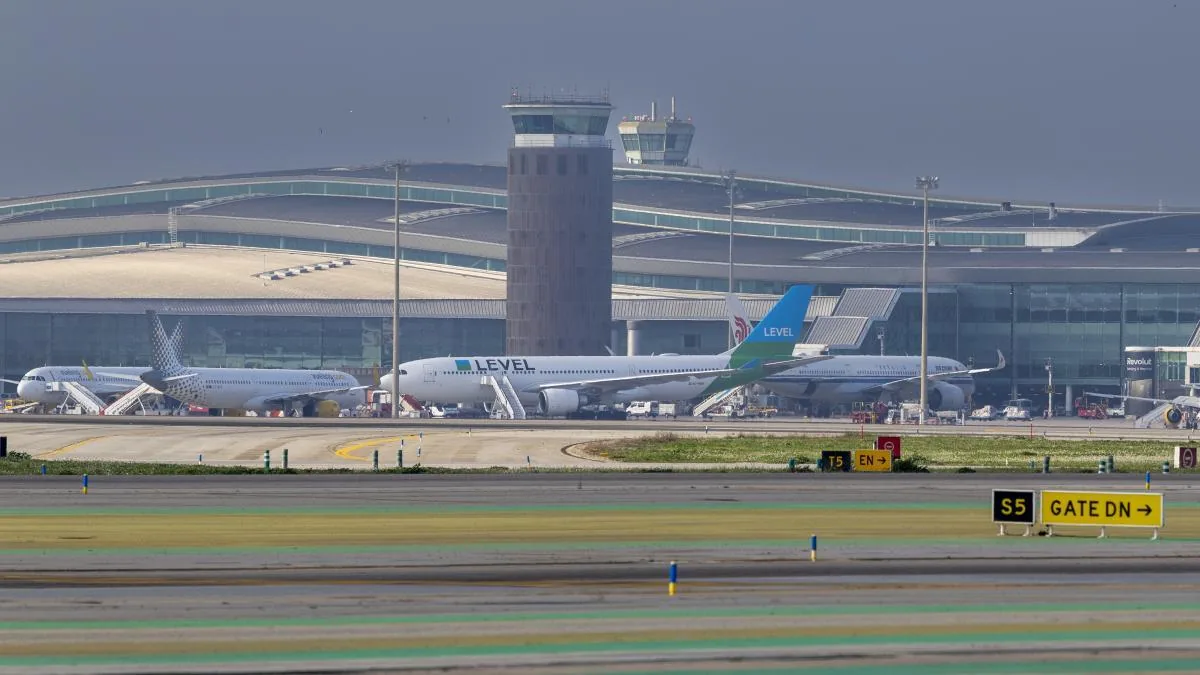
The increase also partly responds to the need to defend available slots, the loss of which is difficult to recover. At Barajas airport, the offer increases by 8%, and at El Prat, by 7.6%, while in the Canary Islands there is a decrease of 2.5%. If more seats are scheduled in Barcelona despite its capacity problem, Gándara explained, it is because there is still room to shift traffic to less requested hours or use planes with more passengers.
“There is a perception of Spain and the Western Mediterranean as a safe destination”
The factor that, despite the uncertainty, generates “good prospects” is the country’s better relative situation in the conflict. “There is a perception of Spain and the Western Mediterranean as a safe destination,” Gándara pointed out, which contrasts with tourist destinations like Turkey or Egypt, to which travelers attribute more risk.
Tankering also plays in Spain’s favor, as it is limited. With the regulation of alternative fuel SAF, the rule was established that, on each flight, 90% of the fuel must be refueled at the origin. As there is more kerosene in Spain, flights can leave the country loaded at 110% of what the outbound journey requires. It is limited tankering, but in return, Spanish airlines prevent other foreign airlines from using the country for excessive refueling and depleting its supply.
Read more Trump’s Labor Secretary resigns amid misconduct allegations
What is evident, as the president of ALA indicates, is that the situation is “more uncertain than ever.” The price of kerosene has doubled and accounts for 30% of costs. The increase “has a very significant impact” that some airlines are managing to mitigate in the short and medium term thanks to long-term purchase hedging contracts.
This situation, however, can harm smaller airlines, which do not have these hedges. “It is a sector with difficult survival, and it is common for companies to go bankrupt in shock situations,” Gándara explained. “Often, smaller companies do not usually have these hedging contracts, but we wish for all of them to continue.”
ALA is not “aware” that other airlines will apply the commercial policy announced by Volotea, which will apply a surcharge of up to 14 euros on the ticket price depending on the cost of kerosene.
Its president also pointed out that refineries are increasing kerosene production to put “even more than the consumption of Spanish airports” on the market, which puts Spain in a good position to participate in any solidarity mechanism that the EU may launch.
The routes directly affected by the conflict account for 1.5%, but the increase in kerosene price, which already reaches 220 dollars per barrel, has an impact. While kerosene usually costs about 20 dollars per barrel more than Brent, the differential is now 90 dollars.
ALA also calls for a new boost for alternative fuel SAF, made from biomass or waste, in which Spain has strong potential. Currently, almost all SAF is recycled cooking oil and costs three to four times more than the conventional price of kerosene. However, airlines are confident that it will become cheaper in the future thanks to second-generation SAF and the creation of a global market.
Read more How to end the war