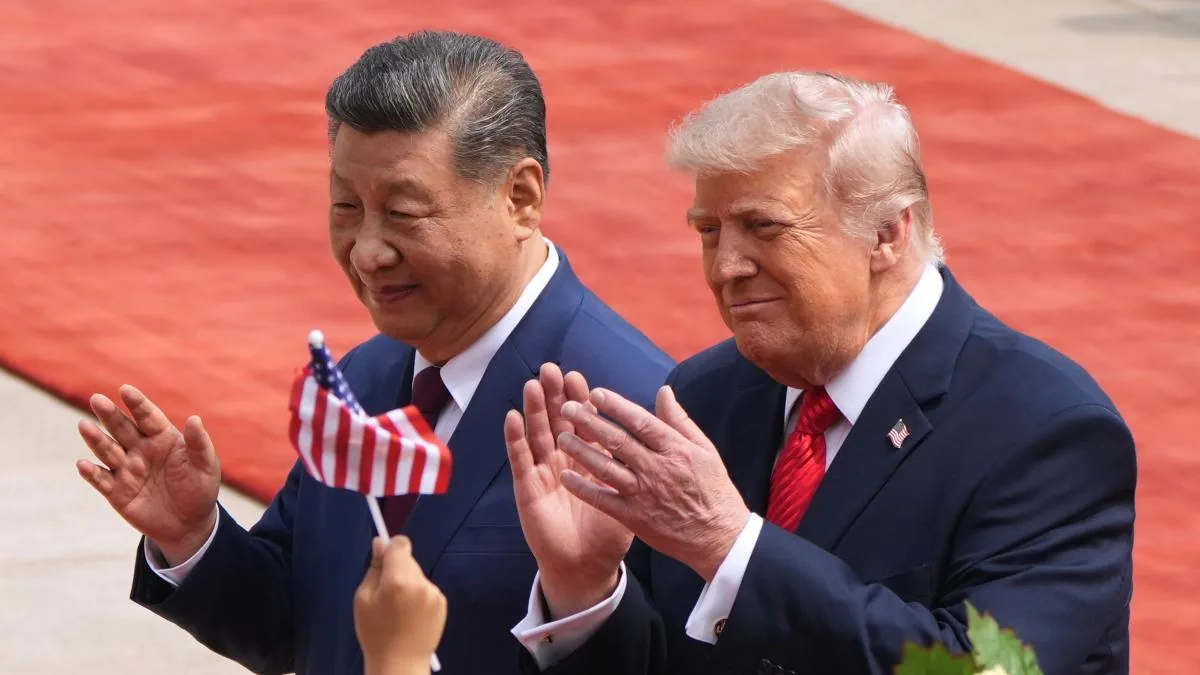
The long-awaited summit between China and the U.S. kicked off this Thursday in Beijing, with apparent harmony between Presidents Xi Jinping and Donald Trump. Despite the commercial focus, the shadow of Iran and Taiwan looms over the meeting from the start. Xi, in fact, pointed out that the Taiwan issue is the most important in the relationship between China and the U.S.: “This will be stable if handled well, otherwise there will be clashes and even conflicts, which will pose a great danger.”
The Chinese president referred to maintaining peace in the Taiwan Strait as “the common denominator” between China and the U.S. He then warned that “Taiwan independence and peace in the strait are as irreconcilable as water and fire.”
However, according to Xi, the U.S. and China can choose “to be partners instead of rivals.” “When we cooperate, both sides benefit; when we confront each other, both suffer the consequences.”
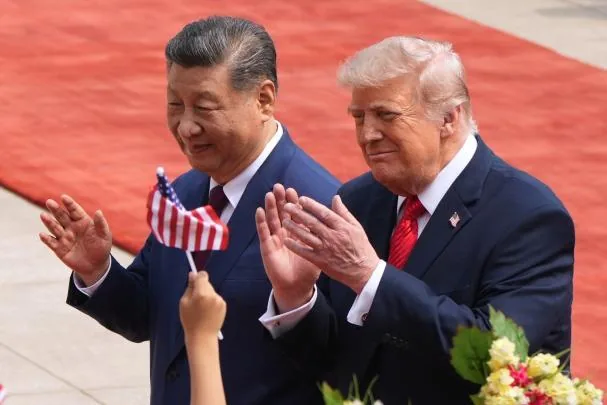
In this regard, he highlighted that the preparatory work of their respective economic teams, this week in South Korea, had achieved “a positive and balanced result.” Music to the markets and music to Trump’s ears, who needs to return to Washington with something solid. Meanwhile, as the guest, he has been much more restrained and generous in his words than Xi, after being received on the steps of the Great Hall of the People. “You are a great leader and I have great respect for China and the work you have done.”
Donald Trump also emphasized that the relationship between them, besides being “fantastic,” is “the longest in history between presidents of our respective countries.”
Beyond trade
Xi has slyly warned that Taiwan independence would mean war
The U.S. leader descended the Air Force One stairs Wednesday night followed by his son Eric Trump and daughter-in-law Lara, as well as the heads of Tesla and Nvidia, Elon Musk and Jensen Huang. Family and business. He is also accompanied by Tim Cook of Apple and “another thirty number ones, because out of respect he would not accept bringing number twos or threes,” he explained to Xi Jinping. “It is the best business delegation and hopes to do business… we’ll see if it’s reciprocal,” Trump hinted.
Flanking the U.S. president at the imposing meeting table, the longest faces were those of the belligerent Secretary of War, Pete Hegseth, and the staunch anti-communist Marco Rubio. Beijing has turned a blind eye to the entry ban in China that weighs on the Secretary of State. In effect since Rubio, during his time as senator, led a campaign to degrade relations between the West and China, due to the strict anti-terrorism policy in Xinjiang.
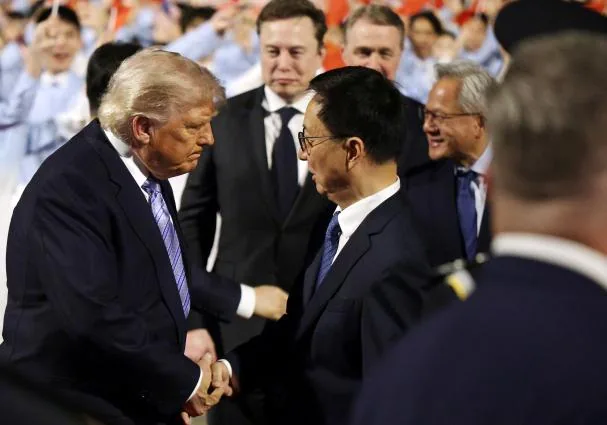
However – diplomacy obliges – today Tiananmen did not exist, while the U.S. delegation crossed Tiananmen. Nor did any concentration camp exist, with supposedly a million Uyghurs inside, if not enslaved in cotton fields.
Read more The City Council entrusts exclusively to the court the resolution of the VPP scandal in Alicante
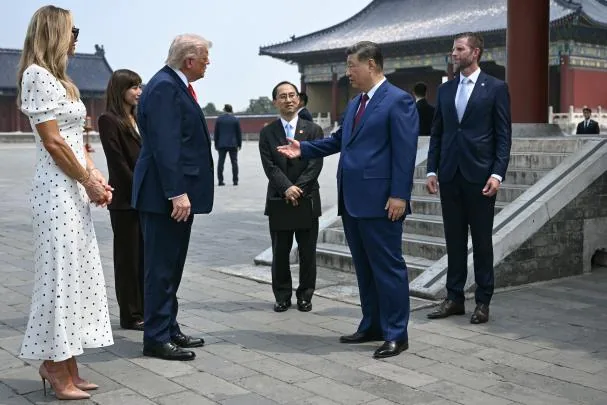
After the morning meeting, which ended after two hours and fifteen minutes, both leaders visited the Temple of Heaven, the cosmic navel of Beijing and – for the ancient Chinese – of the imperial order, if not universal. Later, at the State banquet – lobster, beef ribs, and the inevitable Peking duck – Donald Trump not only invited his host to the White House (on September 24), but exceptionally took a sip of wine with the toast. This Friday there will be a new meeting and a less compromising face-to-face for the teetotal president, over a cup of tea.
“Maybe it is the greatest summit in history and in the U.S. they are talking about nothing else,” concluded Donald Trump. In reality, its format is smaller than that of his 2017 visit. That one lasted one day longer, despite the problems on the table – many of them the result of his own decisions – now being more intractable. The biggest of them is the fragile truce with Iran, a close ally of China. Although the shadow of war looms over the summit, it has not even been mentioned publicly, like the rope in the house of the hanged. Yes, behind closed doors, along with the dossiers on Ukraine and Korea, in a dialogue considered “constructive” by Marco Rubio.
The staging of Trump gives the impression that he went to China only to do business. In reality, the U.S. is also actively seeking Beijing’s mediation to come out unscathed from the Strait of Hormuz. To Washington’s relief, China is almost as interested as any of its Asian neighbors in hydrocarbons returning to sail the seas peacefully.
To his regret, Trump has landed in China with a less favorable balance of power than he found nine years ago – in the last visit of a U.S. president to Beijing – and without having been able to bend the Islamic Republic of Iran.
A matter that goes beyond the arrangements on tariffs, chips, rare earths, soy, beef, and commercial airplanes. Politics in capital letters is paid with politics, not goods. Hence in Taiwan, both the government and the opposition pay the utmost attention to that “fantastic future” that Donald Trump paints for Americans and Chinese.
A new U.S. arms package for Taiwan, worth 13 billion dollars, depends on his signature. But that signature – right now – must wait.
Crossroads
How to avoid the Thucydides trap
Xi Jinping repeated one of his favorite ideas this Thursday. “Unseen changes in a century are accelerating and the international situation is fluid and turbulent. The world is once again at a crossroads.” The General Secretary of the Communist Party of China did not shy away from the cliché that since the times of Sparta and Athens, a hegemonic power is doomed to go to war to stop a rising power. “Can the U.S. and China avoid the Thucydides trap and create a new paradigm of great power relations?” Xi asked Trump, inviting him to work together to open “a new stage for mutual benefit.”
Read more Education calls the unions tomorrow and Llorca says they will negotiate all requests