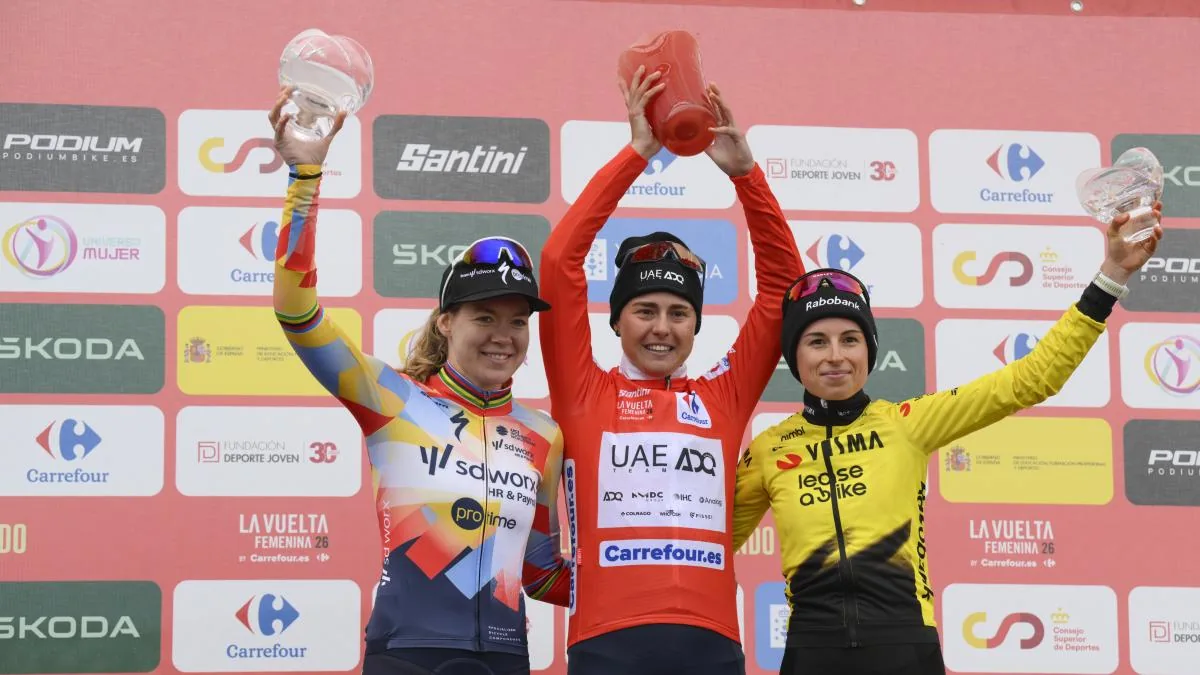
The myth chose the promise. Paula Blasi’s story will forever be linked to the legend of L’Angliru. It was on one of the most fearsome climbs that can be tackled where the Catalan was crowned winner of the 2026 Vuelta a España, where she rose among the greats of this sport at just 23 years old. In the queen stage, where the great pages are written, the cyclist from Esplugues was able to seize the final victory and snatch the red jersey from Anna van der Breggen, one of the best of the century. The present and the future overtook the past in an unforgettable ascent that exalted Blasi.
L’Angliru had never been climbed in a women’s race before and it was the judge of a spectacular turnaround. Hell for Van der Breggen, heaven for Paula Blasi, brave and powerful.
Like Pesarrodona and Mauri
The one from Esplugues is the first Spanish woman to win the women’s Vuelta and the successor to Joane Somarriba
She was not going to settle for being second, for the podium, without pushing her chances, without standing up to the challenge. If the Catalan from UAE Team ADQ has anything, it is ambition, confidence, and talent. She was going to try to dethrone the leader on the last day. And she achieved it on the toughest climb, where she caused the leader to falter 4 km from the finish while she, eyes fixed on the horizon, glasses on her helmet, could indeed push forward.
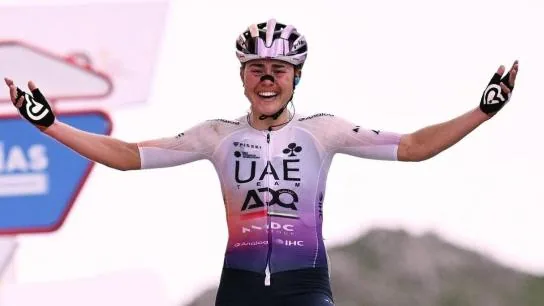
Experience did not help Van der Breggen to quell Blasi’s surge. Nor could all the power of SD Worx stop the Catalan’s momentum. And she did not win the stage because the Swiss Petra Stiasny, lighter, a pure climber, overtook her just after leaving behind the Cueña les Cabres, the toughest section, with gradients reaching 23%. As in Les Praeres, that ramp hurt Blasi, who had to give up the race lead but her battle was another, a bigger one.
Nothing less than becoming the first Spanish winner of the women’s Vuelta and being the successor to Joane Somarriba, winner of three Tours and two Giros two decades ago. Paula Blasi is the third Catalan to win a grand tour after Josep Pesarrodona (1976 Vuelta) and Melcior Mauri (1991 Vuelta).
Read more The WHO addresses Canarian society to reassure them: “This is not another covid-19”
Her career is meteoric. In a few months she has gone from being an unknown to turning professional, finishing third in the U23 World Championship in September 2024, winning a classic like the Amstel Gold Race in April, and being crowned in the women’s Vuelta in May. Her growth has no ceiling.
“I didn’t have a super day. In the end, I was just hanging on, with the hook,” Blasi confessed honestly. “But on a 50-minute climb, you have to go to the limit. When I saw Anna suffer, I thought: ‘Go for it’,” she explained about the key moment when she went for the Vuelta leadership. She needed 18 seconds and gained 36.
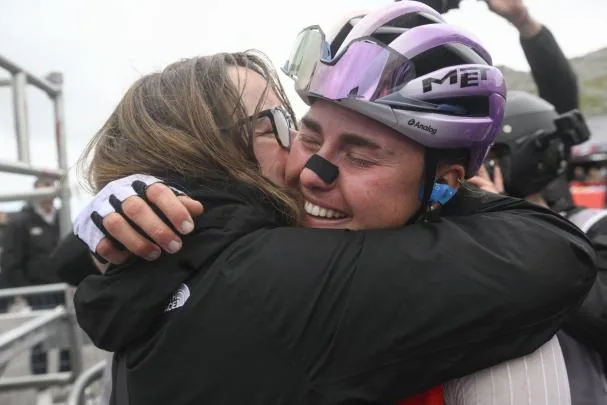
At the top of L’Angliru, her mother was waiting for her, the first person she hugged through tears. At the top, the veteran Mavi García, her guide and protector, 42 years old, cheered her on among the crowd. At the top, the great Perico Delgado took out a phone and immortalized the moment she climbed the podium, the highest step, and was dressed in the red jersey. Historic.
Read more Unprecedented deployment to contain the hantavirus outbreak from the ‘Hondius’ in Spain