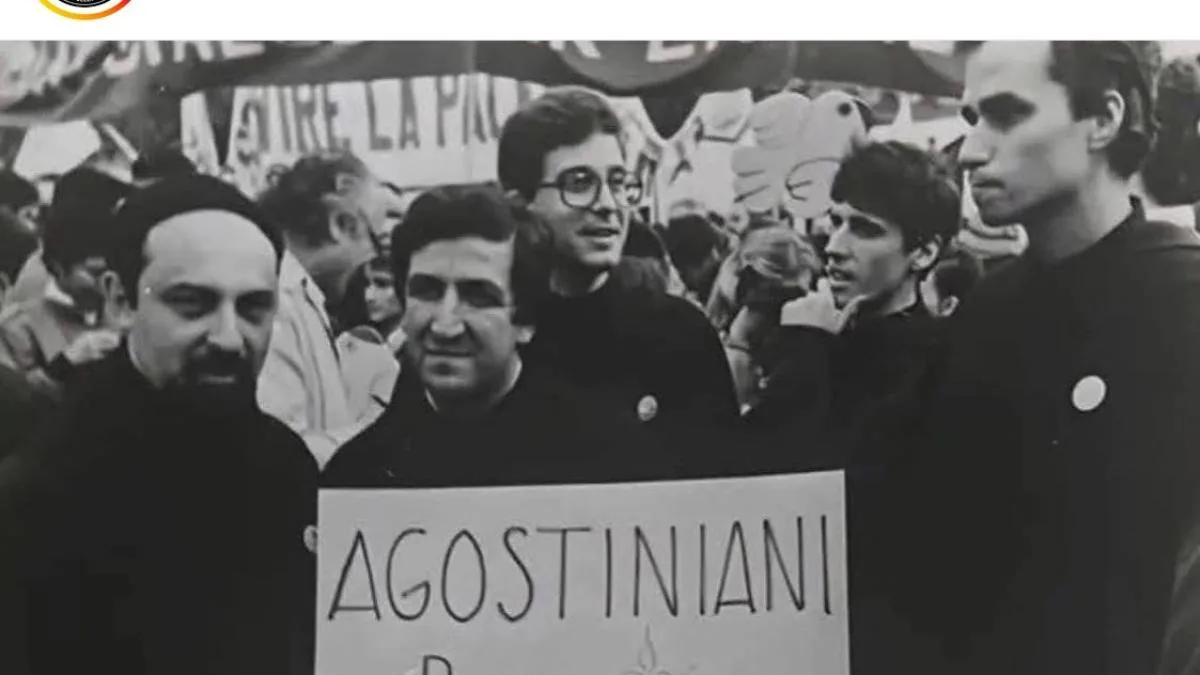
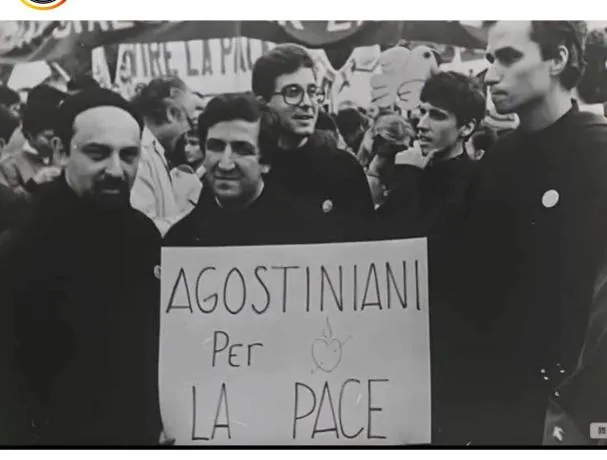
A group of Augustinian friars participate in a massive demonstration in Rome against the deployment of Cruise nuclear missiles (BGM-109G Griphon) at the Comiso military base, a few kilometers from the town of Ragusa, in the southeast of the island of Sicily. October 22, 1983.
Read more A deadly road rage on the M-30: when killing with a car can indeed be expensive
It is NATO’s response to the deployment of Soviet SS-20 rockets in East Germany and Czechoslovakia. The United States has decided to deploy Cruise nuclear missiles in the United Kingdom, Italy, Belgium, and the Netherlands, and will later install the more powerful and precise Pershing missiles in West Germany. Called by left-wing parties, trade unions, and civic platforms, one hundred thousand people participate in the march. Catholic pacifism, led by Bishop Luigi Bettazzi, president of Pax Christi, has mobilized. Pope John Paul II, not a friend of the left, an adversary of collaboration between Catholics and Marxists, did not stop them. The Augustinians, therefore, do not defy the Vatican. Karol Wojtyla advocates for simultaneous disarmament of the two blocs.
Proclaiming that the time of the populist far-right is coming to an end is premature
A minority sector of the Christian Democracy supports the protest. They are the heirs of Aldo Moro, the DC president kidnapped and murdered in 1978 by the Red Brigades when he was about to close a legislative pact with the Italian Communist Party (PCI); the famous historic compromise that was not liked in Washington or Moscow. Moro’s death marked an era: the Cold War was unmovable. In 1983 there were still moroteos. The experiment was canceled by gunfire, but there are still followers of Moro.
Someone takes a photo of the friars, who display a sign that reads: “Augustinians for Peace.” The young friar who appears in profile on the right side of the image adds a unique note to the scene. He was born in Chicago, United States, and protests the deployment of American nuclear missiles in Europe. He is 28 years old and is in Rome studying Canon Law at the Pontifical University of Saint Thomas Aquinas, of the Dominican order. He will soon be sent on his first mission to Peru. His name is Francis Robert Prevost, and today we know him by the name of Leo XIV .
There is more history behind that photo, published these days on social media by one of the organizers of that mobilization. In Ragusa, they are excited. The American military base in Comiso no longer exists, and the Cruise missiles were withdrawn in 1987 after the first nuclear disarmament agreement between Ronald Reagan and Mikhail Gorbachev.
There were still moroteos in 1983, but the reformists of the Christian Democracy had gone through another bitter experience. On January 6, 1980, Epiphany, Piersanti Mattarella, regional president of Sicily, an exponent of the most reformist wing of the DC, committed to curbing the infiltration of the mafia into public administration, was shot dead. The day he was killed, the decision to install Cruise missiles in Comiso had already been made. Like his admired Aldo Moro, Piersanti Mattarella was in favor of collaboration with the PCI in regional politics. He died in the arms of his brother Sergio, then a professor of Political Law in Palermo. Since February 2015, Sergio Mattarella has been the President of the Italian Republic. His second term will conclude in 2028.
Read more The «Solidarity Aces» of Banco Sabadell are dedicated this year to rare diseases
Impressed by the assassination of a political adversary he respected, Pio La Torre, former secretary of the Sicilian PCI, then a deputy in Rome, asked to return to the island to reactivate the political fight against the mafia. La Torre argued that the deployment of the missiles would give more power to organized crime. The island had to be under strict control again – social control is the historical role of the Cosa Nostra in Sicily – and the expansion of Comiso would give them more business opportunities. La Torre became one of the great promoters of the pacifist protest. He was shot dead on April 30, 1982. Moro’s project died twice, first in Rome and then in Palermo.
Read also
The Mafia grew under a nuclear umbrella. Ten years later (May 1992), Judge Giovanni Falcone was killed. They caused a section of highway to explode so that his car would be blown up. Weeks later, they eliminated his replacement, Paolo Borsellino. They detonated a car bomb as the judge approached the entrance of his mother’s house. A year later, they detonated a powerful bomb next to the Uffizi Museum in Florence, warning that the Mafia was willing to cause a massacre. They wanted a pact with the State. After the Florence attack, television entrepreneur Silvio Berlusconi announced his intention to enter the political arena.
Italy was starting a new experiment. In some ways, Berlusconi was a precursor to the Trump phenomenon. A less delirious herald, more attentive to the formalities of the era. He sought entry into the European People’s Party, and José María Aznar facilitated it in 1999; he surrounded himself with classic Christian Democrats, sought and obtained the support of the president of the Italian bishops, Cardinal Camillo Ruini; he did not bother Pope Wojtyla, fought the moroteos, organized spectacular parties in Sardinia, had a true harem of young girls, confronted judges, demanded a constitutional change to reduce their power in Italy (a referendum on the matter just said no), made deals with Vladimir Putin for large gas purchases and other businesses, and one day proclaimed himself the Anointed of the Lord. “I am the Jesus Christ of politics,” he said in 2006. “I am Jesus Christ.” Does that sound familiar?
Robert Francis Prevost knows that convoluted history. Leo XIV comes from afar and seems to go further. These weeks he has emerged as the main moral counterpoint to Trump. There are other movements underway, as we have just seen in Barcelona; an international reorganization of political poles has surely begun, but it is premature to state that the time of the populist far-right is ending. We haven’t seen everything yet.
Read more Humanoid robots cut almost two hours off last year’s time in the Beijing half marathon