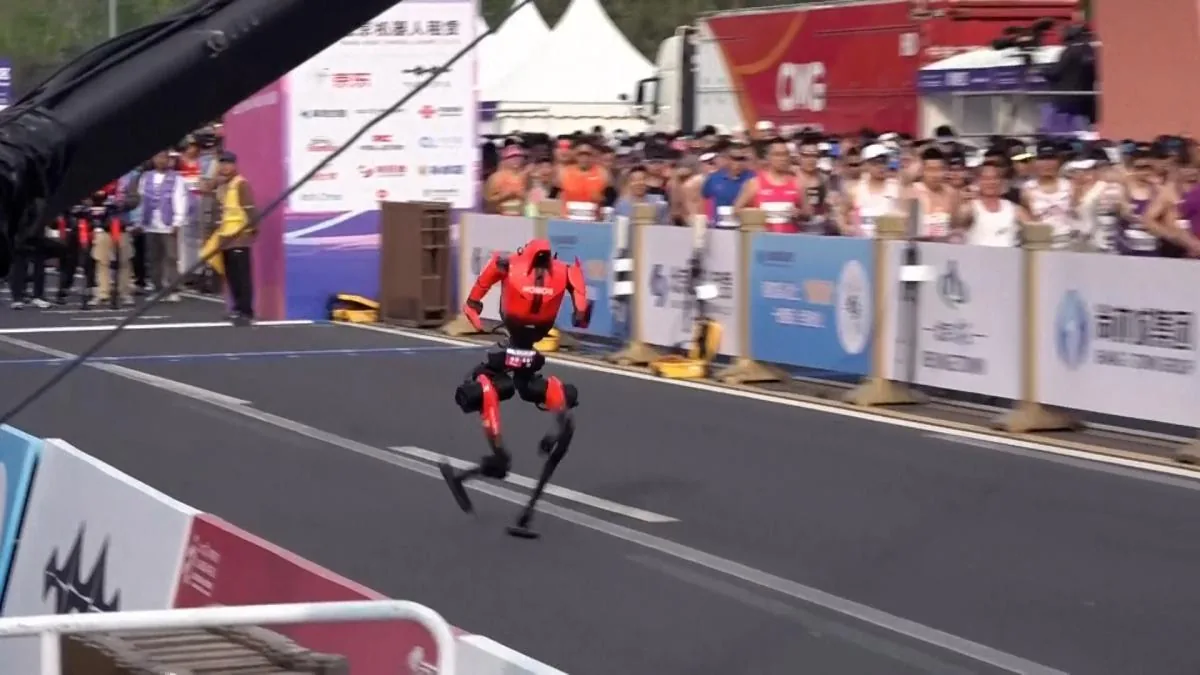
A humanoid robot has made history in Beijing by winning a half marathon with a time of 50 minutes and 26 seconds, even surpassing the human world record for that distance. The race, organized in the Beijing E-Town technology district, became a showcase for the advancement of artificial intelligence and robotic engineering in China. The winning robot, developed by manufacturer Honor, managed to complete the 21 kilometers faster than Ugandan Jacob Kiplimo, the current human record holder.
Read more Controversial naturopath Txumari Alfaro, presenter of ‘La botica de la abuela’, dies
The achievement represents a huge leap compared to last year’s inaugural edition, when the winning robot took more than two and a half hours to complete the course. Although the competition was not without its flaws — with falls and collisions during the start — the overall performance surprised both experts and spectators. Many highlighted that, for the first time, machines are not only competing with humans but surpassing them in demanding physical tests.
The event also highlighted the growing role of automation: nearly 40% of the robots completed the circuit fully autonomously, while others were remotely controlled. In addition, the race included futuristic elements such as robots acting as traffic agents. Honor engineers attribute the success to innovations such as an optimized long-leg design and advanced liquid cooling systems, which allow performance to be maintained for long periods.
Read more Jeff Bezos launches the New Glenn rocket, a key piece of the Artemis program to the Moon
Beyond the spectacle, this advance is part of a broader strategy by China to lead global technological development, in direct competition with the United States. The push for humanoid robots is part of the 2026-2030 five-year plan, which seeks to accelerate their application in industrial and productive sectors. For many, what happened in Beijing is not just a race: it is a clear sign that the boundary between humans and machines continues to blur.
Read more From saving a life in Paiporta to recovering a home: the reconstruction after DANA