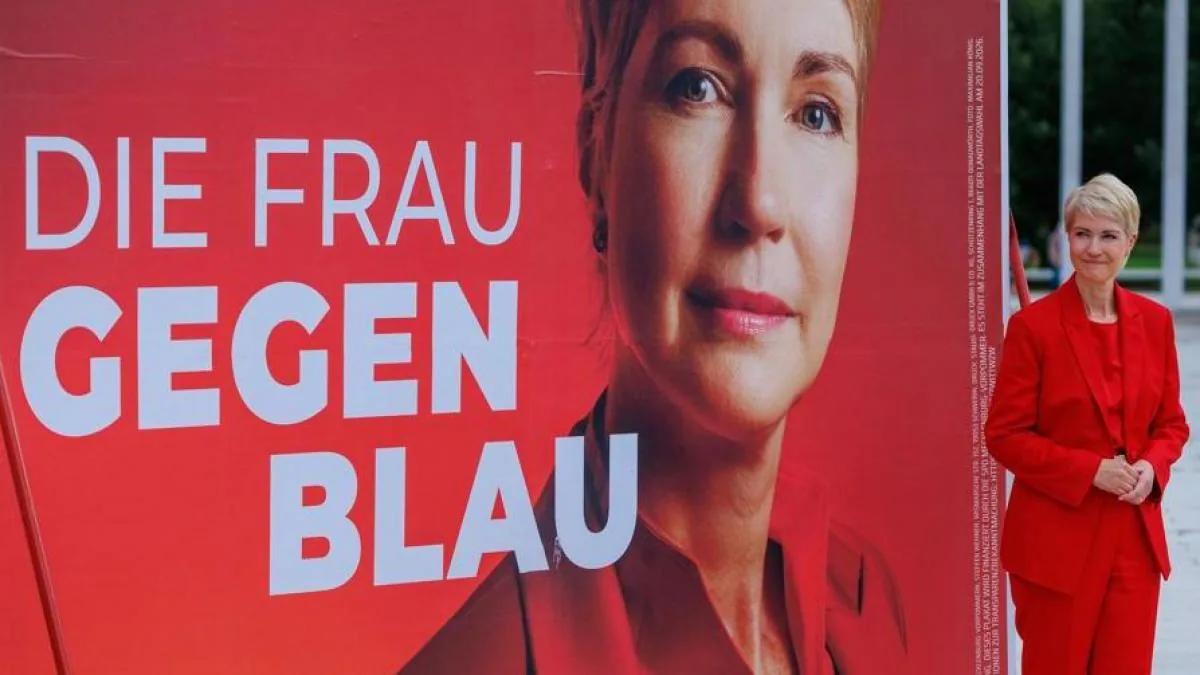
In the northeastern German state of Mecklenburg-Western Pomerania, which goes to the polls this Sunday to renew its regional Parliament, an electoral battle is being fought that resonates throughout Germany following the recent overwhelming victory of the far right in another eastern federal state, Saxony-Anhalt.
Read more De Gaulle’s Revenge
The far-right AfD party has led the polls in this Baltic region for weeks, but the Social Democrat SPD, boosted by the great popularity of its regional leader and current state president, Manuela Schwesig, has been closing the gap. A survey revealed on Thursday by the public broadcaster ZDF places the SPD (37%) ahead of the AfD (36%) for the first time.
If these percentages are confirmed, the Social Democrat stronghold in the east could hold and curb the favorable winds for the far right, while at the same time delivering a severe blow to the Christian Democratic CDU, which is dragging along with around 6% support while Chancellor Friedrich Merz receives cross-party reproaches and sinks in popularity polls.
According to the polls
The Christian Democratic CDU, Chancellor Merz’s party, is heading towards poor results of around 6% in this eastern state with a Baltic coast
With considerable skill, Manuela Schwesig, a 52-year-old former finance inspector, has centered her electoral campaign on the slogan Die Frau gegen Blau (the woman against blue), which rhymes and alludes to the AfD’s corporate blue color. “The new survey shows that we are in the lead. That motivates us, but it is not yet a result,” she said yesterday at the campaign closing in Warnemünde, a coastal town belonging to Rostock, the largest city in this federal state whose capital is Schwerin.
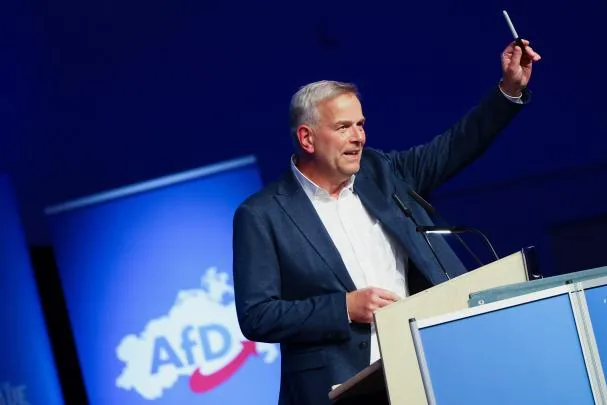
The Social Democrat’s approach has effectively turned this election into a contest between two forces – her opponent is the far-right Leif-Erik Holm – weakening by rebound the Christian Democratic candidate, Daniel Peters. “What I thought is happening; if things go well in Saxony-Anhalt, we will notice it here too,” Holm said enthusiastically at a meeting with the Foreign Press Association. But even if Alternative for Germany (AfD) won tomorrow, the lack of partners due to the firewall against the far right will likely make their access to power unfeasible.
Manuela Schwesig has led the regional government of Mecklenburg-Western Pomerania for two terms, a mostly rural and sparsely populated state. It has 1.57 million inhabitants, of whom 1.3 million are eligible to vote. In July 2017, Schwesig became president, and was re-elected in the 2021 elections when the SPD achieved 39.6%. Previously, she had been Minister of Family (2013-2017) in one of the coalition governments of conservative Chancellor Angela Merkel with the Social Democrats.
Read more More than 3,000 immigrants remain on the streets in Ceuta after a tense relocation
In this legislature, Schwesig has governed with the leftist party Die Linke. According to the polls, the current coalition will not have a majority, so the most likely scenario would be a tripartite coalition with the Greens. Problem: Die Linke stands at around 10%, but the Greens score 5%, at risk of falling below that percentage, which is the minimum threshold to have parliamentary representation.
Battle for first place
In almost all polls so far, the far-right AfD is poised to be the most voted party; only in one recently revealed does the Social Democracy take the lead
Manuela Schwesig’s popularity – which an INSA survey places at 60% – is based on her aura as a politician empathetic to the concerns of ordinary citizens, in contrast to the coldness attributed to Merz. “With all due respect, the CDU must take responsibility for its electoral result and ask itself why it is in such a weak position,” Schwesig concluded.
As head of the regional government, Schwesig has promoted free daycare centers and discounts on train passes for young people and the elderly. Born and raised in the former communist GDR – she was born in 1974 in Frankfurt (Oder), in the state of Brandenburg – she often explains how her family struggled when her father lost his construction job after the fall of the Berlin Wall. It is an experience with which many families in eastern Germany can identify.
Before Russia’s large-scale invasion of Ukraine in February 2022, Schwesig defended the import of Russian natural gas through the Nord Stream pipelines, which end in Lubmin, a small coastal town in Western Pomerania. The end of Russian gas painfully impacted the regional economy. Faced with controversy over her stance, the president now defends that the future of the state lies in renewable energies. If she manages to defeat the AfD this Sunday, her national prestige will grow.