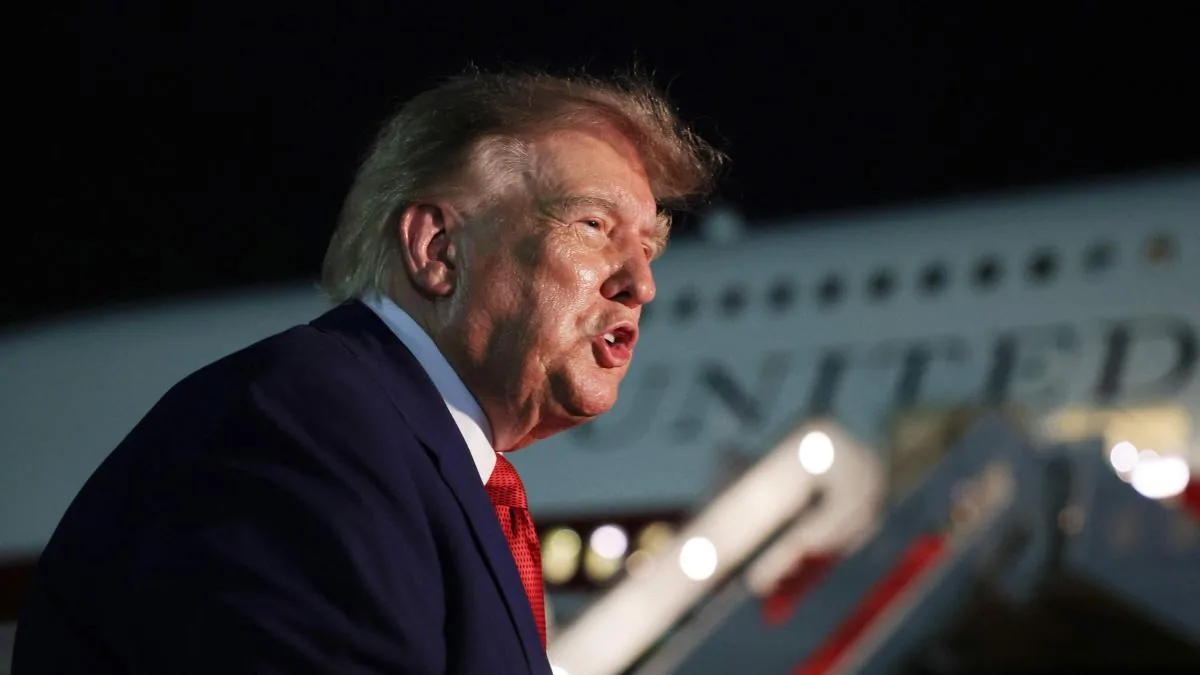
The President of the United States, Donald Trump, has just announced one of his biggest attacks on press freedom to date. In a post on Truth Social, he said that, “with immediate effect,” he will ban the entry to the White House of three of the main U.S. media outlets, CNN, MSNOW (formerly MSNBC), and Politico, as a consequence of “their constant false news reporting.” The president said that “other fake news media will follow the same path,” without giving further details.
Read more U.S. restricts Afrikaner refugees while banning entry of black South Africans
The content of the statement is as follows: “I am proud to announce that, with immediate effect, I ban the entry to the White House of the fake news CNN, MSNOW (which recently changed its name from MSNBC due to lack of audience and credibility); and Politico (the beneficiaries of an illegal and ridiculous $8 million subscription, a record amount, directly from the U.S. Government, under the corrupt Joe Biden’s command, in order to keep them ‘alive.’ To me, that looks like corruption!), as a consequence of their constant ‘reports’ of FALSE NEWS.”
Also read
The post continues: “The media should not be able to constantly write or report FICTION and LIES when covering the President of the United States, the Trump Administration, or the U.S. Other fake news media will follow the same path.”
Since he entered politics a decade ago, Trump has always targeted the free media with the aim of finding a common enemy, undermining their credibility, and strengthening his alternative narrative full of lies, falsehoods, and half-truths.
This crusade against press freedom, protected by the First Amendment of the Constitution, has intensified greatly in his second term.
In the first weeks, he took control of the White House pool, the limited group of journalists who have access to the president in the smallest venues. Shortly after, he repeatedly banned entry to journalists from the Associated Press agency because their editors decided to continue using the name Gulf of Mexico instead of the renamed “Gulf of America” to refer to the maritime area between Mexico and the U.S.
The president has intensified attacks on the First Amendment of the U.S. Constitution in his second term.
Added to this are repeated insults, often sexist and racist, against reporters who asked him questions at the White House, or comments during rallies assuring his followers that he would not feel bad if someone shot the journalists present. These types of comments have encouraged harassment of journalists around the U.S., especially during far-right gatherings.
The Trump Administration also tried to impose significant limits on journalists’ visas, which currently generally last 5 years, and wanted to force them to renew their status every 240 days. This way, it could review the content of these foreign journalists and decide, as Russia or China already do, to expel them if they were not to their liking.
Read more Robles awards CNI agents amid controversy over Ceuta warnings
However, the judiciary temporarily blocked this limit last week, considering that the national security justification put forward by the Administration “bordered on the absurd.” The White House based its argument “almost entirely on a small handful of anecdotal cases, each involving incidents that the new rule would do nothing to prevent or even mitigate.”
Trump’s latest attack on the free press comes less than two months before the midterm elections, legislative elections in which Republicans arrive with their worst poll numbers since Trump took office. The president himself also currently has his worst approval ratings since entering politics, with a popularity of 30%.
While progressively limiting traditional media access at his events, Trump has been empowering alternative and digital media close to his ideology, to whom, for example, he gives the opportunity to ask the first question at each briefing.
Additionally, the president has managed to grow his fortune thanks to a series of controversial out-of-court settlements with major tech and media companies, which have paid the president $90.5 million in recent years.
Among others, he has settled legal disputes with X, Meta, and YouTube (Trump sued the three platforms because they suspended his account after the Capitol assault in 2021), ABC News (defamation lawsuit because a journalist said Trump was found guilty of “raping” writer E. Jean Carroll, when in fact it was for “sexual abuse”), and Paramount/CBS (because, during the 2024 campaign, they edited an interview with Democrat Kamala Harris, a common practice on television, and Trump claimed that this benefited her electorally).
This last case is the clearest exercise of his influence, as Redstone had been trying to sell Paramount to Skydance Media since July 2024, but the transaction was on hold pending government approval. Three weeks after the agreement, the merger was approved by the Federal Communications Commission for $8 billion, confirming that Trump had received money in exchange for a business favor.
Read more Meta censors an ad about a Virginia Woolf play that contains the word ‘feminism’