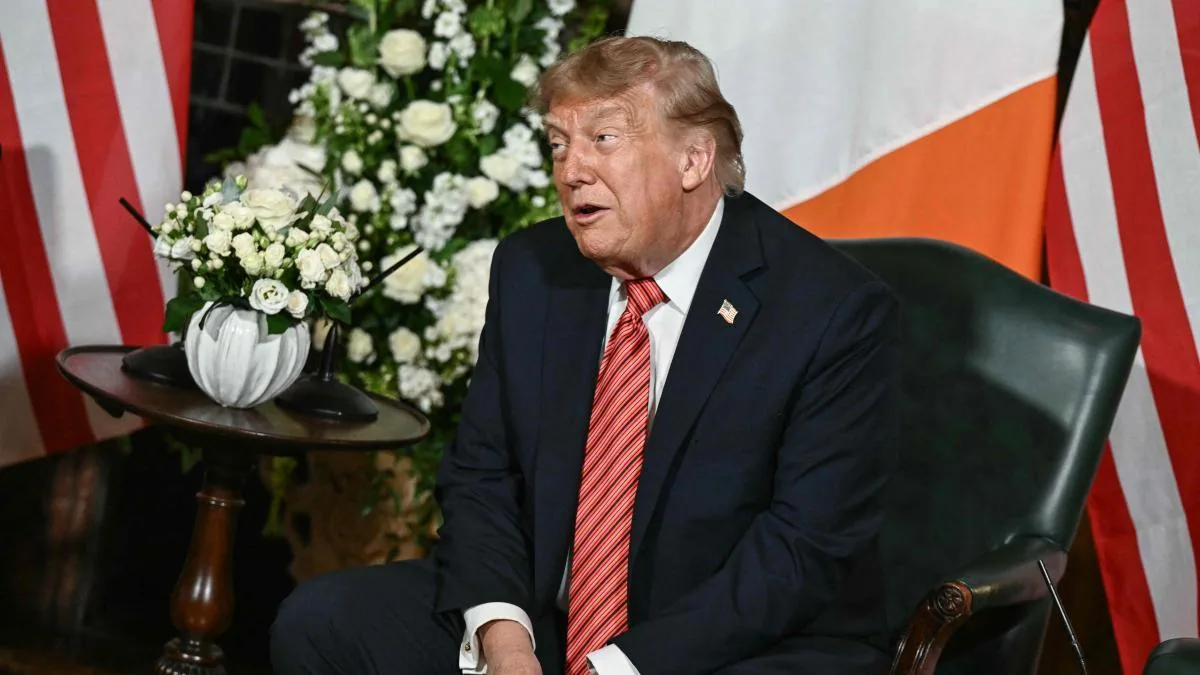
The President of the United States, Donald Trump, reiterated this Saturday that he believes the war with Iran will end after the midterm elections, which the United States will hold on November 3rd, and in which Republican candidates will compete for conservative majorities in the House of Representatives and the Senate.
Read more The monumental curve challenge of Madring
“I think very soon. It will probably be just after the midterm elections. They try to hold on as long as they can to complicate the elections. But I think people realize the play,” Trump told reporters in Dublin, where he is on a two-day visit to attend a golf tournament and took the opportunity to meet with Prime Minister Micheál Martin and Ireland’s President Catherine Connolly.
Likewise, the U.S. president assured that when the war ends, “oil prices will plummet.” He also referred to the price collapse if the United Kingdom opens the North Sea to oil and gas drilling.
Trump says that when the war ends “oil prices will plummet”
During his informal visit to Ireland, Trump responded this morning to a question from a media outlet about the increase in the price of heating oil, which in the case of the Emerald Isle has experienced a 40% increase since the start of the war between the United States and Iran.
“If the United Kingdom opens the North Sea, your prices will plummet. As soon as they open the great North Sea, and they haven’t yet, being one of the most valuable fields in the world, prices will drop a lot,” said the U.S. president in Dublin after meeting with Irish President Catherine Connolly.
Trump has repeatedly urged the United Kingdom to exploit North Sea oil to ease the energy crisis caused by the war in Iran and the sustained blockade of the Strait of Hormuz.
British Prime Minister Andy Burnham is expected to authorize next week a controversial gas exploration project known as Jackdaw, near the Scottish city of Aberdeen, which would effectively end the hydrocarbon project freeze policy with which the Labour Party came to power in July 2024.
Brent crude, the North Sea oil and benchmark in Europe, stood at $104.61 on Friday, although during the week it surpassed $109, its highest level since mid-May, as a result of the escalation of the war in the Middle East.
Trump says he would like to see the reunification of Ireland and that it will happen “sooner or later”
On the other hand, the President of the United States said this Saturday in Dublin that he would like to see the reunification of Ireland and assured that it is something that “will happen sooner or later.”
In statements to reporters at the end of a bilateral meeting with the ‘taoiseach’ (Irish Prime Minister) Micheál Martin, the White House chief said: “I would love to see (Ireland) unified. I think it would be a great achievement for everyone if that happened. Sooner or later it will happen.”
Read more Irene Montero will run in open primaries in Podemos to lead a left-wing candidacy
The U.S. leader referred to himself as “the right man” to initiate this eventual reunification process, although he added that the United Kingdom will also “have something to say about it.”
“I think it would be great. I mean, how can it be bad?” Trump said, continuing that the Irish are “great people” and that he has friends “on both sides.”
Later, in a speech delivered at the residence of the U.S. ambassador in Dublin, he again referred to the reunification issue and assured that “there is no good answer” to this question.
“They (the journalists) asked me: what do you think about the unification of Northern Ireland and Ireland? And I said, oh, that’s a good question, and I think I gave a good answer… but we’ll read about it tomorrow,” the Republican politician commented.
The island of Ireland has been divided into two parts, the Republic of Ireland and the British province of Northern Ireland, since 1921, after decades of unrest between nationalists and unionists.
The Northern Irish status, whether it should be part of the United Kingdom or reunified with the rest of the island, was the core of the bloody conflict known as the ‘Troubles’, from the late 1960s until 1998, when the so-called Good Friday Agreement was concluded.
Reactions to Trump’s controversial words have not been long in coming. A Downing Street spokesperson said that the issue of a referendum “on the border” corresponds to the British Secretary of State for Northern Ireland and “when there is a clear consensus in the country, when public opinion has changed to the point where the proposal must be considered.”
In this hypothetical vote, the inhabitants of Northern Ireland could decide whether they want to remain part of the United Kingdom or join the Republic of Ireland.
For his part, the leader of the Democratic Unionist Party, Gavin Robinson, who supports Northern Ireland’s remaining in the United Kingdom, said that the constitutional future of the territory “will be decided by the people of Northern Ireland and not by comments made in London, Dublin, or Washington.”
Read more The PP sees the resignation of the chief of staff in Ceuta as insufficient: «It’s a joke»