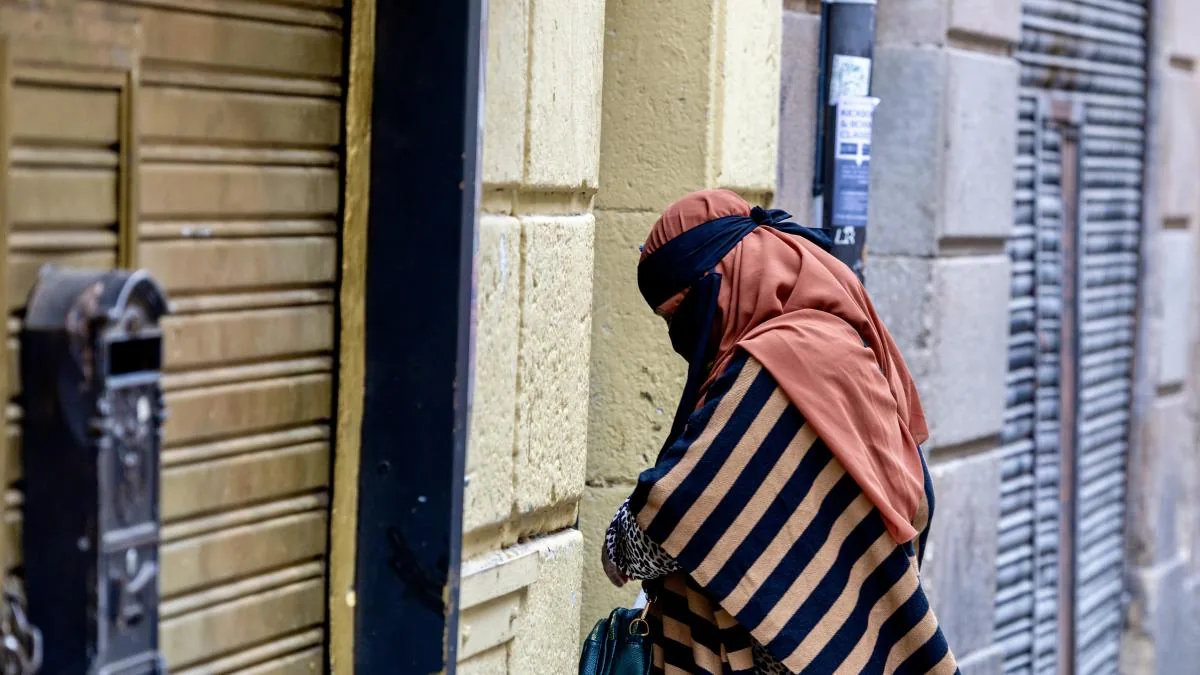
Spain debates the ban on the burka. The Popular Party and Vox are promoting legislative proposals. But the most significant signal has come from another place: Fèlix Larrosa, socialist mayor of Lleida, has taken the initiative to ban the full veil — burka and niqab — in public spaces of his city. His argument is the defense of women’s fundamental rights.
Read more Pepe Cruz Novillo dies, the designer of the logos of Correos, Renfe, the Police, and the PSOE
I recognize this moment
The response from his own camp is eloquent. Spanish socialists hesitate, distort, vote against the proposals of the right and far right — as if the correctness of a measure depended on who proposes it. And they disavow one of their own. I know this contradiction well. France experienced it for thirty years.
The left is trapped in a contradiction that is hard to escape: the visceral fear of attacking those it perceives as the new damned of the earth — immigrants, Muslims, victims of capitalism and colonial legacy. This reading, generous in its intention but blind in its effects, has led it to avoid identity issues, underestimate Islamism, and ultimately abandon those it should defend on the front line: women.
1989: the first failed encounter
In France, the Creil case in 1989 was a warning sign. Three female students showed up veiled in class. The political world was divided. On the left, great intellectuals — Élisabeth Badinter, Alain Finkielkraut, Régis Debray, Jacques Julliard — signed a strong manifesto: no veil in school. Clear-sighted, brave, they were right.
A young councilor from the Paris suburbs, I was on their side. But my mentors, Michel Rocard and Lionel Jospin, chose the legal compromise of the Council of State: to authorize the discreet veil while prohibiting proselytism. A seemingly balanced solution that still seems to me a guilty weakness. They yielded to an ideological offensive believing they were negotiating peace. They offered a precedent: the Republic could yield.
2004: the brave law
It took fifteen years. The law banning ostentatious religious symbols in public schools was adopted by an almost unanimous majority. As a deputy, I voted for it without hesitation. This text owes much to President Jacques Chirac, who in 2003 entrusted a mission to a multidisciplinary commission chaired by Bernard Stasi — a moderate and respected former minister — along with jurists, philosophers, representatives of religions, and field actors. Their report showed that these issues could be addressed rigorously, without yielding to demagogy or naivety. The school of the Republic had to be protected. Since 2023, the use of garments like the abaya by students is also prohibited.
2010: the burka, public space, and women’s dignity
The burka — that fabric that erases a face, denies a presence, nullifies a being — is not a garment. It is a manifesto, a flag. The legislator’s argument to ban it in 2010 was public order: no one circulates masked in the republican space. Valid, but insufficient to say what was really at stake: the offensive of political Islam against secularism, the school, and above all, women. Pretending that the burka is a free choice ignores the mechanisms of family, community, and ideological coercion that produce it.
Read more Catalonia seeks its industrial fit in defense
The burka is not a garment: it is a manifesto, a flag
With barely twenty socialists, I voted for the widely adopted law resulting from a joint initiative by Jean-François Copé (UMP, center-right) and André Gérin, communist deputy. An unlikely but essential alliance. Against Islamism, there is no right or left. There are those who see and those who refuse to see.
The left and its failed encounter with feminism
A part of the left has betrayed women. In the name of cultural relativism and the obsession not to stigmatize, it has closed its eyes to what Islamism does to them — in Iran, in Afghanistan, in our neighborhoods. Iranian women risking their lives to remove a scarf, Afghan women expelled from universities, reduced to invisibility: they deserved a left that would shout. They found ashamed silences and shameful balancing acts.
There is an inconsistency here that borders on imposture. The same left that fights for the right to abortion and women’s bodily freedom abandons other women to their fate — those whom Islamism coerces, veils, erases. Bodily freedom cannot be selective. The Palestinian cause, legitimate in its core, too often serves as a cover for deals with movements like Hamas that deny democracy, persecute homosexuals, and make women disappear from public space. No tradition, no religious reading, no invocation of freedom can justify erasing a woman.
‘Charlie’, Samuel Paty: the same offensive
The murder of the Charlie Hebdo cartoonists in 2015 and the beheading of Samuel Paty in 2020, for having exercised his profession as a teacher, fit into the same logic led by a political Islam that wants to impose its laws where democracy has established its own. The veil, the burka, the attacks, the pressures on teachers: the same offensive, different means, the same end. Spain should know this: it has paid a bloody tribute to Islamism, in Madrid in 2004, in Barcelona in 2017. The threat is not abstract. It has faces, dates, victims.
To the Spain that hesitates
Voting for the burka ban in 2010 was understanding that women’s freedom is not a value to be negotiated according to pressures. Islamism, the Muslim Brotherhood, test our capacity for resistance. There is a striking inconsistency in the left. Spain has been a pioneer in Europe in the fight against violence towards women. How can it hesitate to defend those same women against an ideology that erases them?
Underestimating Islamism, the left has abandoned women
To the Spanish left that disavows one of their own for daring to defend women, I say: do not lose thirty years. Compromises on these issues are not wisdom — they are time given to those who want to undo what we have taken centuries to build. Fèlix Larrosa is right. Others must follow him.
Read more Four men arrested for a kidnapping between Girona and the Franco-Belgian border