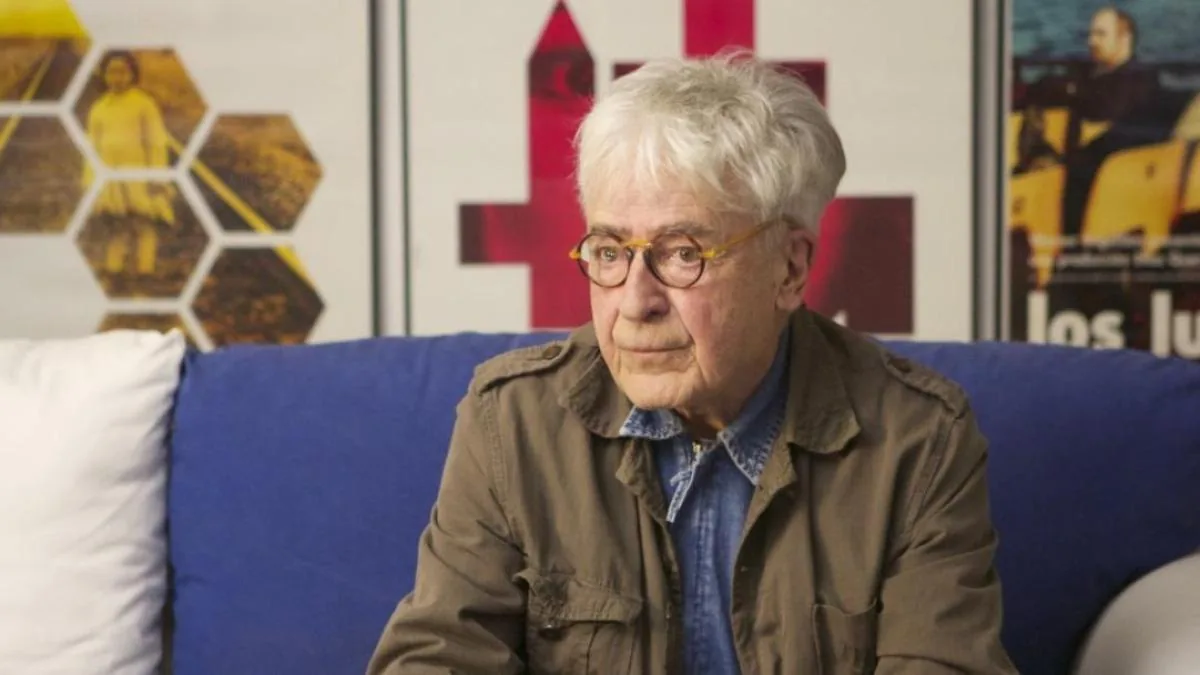
José María Cruz Novillo, known as Pepe Cruz Novillo, has died at the age of 89, according to the specialized portal Gràffica. Born in Cuenca in 1936, he was the designer responsible for the identity of companies such as Correos or Repsol, the National Police, or the PSOE, among others.
Read more Catalonia seeks its industrial fit in defense
His legacy includes an incomplete and ongoing work, his Diafragma dodecafónico 8.916.100.448.256, opus 14, in development since its premiere at the Arco fair in 2010 and which will take 3,390,410 years to be complete, which is why it was called “the longest artwork in the world.”
National Design Award 1997 and Gold Medal for Merit in Fine Arts, Cruz Novillo was also the author of some of the movie posters for Luis García Berlanga, Carlos Saura, or Víctor Erice.
In 2019, a documentary about his figure, The man who designed Spain (written and directed by journalist Andrea Gutiérrez Bermejo and filmmaker Miguel Larraya) reclaimed the memory and work of one of the fundamental artists of democratic Spain.
Draftsman, graphic artist, painter, sculptor, and composer, as he liked to define himself, he began his career in 1957, within the art department of the advertising company Clarín, after having left his Law degree. But the big step came in 1962, when he traveled to the United States to be part of the team of artists of the Spanish Pavilion at the New York World’s Fair. “I became a very cosmopolitan bumpkin,” he recalled, amused, in the aforementioned documentary.
Read more Four men arrested for a kidnapping between Girona and the Franco-Belgian border
Ironies aside, the artist was born in New York. Because it was in the world capital where he could take a training course (carried out by the New York firm associated with his Madrid one) that allowed him to learn and absorb the sharpest techniques and styles in the field of advertising design.
In Spain there was no image, design did not exist; not even the word”
José María Cruz Novillo
Designer (1936-2026)
It was that knowledge that he brought to Spain emerging from Francoism. With his sense of aesthetics, he broke the idea of image in a sociologically still dictatorship-imbued Spain. In Cruz Novillo’s own words, in Spain “there was no image, design did not exist; not even the word. And the country needed to establish a global image if it wanted to integrate into modernity.”
Cruz Novillo worked until the end of his days with his son and partner in their workshop in Madrid. In statements to La Vanguardia in 2019, his son, also named Pepe, spoke about the evolution of anagrams in recent times. There have been many “worsenings” regarding logos that worked well, he said, favoring “a lower quality,” which he blamed on the clients.
Read more This is what the election posters of the main parties look like in the elections in Andalusia