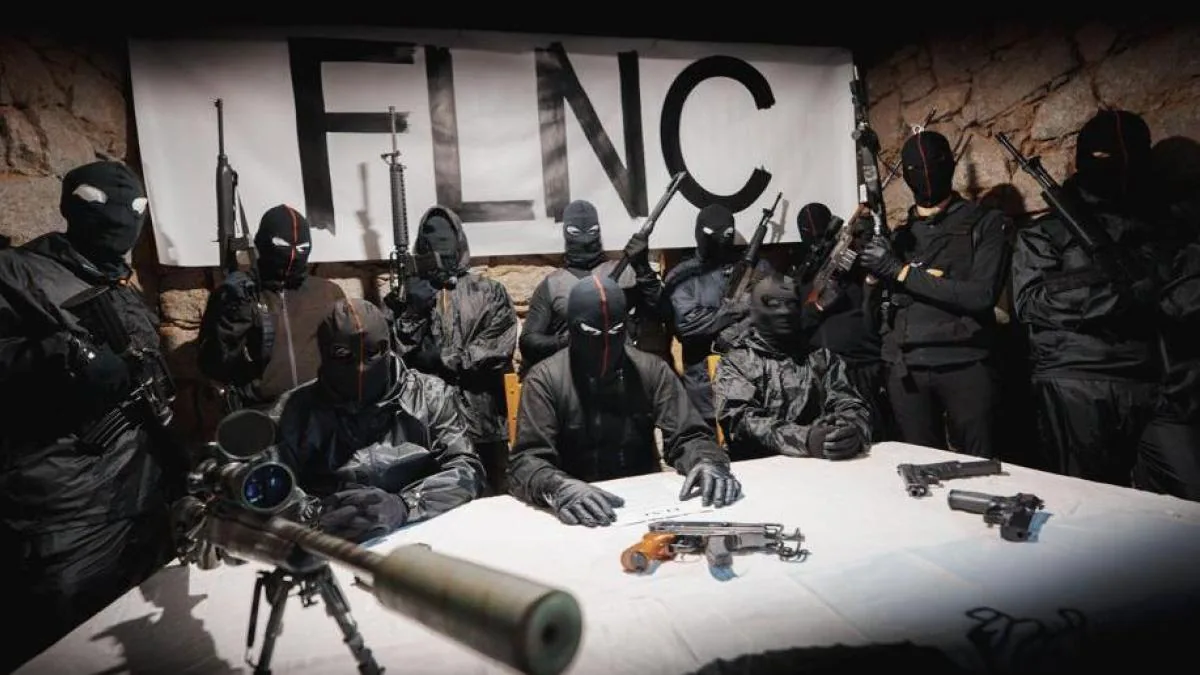
Corsican terrorism, which had been dormant in recent years, has made a spectacular reappearance, with a highly media-driven staging. At a clandestine press conference, attended only by the local newspaper Corse-Matin, a group of hooded and heavily armed men, under a banner with the initials of the National Liberation Front of Corsica (FLNC), threatened mainland French people who settle on the island and called the new autonomy project being discussed in the Paris Parliament a “masquerade.”
Read more Italy receives, despite everything, more immigrants than Spain
Hours after the exclusive news was published by the Corsican newspaper on Thursday, the National Anti-Terrorist Prosecutor’s Office opened an investigation for “criminal association with the intent to prepare acts of terrorism” and for “acquisition, possession, and transport of category A and B weapons and ammunition in connection with a terrorist plan.” Contacted by La Vanguardia, the journalist who attended the unique press conference and wrote the report, Antoine Giannini, indicated that the police summoned him to testify but did not reveal the place or date, invoking professional secrecy.
Those knowledgeable about the Corsican issue have doubts about what may happen from now on, whether the striking photo with assault rifles, pistols, and even a sniper rifle is the prelude to a new campaign of attacks against second homes and interests of mainland French people or signifies the swan song of violent independence.
The previous press conference, on January 26, 2024, was to claim the “blue night,” between October 8 and 9, 2023, during which there were 45 bomb attacks. Since then, actions have been very sporadic: seven bombs in 2025 and three since January of this year, although without FLNC claims.
Since its founding more than half a century ago, the FLNC—like the independentist political movement—has suffered many splits, with a permeability between political violence and purely mafia and criminal violence. In the last appearance, the five-page statement was signed by the FLNC-Union of Combatants. It is understood to be the hard core of the organization. It was read by a spokesperson whose voice was distorted by an electronic device.
Corsica, with about 365,000 inhabitants, the birthplace of Napoleon Bonaparte and which depended for four and a half centuries on the Republic of Genoa, has been French since 1769. For the independentists, it is still a colonial occupation. The FLNC issued a new warning in its manifesto to “those who disembark here on conquered land.” It added: “While waiting for our national rights to be respected, we have a message to convey to you. Stay in your home. And, if not, do not consider yourselves safe in our national territory.”
Read more De la Espriella assumes the Colombian presidency in another advance of the South American hard right
For the FLNC, the continuous arrival of non-island population is unacceptable, which it places at “5,000 foreigners, the vast majority of whom are French of all origins.” It also attacks the flow of immigrants “who contribute to statistically inflating the social aid attributed to the Corsicans.” Among its enemies, the FLNC points to the islanders it defines as “highly placed manipulators who primarily defend their interests and those of a caste of Corsican financial groups.” “You will always find us in your way,” it states.
Independentists see the constitutional reform being prepared in Paris as insufficient and which does not include the co-official status of Corsican
The constitutional reform being prepared in Paris, although it is not clear that there is a majority to approve it in the fall, would emphasize at the highest level the historical and linguistic uniqueness of Corsica, but for the independentists it falls very short because it does not accept the existence of a Corsican people as such, nor the resident status (an old demand, to veto the purchase of second homes), nor the co-official status of Corsican, nor broad legislative capacity.
The announced failure of the autonomy project could rekindle identity tension, as happened four years ago, with serious riots, when Yvan Colonna was killed in prison, who was serving a life sentence for the assassination of Prefect Claude Érignac in 1998.
The unexpected reappearance of the FLNC was also an internal message to all sovereigntists, to show that they are alive. It occurred on the eve of the International Days of Corte, this weekend, organized by the independentist movement Nazione. Among the foreign guests is Laura Borràs, former president of the Parliament of Catalonia.
Read more Minors from Ceuta are not illegal