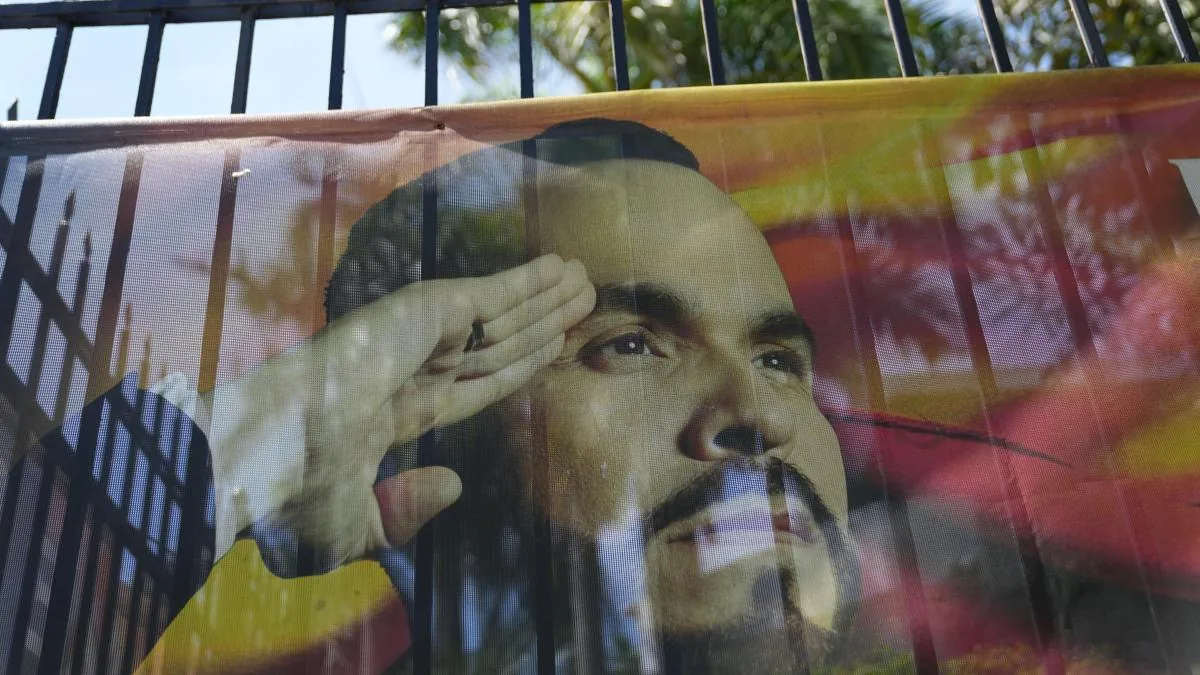
The colors of the Colombian flag had covered the old murals of the victims of police violence along Quinta Street, the main avenue of Cali through which Abelardo de la Espriella passed on his way to the University of Santiago, where he took office as Colombian president.
Read more Minors from Ceuta are not illegal
But the backdrop tailored to the famous slogan of the new president, “Firmes por la patria” (“Steadfast for the homeland”), had been altered overnight with two graffiti: “Abelardo gonorrea, el pueblo no copea [does not give in]” and “The horrible night has returned.”
It was not the message intended to be conveyed to the international guests, including King Felipe of Spain, heads of state from the new wave of Latin American right-wing leaders such as Javier Milei and Daniel Noboa, and a U.S. delegation dominated by officials specialized in drug trafficking. The King traveled accompanied by the Spanish Foreign Minister, José Manuel Albares, a novelty in the monarch’s foreign trips.
Inside the amphitheater of the University of Santiago de Cali, where the ceremony was held at three-thirty in the afternoon, Colombian time, the contrast was evident between the city’s diversity, with its large Afro population, and the audience—almost all white, mostly men—watching as De la Espriella swore allegiance to Colombia, just as he had sworn allegiance to the U.S. in Miami three years earlier. This despite the commitments of the lawyer and romantic singer, now president of Colombia, to decentralize and diversify power.
De la Espriella is the latest of what are now twelve hard-right populists who have come to power, from El Salvador and Honduras to Argentina and Chile, all loyal allies of Donald Trump.
The rhetoric of the new Colombian president has somewhat moderated since the end of the campaign during which he threatened to “gut” the left. In his speech on Friday, delivered after the inauguration at the Batallón Pichincha military base, a call for national unity was expected. Hours before the event in Cali, the new president announced that his government will do “what benefits the most humble, the most unprotected, and the weakest.”
The President of Congress, Honorio Henriquez—from the conservative Centro Democrático party—cited the Spanish transition in his speech after the inauguration as an example to unify Colombia. But neither the Spanish king, who attended accompanied by Foreign Minister José Manuel Albares, seemed entirely convinced by the example.
The truth is that, after a very narrow victory in the June 21 elections against the leftist candidate Iván Cepeda and facing a progressive opposition with the largest bloc in Congress, De la Espriella presides over a country divided in two and with high possibilities of social confrontation.
The outgoing president Gustavo Petro, who does not recognize the legitimacy of the new government due to difficult-to-prove accusations of electoral fraud, has already called for protest demonstrations.
With 70% of the votes favoring Cepeda, Cali seemed a location chosen by the new president to mark the new lines of the coming battle. “De la Espriella’s inauguration in Cali is meant to be a provocation,” said doctor and pro-Cepeda activist Manuel Rosenthal, a resident of the town of Santander de Quilichao, 40 kilometers south of the city, where the Army found 400 kilos of explosives in a truck on Tuesday. After the deployment of 11,000 security forces members, “Cali is militarized; there is enormous tension,” Rosenthal said in a phone interview.
Read more Trump insists on ousting Lisa Cook from the Fed despite the Supreme Court blocking the first attempt
The King of Spain attended the ceremony accompanied by Foreign Minister José Manuel Albares
The new president has reaffirmed his intention to wage an unrelenting war against armed groups linked to drug trafficking that operate freely in large areas of the country, including Cauca, the region south of Cali. In his speech before taking office, he pledged to recover “the territory to take it away from the violent who have devastated the country.” But in much of his electoral rhetoric, the new president has identified the Petro left with those groups. Cepeda distributed a statement yesterday according to which De la Espriella, in coordination with the U.S. Drug Enforcement Administration (DEA), “intends to link us with drug trafficking (…) Gustavo Petro (…) and me.”
There were signs of confrontation on Friday in Cali. Despite being banned by the conservative mayor, Alejandro Eder, the indigenous movements of Cauca, known as “la minga,” which the right links to armed groups, planned “to be present as a protest,” said an activist in the region.
To further heat the atmosphere, in his last presidential speech, Petro announced “the first manifestation of resistance,” referring to the protests he had called against De la Espriella throughout the country.
Given the significant victory of the Historic Pact in the May legislative elections, in which the left achieved its largest number of representatives in history, the country’s polarization is total. Petro has even called De la Espriella “Abelardo the Short,” paraphrasing Hugo Chávez’s reference to Pedro Carmona, who was president for 24 hours after the attempted coup in Venezuela in 2002. In a speech delivered on Friday in Barranquilla, the new governmental seat of De la Espriella, Cepeda encouraged his followers to carry out peaceful civil disobedience actions.
The ultra-conservative president has already announced his decision to reinstate the Mobile Anti-Disturbance Squadron (ESMAD), responsible for “excessive and unnecessary use of force” during the 2021 social outbreak, according to Amnesty International.
De la Espriella not only challenges the left. The decision not to invite Juan Manuel Santos, former president and Nobel Peace Prize winner, confirms fears that De la Espriella intends to dismantle the entire peace process and its mechanisms of transitional justice and reconciliation. The new president has committed to resuming the relentless war against the multiple armed groups occupying large territories in departments such as Cauca. But his popular mandate is much weaker than his rhetoric. Only 250,000 votes—just 1% of the total—separated De la Espriella from Cepeda, and one in three of these votes was cast abroad, mainly in Florida.
The U.S. delegation is led by prosecutor Todd Blanche and includes drug trafficking experts
To recover territories managed by armed groups and drug traffickers, De la Espriella counts on U.S. support. But despite the enthusiastic reaction of the Trump administration to his electoral victory, neither Trump, nor his vice president JD Vance, nor Secretary of State Marco Rubio decided to attend the inauguration. Instead, a group of experts in the fight against drug trafficking led by Todd Blanche, the attorney general appointed by Trump, and DEA director Terry Cole arrived in Cali. Joseph Humire, designer of the bombings against the so-called narco-speedboats, classified as extrajudicial killings by human rights groups in Washington, will also be part of the delegation. Rubio’s collaborator and the Cuban lobbyist in Florida, Mario Díaz-Balart, will also participate in the U.S. delegation.
According to Nate Morris, the Kentucky billionaire whom Trump has named as the next ambassador to Bogotá, De la Espriella has already yielded to pressures from Washington to withdraw from the Chinese Belt and Road Initiative to improve infrastructure. “The president-elect has made me aware of his commitment to withdraw from the memorandum of understanding (with China). All nations must decide whether to do business with us or with China,” Morris said in Washington. For those in Bogotá who have seen how a Chinese construction company is advancing like no previous company in building the new metro, working 24 hours a day, the news will not be so good.
Read more Spain suspends Schengen with Italy after Meloni rejects Sánchez’s ultimatum