For many travelers, cemeteries have a special charm. The charm of peace, silence, and connection with the past… Some do not leave Paris without wandering for a few minutes through the tree-lined paths and the sumptuous mausoleums of Père-Lachaise. In tours of Prague, a visit to the old Jewish cemetery is usually included, with that sea of tombstones that seem to eternally clash. In Vienna’s Zentralfriedhof are the graves of great composers like Beethoven, Schubert, and Brahms… Well, the small civil cemetery of Bausen has none of these attractions. Its essence is smallness. A tombstone, a true love, and a legend.
Read more If there are no books in your house, I won’t stay overnight
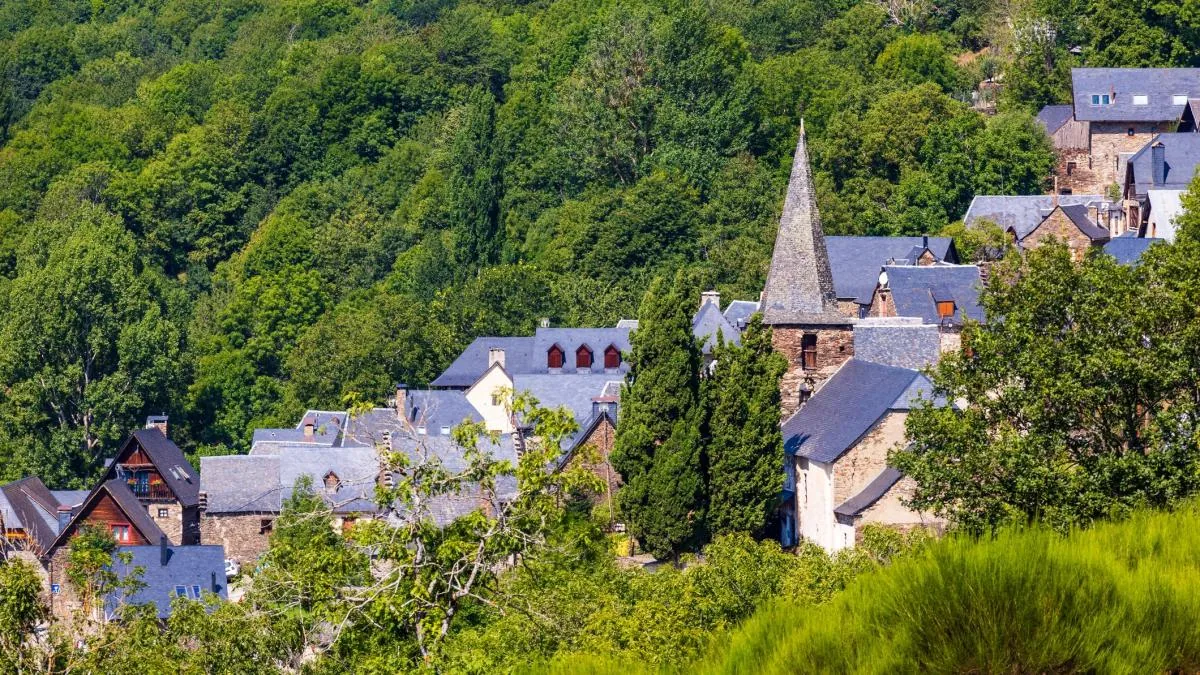
This tiny Aranese village – with about sixty registered inhabitants, but an even smaller number of permanent residents – is one of the northernmost municipalities in Catalonia. Touching the border with France and half an hour by car from Vielha, its isolated location has allowed it to maintain its essence. Cobblestone streets, wooden and stone houses with slate roofs, stairs to adapt to the terrain… and a spectacular natural environment.
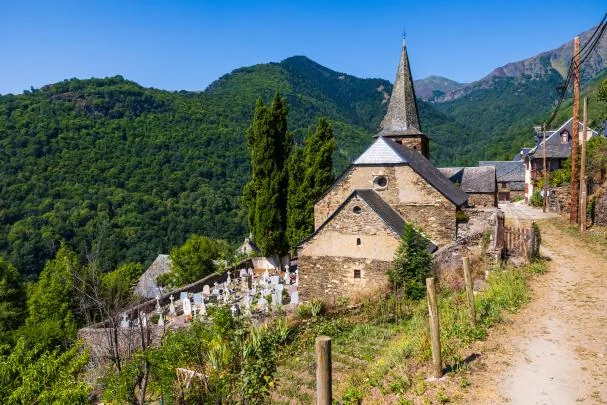
From the Bausen viewpoint, there are wonderful views over the Val de Toran and the surrounding mountains. On the other hand, a typical excursion is the Carlac forest: a circular route of about three hours that runs among centuries-old beeches and intriguingly shaped trunks. As for the town center, the Baroque church of Sant Pèir stands out on Major Street, with its adjacent cemetery, and the chapel of Sant Ròc, a few steps from the second cemetery. The one we are concerned with.
The legend of the lovers of Bausen
This is the story of Teresa, Sisco, and Joaquín. Teresa Estampa, from the Belanna house, was born in Bausen on July 21, 1883. And almost three months later, on October 20, Francisco Bugat, from the Doceta house, was born. Both were baptized by the rector Joaquín Tellosa. But given their status as second cousins – they had common great-grandparents – when years later they wanted to marry, the same priest demanded a consanguinity dispensation: a special permit from Rome that they could not afford. Then, they opted for a civil wedding. It was held on April 5, 1907, with Teresa pregnant.
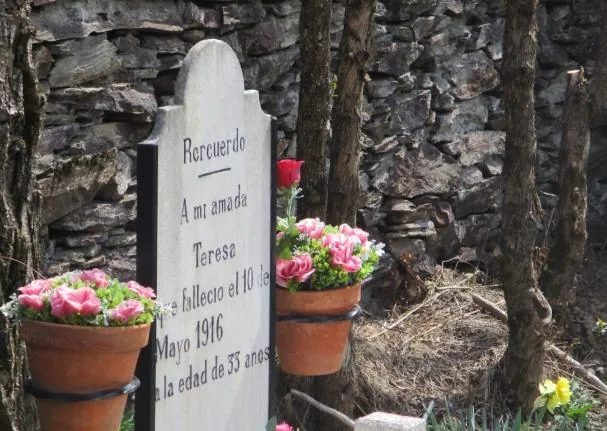
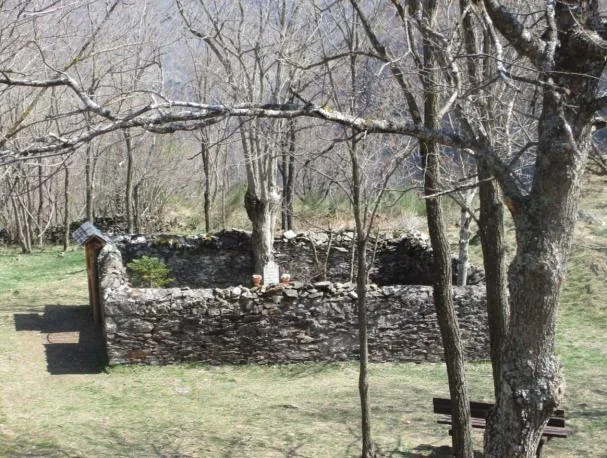
When she died at 33 years old – on May 10, 1916 – due to a chronic illness, rector Tellosa refused to give her burial in a sacred place. He considered that living with Sisco had been sinful. Then, in a response reminiscent of Fuenteovejuna, the people of Bausen built with their own hands a small cemetery for Teresa. On the plain known as the Coret, among beeches and firs, they erected in a few hours four dry stone walls with a simple iron door. Inside, they placed a tombstone with Sisco’s dedication: “To my beloved Teresa.” It thus became a symbol, always cared for and surrounded by flowers, which since 2020 has been recognized as a cultural asset of local interest.
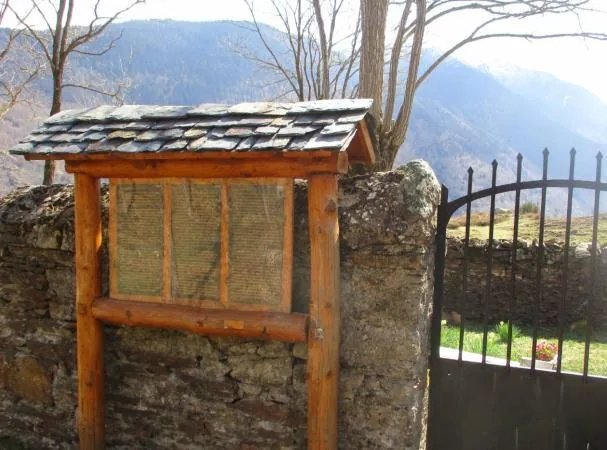
This is roughly what the panel located next to the cemetery details, unveiled on the centenary of Teresa’s death.
Years after becoming a widower, during the Civil War, Sisco went into exile in France with their two children: Valerosa (born September 14, 1907) and Cándido (born November 3, 1909), also baptized by Tellosa. They and their descendants made their lives in the neighboring country. Even so, they remain closely tied to Bausen and take care of the tombstone.
From the story to documented facts
But what is true in the legend? A report titled The Cemetery of Teresa in Bausen. Lights and Shadows by doctor Joan Carles Riera Socasau, member of the Royal Academy of Medicine of Catalonia and of the History section of the Institut d’Estudis Aranesos, investigates the facts based on historical documents.
Read more David Foenkinos: “Everything is written, we are predestined”
The research assumes there was a confrontation between the couple and the rector, although it questions that it was due to the dispensation. It points out that, when “40% of marriages celebrated in Bausen had consanguinity ties,” it seems “unlikely” that Sisco and Teresa could not obtain it. Especially since “as a general rule, a reduction in the fee was applied to those who requested it, due to inability to pay, and it could even be granted free of charge.”
Also read
On the other hand, the author notes that “the mere fact of not paying a consanguinity dispensation or contracting a civil marriage did not constitute a reason per se to deny Teresa burial in the religious cemetery.” In fact, the documentation reveals that it was the judge who ordered her to be buried in the “civil cemetery” of Bausen. Which, by the way, suggests the prior existence of a civil cemetery in the village.
The study raises the dilemma that “either Teresa did not want to die in the Christian faith nor be buried in holy ground or that Father Tellosa did not want to assist Teresa in her last moments, an attitude difficult to understand.”
Be that as it may, the tension with the rector is evident in the baptism records of Valerosa and Cándido, where Tellosa changed the usual formula. In both cases, he wrote: “I baptized according to the ritual prescribed by the diocese…” removing the word “solemnly” that appears in earlier and later inscriptions. Also, he did not record either as “legitimate and natural children of…”, but as descendants of Teresa and Sisco “according to public voice.”
Finally, Riera Socasau questions that Teresa’s is the only civil cemetery in the Val d’Aran – citing as examples those of Vilac (in 1902) and Canejan (in 1904) – nor the smallest in the Peninsula, as has sometimes been published.
‘Delicatessen’
Every August 16, Bausen celebrates the feast of Sant Ròc, local patron and a figure venerated throughout the Val d’Aran as protector against epidemics and plague. The small chapel, with a simple rectangular structure and white-painted stone walls, becomes a meeting point and place of religious celebration. The temple is located next to a huge linden tree that shelters parishioners in its shade.
Read more Lost in the hotel room