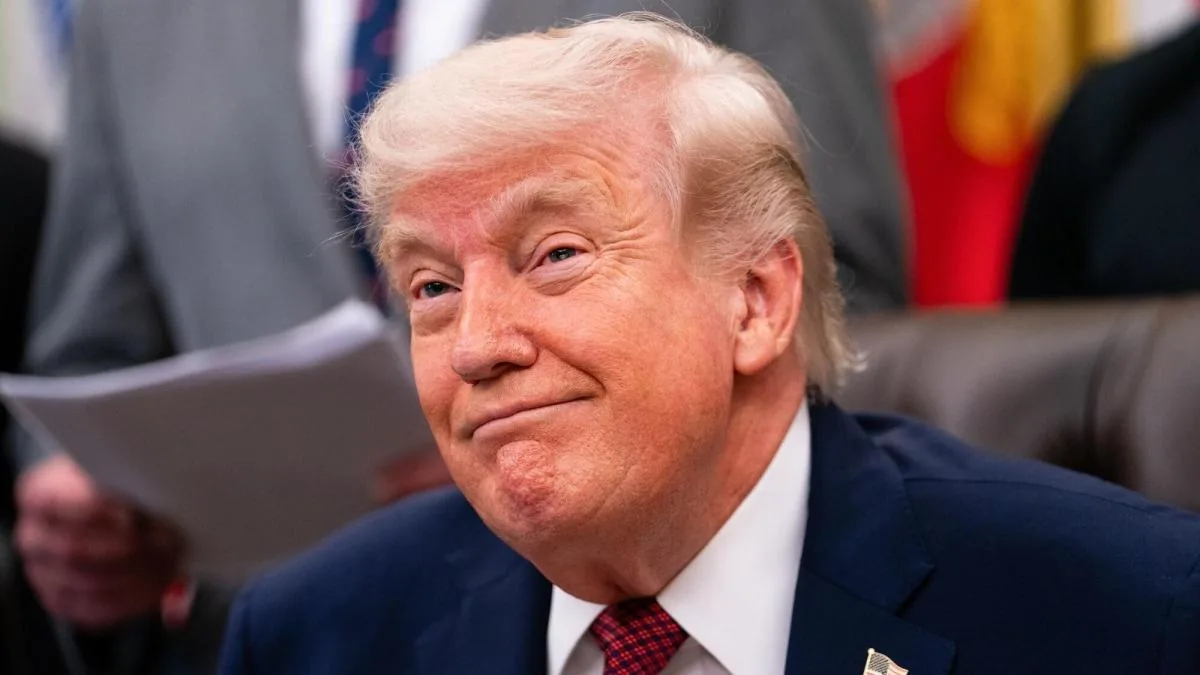
The president of the United States, Donald Trump, again threatened Iran this Sunday, this time with destroying “each and every power plant, and each and every bridge in Iran” if that country does not accept the agreement offered by the U.S. and which he assured is “very fair and reasonable.”
Read more The Spanish super-submarine S-81 sailed with the dual emergency surfacing system deactivated
Trump, who announced on his social network Truth that his representatives are heading to Pakistan to negotiate with Iran tomorrow, Monday, insisted that the agreement is “very fair” and, if not accepted, the “being the nice guy” act will end.
They will fall fast, they will fall easy”
Donald Trump
President of the U.S.
“They will fall fast, they will fall easy,” said the U.S. president, who lamented that Iran opened fire yesterday “against a French ship and a United Kingdom freighter” in the Strait of Hormuz, in what he called “a total violation of our ceasefire.”
The U.S. president told Fox News that special envoy Steve Witkoff will travel to Islamabad on Tuesday for talks that could extend until Wednesday. And the New York Post reported that Trump’s son-in-law, Jared Kushner, will also participate in the negotiations to end the war that has claimed thousands of lives. The announcement came after Iran reversed its decision to reopen maritime traffic through the Strait of Hormuz in response to the U.S. blockade.
The conflict around Hormuz —through which approximately one-fifth of the world’s oil transited before the war between the United States and Israel against Iran— threatens to worsen the global energy crisis and undermine expectations of an imminent peace agreement. Hormuz is one of several pending issues in the peace talks, including the Iranian nuclear program and the Israeli invasion of Lebanon.
“Ships are awaiting instructions from the Iranian armed forces to determine if they can transit the route,” the semi-official Iranian news agency Mehr reported on Sunday.
Read more The first victims of AI: software, consultants, and cybersecurity
However, late yesterday, the Speaker of the Iranian Parliament, Mohammad Bagher Ghalibaf, who led the Iranian delegation in talks with the United States earlier this month in Pakistan, stated that, while significant differences persist, negotiations are progressing. He added that the Iranian armed forces are prepared to act even while talks are underway.
“It is impossible for others to cross the Strait of Hormuz while we cannot,” he declared in a televised speech, referring to the U.S. naval blockade.
It is impossible for others to cross the Strait of Hormuz while we cannot”
Mohammad Bagher Ghalibaf
Speaker of the Iranian Parliament
Meanwhile, the U.S. military is preparing to board Iran-linked oil tankers and seize merchant vessels in international waters in the coming days to pressure Iran to reopen the Strait of Hormuz, the Wall Street Journal reported yesterday, citing anonymous U.S. officials.
The Islamic Revolutionary Guard Corps Navy issued a statement yesterday afternoon warning vessels not to leave their anchorages in the Persian Gulf and the Sea of Oman, and that approaching the strait “will be considered cooperation with the enemy, and the offending vessel will be attacked.”
“They wanted to close the strait again, as they have been doing for years, and they cannot blackmail us,” Trump told reporters on Saturday, referring to Iran, although the strait was completely open until the United States and Israel began their bombing campaign seven weeks ago. “We will have information by the end of the day. We are talking to them. We are taking a firm stance.”
Read more The war in the heart of the Gulf