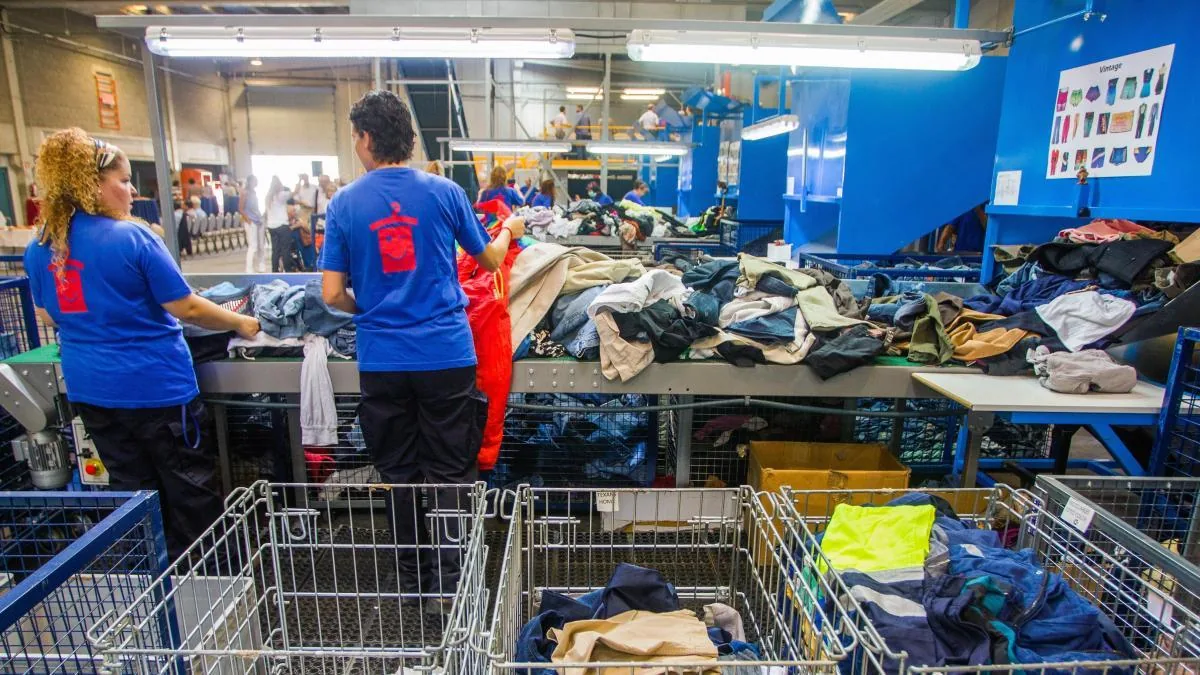
Ultra fast fashion, the ephemeral fashion that generates textile waste at dizzying speeds, also conquers markets in developing countries. The result of this global production model designed for use and throw away is the saturation of destination markets, which is why it is closing the doors to the export of second-hand clothes collected here selectively.
Read more “My colleague has a Civil Merit medal, but not a permanent position,” denounces a temporary worker
Spain separately collects 118,952 tons of second-hand clothing per year (2024 data), which represents 13% of the total clothing put up for sale; but four out of five used garments collected are exported abroad (to African and Asian markets).
Therefore, the blockage of receiving markets “is generating an unprecedented viability crisis” in the used clothing sector. This is indicated by a report on the situation prepared by Moda re-, promoted by Cáritas.
The emergence of ultra-fast fashion in the third world also results in a price drop, which, combined with bans on exporting low-quality fabrics, is making it impossible to increase the outlet for collected clothing, the report adds.
“There is so much new clothing in international markets that it is very difficult to place more of our used clothing. We are exporting to the United Arab Emirates but with the Iran war, that has become even more complicated,” says Marina Arnau, co-director of Fundació Formació i Treball.
87% of used clothing ends up in landfill in Spain while reuse structurally depends on export.
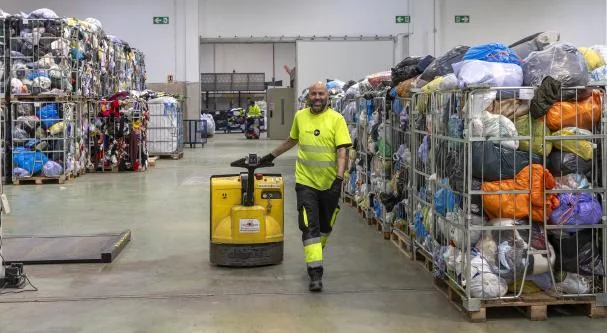
Of the 118,952 t collected selectively, 80.5% is destined for export (95,727 tons); 11.3% corresponds to national consumption, mainly focused on the reuse of second-hand clothing in stores and on fiber recycling (incipient). And finally, the remaining 8.2% is the rejection that cannot be used and mainly goes to landfill.
The tsunami of hyperproductivism and its damages
Ultra-fast fashion is a tsunami of used clothing that does not always have an outlet, explains Rosa Garcia, director of Rezero, dedicated to waste prevention. “There are companies that put up to 50 collections on the market per year,” recalls Enric Carrera, expert in textile engineering and former professor at UPC.
Furthermore, the poor quality of fibers used in its manufacture “reduces the potential for its reuse” – adds the Moda re- report – while the heterogeneity of those fibers makes recycling difficult.
Used garments (collected on the street or in containers by Cáritas, Roba Amiga or other entities or social economy companies) meet the demands of the most disadvantaged sectors in need of clothing, and at the same time, feed a commendable second-hand market that sometimes even turns out to be flourishing.
The responsibility of manufacturers is key
But the globalization of fast fashion works against this. Giving a second life to clothing is an activity or attitude permanently at risk of being overwhelmed by cheap fashion. Chinese (and European…) brands are flooding the market with poor quality and giveaway prices. This sometimes makes the reuse of second-hand garments no longer competitive.
Read more Bodies of a Civil Guard officer, his wife, and his son found dead in Dolores
All this complicates the viability of companies in the sector (basically attached to the social and solidarity economy).
But “buying reused garments not only prevents tons of clothing from ending up in landfill, but also contributes to the generation of social employment and the construction of a more responsible model,” say the authors of the study.
Funding for collection and recycling, a pending issue
For all social economy entities and companies, the entry into force of the state decree that will require textile sector manufacturers to assume the costs of collection, classification, separation, and recycling of these residues is key – following the principle that the polluter pays. For this, manufacturers must implement a collective extended producer responsibility system (a Scrap, in this case it will be Reviste), responsible for implementing a levy on the garment and obtaining resources to finance this collection and transfer the resources to municipalities and these social entities.
Since January 1, 2025, municipalities are required to install containers to collect used clothing but the lack of funding to carry out this task (which manufacturers must guarantee) means progress is minimal. In Catalonia, however, the Generalitat has begun transferring economic resources to municipalities for this purpose based on the tons of clothing collected. And when the manufacturers’ Scraps (Reviste) operate, they will have to transfer those resources to the municipalities or social entities that currently handle separate collection.
The Moda re- report highlights “the lack of competitiveness of textile recycling compared to virgin fiber”
The Moda re- report highlights that “another critical barrier is the lack of competitiveness of textile recycling compared to virgin fiber.” Virgin fiber [used for fabrics] “remains significantly cheaper than recycled fiber,” since environmental costs are not incorporated.
At the same time, the “absence of eco-design oriented towards recyclability by most producers structurally aggravates this problem. Its adoption remains incomplete and uneven.”
“Selective collection needs less contaminated flows, but also a reduction in consumption and a longer use of garments,” says the report. Consumers say they are interested in environmental protection, but when it comes down to it, “purchasing is still conditioned by price and the presence of fast and ultra-fast fashion.”
Also read
Solidarity economy: social entities manage more than 60% of textile waste
The report data places the social economy as a key pillar in the management of textile waste in Spain. Insertion companies, social initiative centers, and non-profit entities not only manage waste but generate employment, inclusion, and value in the territory, and have consolidated as an essential actor in the system.
Currently, social entities manage more than 60% of textile waste in our country and generate more than 90% of employment in the sector, with more than 3,700 jobs, of which more than 1,600 belong to the Moda re- network.
Furthermore, the separate collection model provides significant economic and social benefits, as it avoids costs to municipal coffers exceeding 250 euros/ton, thereby reducing the burden on public waste management systems.
Snapshot of used clothing: the number of second-hand clothing stores grows
—In Spain, 19 kilos of textile waste per person per year are generated, which is approximately equivalent to about 60 garments.
—However, most of this waste is not properly managed: 87% ends up in landfill and only 13% is collected separately.
—In 2024, selective collection of post-consumer textile waste reached 118,951.8 tons, equivalent to 2.45 kg per inhabitant, representing an 18.7% increase compared to 2021. Despite this growth, the selective collection rate remains limited (13% of the total generated).
—Moda re-, linked to Cáritas, is the main national operator, concentrating 42% of total collection, followed by AERESS (19%) and Humana (16%).
—Formació i Treball consolidates as the main reference actor in textile collection in Catalonia, with 7,475 tons collected in 2024, equivalent to approximately 34.5% of the regional total.
—In 2024, second-hand stores linked to social economy entities reached 346 establishments, compared to 246 registered in 2021. Of these, more than 42% belong to the Cáritas / Moda re- network, which currently has 191 points of sale.