The indefinite truce between Iran and the United States, announced on Tuesday by President Donald Trump, remains fragile after the capture of at least five ships since then in the region, three intercepted by Tehran and two by Washington. The naval blockade imposed by the Pentagon on Iranian ports, which overlaps with the effective closure of the Strait of Hormuz by the Revolutionary Guard, is making a second round of peace talks impossible, as the Iranian regime considers it an “act of war” that violates the terms of the agreement. Financial markets breathed a sigh of relief when Trump extended the ceasefire just hours before it expired, but have stabilized, cautious because peace still seems distant.
Read more Portal de l’Àngel in testing phase
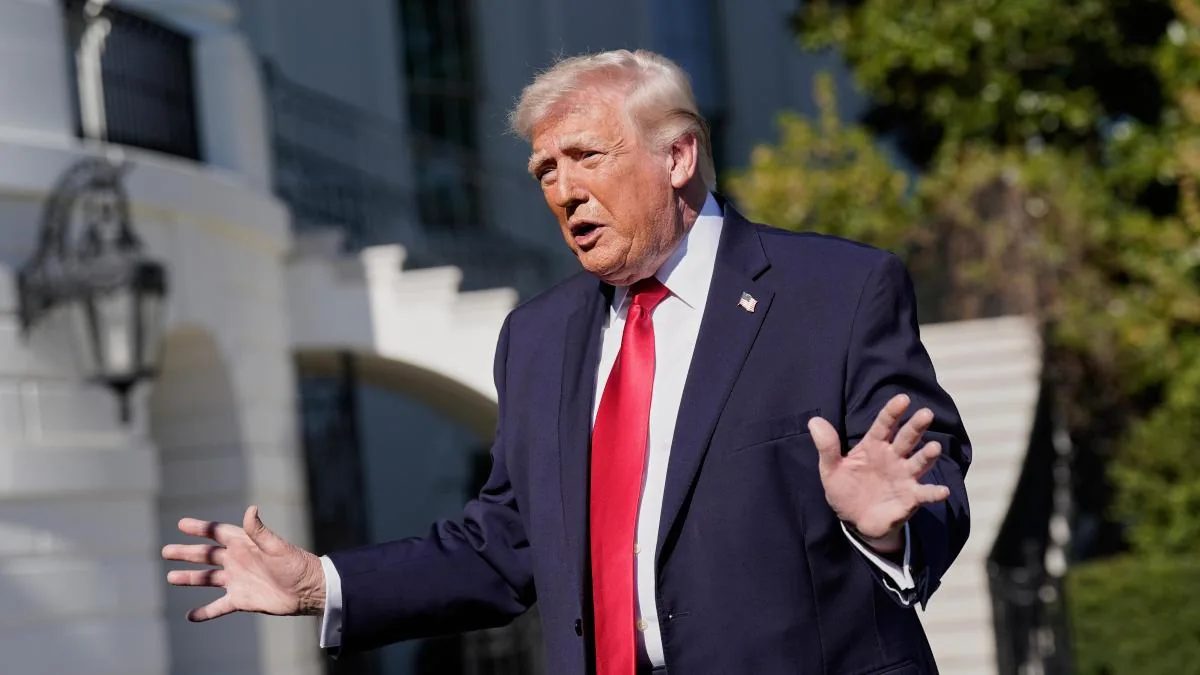
This morning, Trump has regained his more warlike tone by announcing that he has ordered the Navy “to shoot and destroy any vessel, no matter how small, that is laying mines in the waters of the Strait of Hormuz.” “There must be no hesitation,” he warned via Truth Social, adding that US minesweepers are already “clearing the strait right now.” However, there is no confirmation that Iran has been laying mines in the waterway since the truce began.
Read also
In another post, Trump celebrated that the US now has “total control over the Strait of Hormuz” and now “no ship can enter or leave without Navy approval.” It is “completely sealed,” he assured, and will remain so “until Iran is able to reach an agreement.” Since the naval blockade began, US Central Command claims to have turned back at least 27 vessels entering or leaving Iranian ports.
When the president extended the ceasefire, he justified his retreat by stating that the Government of Iran was “seriously fractured,” alluding to its internal divisions, especially between different sectors of the Revolutionary Guard and the political leadership. He assured that he would suspend his attacks on Iran until its leaders, who stood up J.D. Vance in the second round of dialogue in Islamabad (Pakistan), “can present a unified proposal.”
Today he emphasized these divisions through his social network: “Iran is having a lot of difficulty figuring out who its leader is! They just don’t know! The internal struggle between the ‘hardliners’, who have been overwhelmingly losing on the battlefield, and the ‘moderates’, who are not moderate at all (but are gaining respect!), is crazy,” Trump stressed.
The president has been stating for weeks that regime change was not a war objective, but with his joint attacks with Israel, in which he eliminated Supreme Leader Ali Khamenei and a large part of the political and military leadership, “the regime has changed.” However, in this last message he suggests that elements of the regime – including the new supreme leader, Mojtaba Khamenei – are still standing and are immersed in a battle for power.
Donald Trump, US President
“Iran is having difficulty figuring out who its leader is! The internal struggle between the ‘hardliners’ and the ‘moderates’ is crazy”
This internal struggle would be taking place between the speaker of the Iranian parliament, Mohammad Bagher Ghalibaf, who participated in the first negotiation table in Islamabad, and the commander of the Islamic Revolutionary Guard Corps, Major General Ahmad Vahidi, representative of the “hardline” mentioned by Trump.
While Ghalibaf – and other “moderate” figures, such as President Masoud Pezeshkian and Foreign Minister Abbas Araqchi – intended to attend the second round of dialogue in Pakistan, according to The Wall Street Journal, the Revolutionary Guard imposed the condition that the US had to lift the naval blockade to allow negotiations. This indicates that, contrary to Trump’s intentions, the most radical sectors of the Iranian regime have gained more weight and influence during the war.
Thus, rather than an internal power struggle, there has been a concentration of power in the military leadership, which has led figures like Ghalibaf to adopt their positions as their own. “A total ceasefire only makes sense if it is not violated by a naval blockade and the hijacking of the global economy, and if Zionist warmongering on all fronts is ended,” Ghalibaf insisted yesterday, also alluding to the front between Israel and Lebanon, who are meeting today in Washington in search of an extension of their own 10-day truce, which expires on Sunday.
“The reopening of the Strait of Hormuz is not possible if the ceasefire is flagrantly violated. They did not achieve their objectives through military aggression, nor will they achieve them through intimidation. The only way forward is to accept the rights of the Iranian nation,” Ghalibaf declared.
Read also
But the White House has made it clear that it has no intention of lifting its naval blockade until an agreement is reached, as it understands that the attrition will lead to Iran’s capitulation on its own terms. However, it is precisely the blockade that has driven Tehran away from negotiations and, therefore, has made a peace agreement impossible.
Yesterday, Trump indicated that “it is possible” that peace talks will resume this weekend in Islamabad. If Iran finally goes to Islamabad, Vice President J.D. Vance, who leads the US delegation, will encounter the same impediments as in the failed meeting of April 11. The ayatollahs’ regime remains standing and inflexible to Washington’s demand that it renounce its uranium enrichment, and also does not seem willing to reopen the Strait of Hormuz while the American naval blockade lasts, nor to withdraw its financial and logistical support to its allied militias in the region.
But the American people have expressed in polls their rejection of the conflict and, especially, of the deployment of soldiers on the ground, which seems to be the only way to achieve the maximalist objectives declared by the White House. With that possibility discarded for now, and Tehran’s capacity for resistance demonstrated, Washington, which seeks a quick end to the war, has no choice but to seek a middle ground: an agreement that surpasses the one forged by Barack Obama in 2015, which allowed but limited the Iranian nuclear program for civilian purposes.
Read more Complaint in France against Uber Eats and Deliveroo for human trafficking