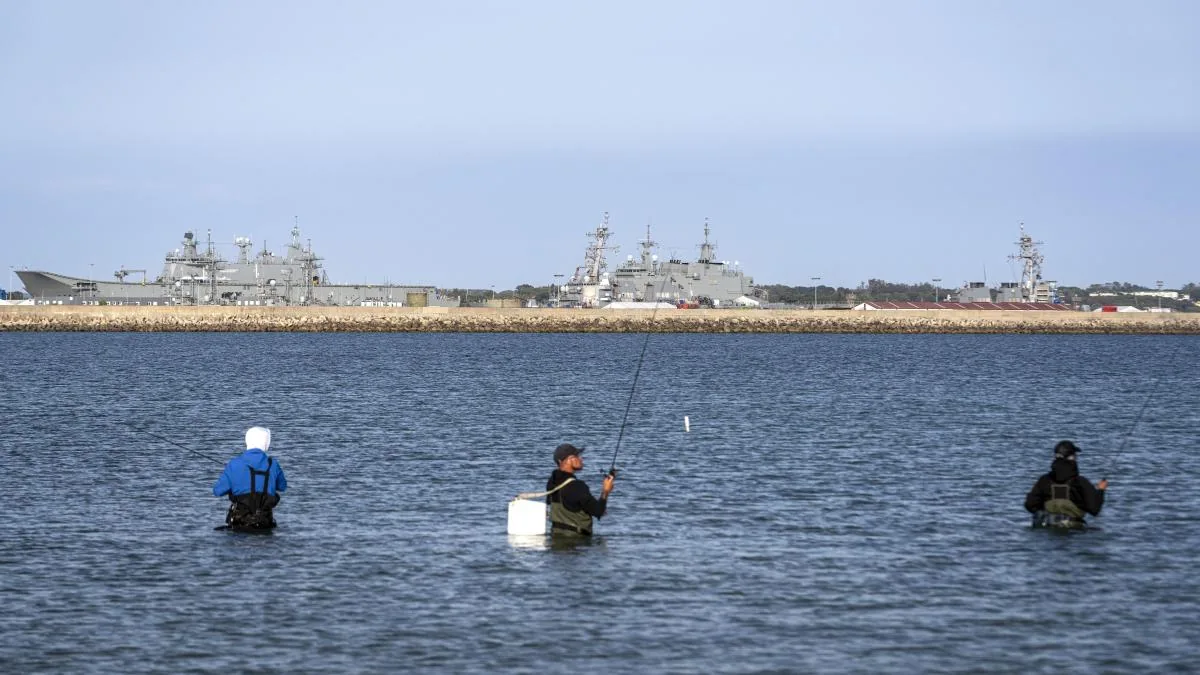
Until yesterday, the central Government appeared in public – and also in private – “absolutely calm” in the face of threats from the President of the United States, Donald Trump, to withdraw his troops from Spain. Sources from Moncloa, who framed them within the hyperbolic rhetoric of the White House occupant, downplayed their importance by pointing out that it is enough to follow – “from logic and common sense” – the dotted line of the million-dollar American investments in the bases of Rota (Cádiz) and, to a lesser extent, Morón de la Frontera (Seville) to determine their future in the face of the repeated warnings coming from Washington. The inconsistency between the shower of millions of dollars and the Republican warnings led to the thought that it was just another salvo. The sequence is clarifying.
Read more A pride for Barcelona
The first time Trump spoke of a possible withdrawal of American troops from Spain – after calling the rest of the NATO countries “cowards” for not cooperating in protecting the Strait of Hormuz – was last March 20. Five days later, the US Navy inaugurated an expeditionary maintenance facility at the naval base in Cádiz after an investment of 26 million dollars. Also in March, a contract for 15 million dollars was made official for the repair of access roads, which will be carried out until 2031, and another for 13 million dollars to modernize sailors’ housing.
The Government was “calm” in the face of Trump’s salvos, but the announcement about Germany causes concern
On April 9, Trump again expressed being “very disappointed” with allies who were not cooperating in the war against Iran – such as Spain, which prohibited the use of its bases to attack the ayatollah regime – putting on the table the transfer of American military personnel to other more “collaborative” countries. Only ten days later, the US Navy awarded a framework contract to six Andalusian companies to maintain the infrastructures in Rota for 100 million dollars. One day later, the Pentagon published a market study, a preliminary step to bidding, to seek suppliers for the repair and maintenance of the five destroyers – awaiting the sixth – and other ships operating from the Cádiz base, described in the text as “the largest US Navy facility in Europe.”
This week, the Republican has again threatened Spain – as well as Germany and Italy – with reducing the nearly 3,814 troops deployed due to the criticisms of Pedro Sánchez’s Government regarding the war in Iran – “It has been terrible,” he censured. The current agreement regulating the presence of the US in Spanish military sites expires on May 22. The cooperation document states that it will be automatically extended for another year unless one of the parties notifies in writing its contrary will at least six months in advance. As of May 2, “there is no news,” according to confirmations from the Ministry of Defense.
There are 3,814 troops permanently assigned in Spain, according to data from December 2025
But the Department of Defense’s announcement about the withdrawal of 5,000 soldiers deployed in Germany breaks that “logic” and “common sense” to which the Government appealed, so now a withdrawal “more symbolic than operational” is not an unreasonable scenario. Nor is it ruled out that it could happen overnight, with no more diplomacy than Trump’s word. Ministry sources still recall the discomfort caused in Defense by the fact that the US president did not inform a partner like Spain beforehand about the attack on Iran. Morón, with half a thousand uniformed personnel, starts from a worse position compared to Rota, due to its strategic relevance.
According to Pentagon data, the US Navy currently has 45 commands in Rota, a key strategic point for operational logistical support. About fifty miles from the Strait of Gibraltar, the deep-water component is not the only major interest of the US, as it also has a military airport and fuel storage. In fact, the large ongoing megaproject, with another injection of 100 million dollars, involves the construction of two gigantic fuel tanks to supply planes and ships with a capacity of 50,000 barrels. Precisely, the United States withdrew its tanker planes from Rota, which supplied warfighters in the air, after Spain did not authorize their use to attack Iran.
Read more Hundreds of people in Barcelona demand Israel release the two flotilla activists
Among the million-dollar contracts is the construction of two giant fuel tanks in Cádiz
The Seville base, although to a lesser extent, also adds investment. The Department of War intends to expand its ammunition storage capacity with the construction of 15 semi-buried powder magazines. A maintenance services contract is also in the bidding phase, for the next nine years, to support the facilities.
Yesterday, the Minister of Foreign Affairs, José Manuel Albares, assured that both sites are operating “with complete normality.” The mayor of Rota, Javier Ruiz, confirms this total normality, with fluid communication channels. In a telephone conversation, he warns that he does not intend to trivialize Trump’s threats, but assures that day-to-day what is drawn on the horizon is an even more robust base, with a strong American presence, whose economic impact affects the entire Bay of Cádiz.
The mayor of Rota assures that day-to-day total normality reigns and that all channels flow
Making precise calculations in this regard is complicated, but some reports can illustrate the scale of the engine that the base represents. The US Navy estimated its contribution to the Spanish economy at 278.7 million. The Confederation of Companies of the province of Cádiz (CEC), in global terms – Spanish and American presence – estimates the annual impact at around 600 million euros for the local economy. There are more precise numbers: Navantia maintains a repair contract with the US Navy valid until 2028 valued at 822 million euros, which supports a thousand direct jobs.
Another figure helps illustrate the base as an economic pillar in the area. It is provided by the mayor of Rota: about 12,000 vehicles enter the military base daily. Currently, there are about 4,000 American citizens (soldiers plus family members) who have about 1,000 rented homes in Rota, with an average rent of 1,500 euros per month. To that must be added the numerous local shops with American products so that the marines feel at home. Ruiz adds that there is nothing urban legend about Rota being the favorite overseas destination among US Navy members: three of the five students with the brightest records in the last class of the US Naval Academy have chosen the Cádiz facilities to start their professional careers. “Nothing suggests a withdrawal of US troops,” concludes the mayor.
Rota does not foresee a US withdrawal on the horizon, but rather the arrival (still undated) of the sixth destroyer of NATO’s missile shield. But the last word belongs to Trump.
Read more Arrested the alleged perpetrator of poisoning several baby food jars in Central Europe