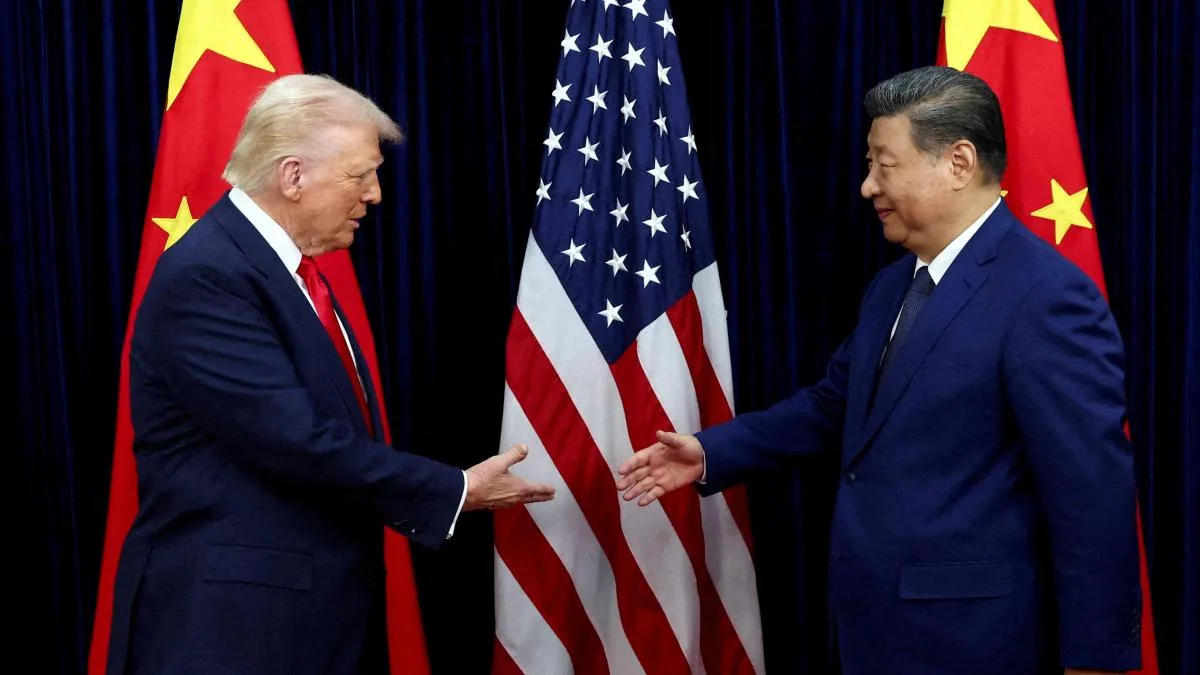
China confirmed on Monday the visit of the President of the United States to Beijing, which will feature key meetings with his counterpart Xi Jinping on Thursday and Friday. Air Force One will land in the Chinese capital on the evening of Wednesday, May 13. That a summit of such importance is officially announced with barely two days’ notice attests to the uncertainty of the moment, with both countries watching the evolution of the fragile ceasefire between Washington and Tehran.
The Chinese Ministry of Foreign Affairs has acknowledged that “world peace” will be at the center of the discussion, along with “bilateral issues.” Washington includes rare earths, AI, the tariff truce, and the Taiwan dispute in the agenda, although the latter is considered by Beijing to be an exclusively domestic matter.
Almost as important as the meeting between heads of state is the prior negotiation, this Tuesday and Wednesday in South Korea, between Treasury Secretary Scott Bessent and Chinese Vice Premier He Lifeng. Both refined the trade talks, over months and in various settings, before the tariff truce signed in October between their respective presidents, also in South Korea.
This time China is expected to commit to more substantial purchases of U.S. hydrocarbons and agricultural products, as well as a greater number of Boeing aircraft, in order to reduce its large trade surplus. As a sign of cooperation, China announced today that last month there was a joint operation with the U.S. against synthetic drug trafficking—another of Trump’s obsessions—in which five individuals of Chinese or American nationality were arrested in both countries.
The official trip will include the Temple of Heaven and a state banquet, but with less fanfare than in 2017, due to the wartime context. Although the visit was scheduled for early April, it was postponed because of the Iranian hornet’s nest. This week, many eyes will be focused on the impact of the summit on the double lock that strangles the global crude supply.
“The most important thing is that the war does not resume,” said a spokesperson for the Chinese Ministry of Foreign Affairs. However, he did not hide his displeasure over the recent inclusion of three Chinese satellite companies on Washington’s blacklist, accused of collaborating with Iran.
Added to this is Donald Trump’s latest message on his social network, expressing his huge disappointment because Iran’s response to his peace plan is “totally unacceptable.” So soon we will know whether the Beijing meeting helps bring peace to the world or is limited to a commercial interlude.
In any case, once confirmed, it will be the first time in nine years that a U.S. president sets foot in China. The previous one was Trump himself, since his successor, Joe Biden, chose not to travel to the Asian giant. The pivot to Asia, already promised in the times of Barack Obama—more than fifteen years ago—has yet to materialize decisively, due to successive stalemates in the Middle East.
The one most concerned is the current government of Taiwan, led by Lai Ching Te, with whom Beijing refuses to maintain any contact due to its “secessionist” stance. Not so with the opposition leader—and head of the Kuomintang—Cheng Li Wun, who was received in Beijing by Xi Jinping a month ago. Immediately after, the People’s Republic of China relaxed several restrictions affecting flights and commercial, tourist, and cultural exchanges with Taiwan.
In just correspondence, the Legislative Yuan (the parliament of the self-proclaimed Republic of China, dominated by the opposition) approved last week a military budget increase of 25 billion dollars, well below Washington’s demands and Lai Ching Te’s promises of 40 billion.