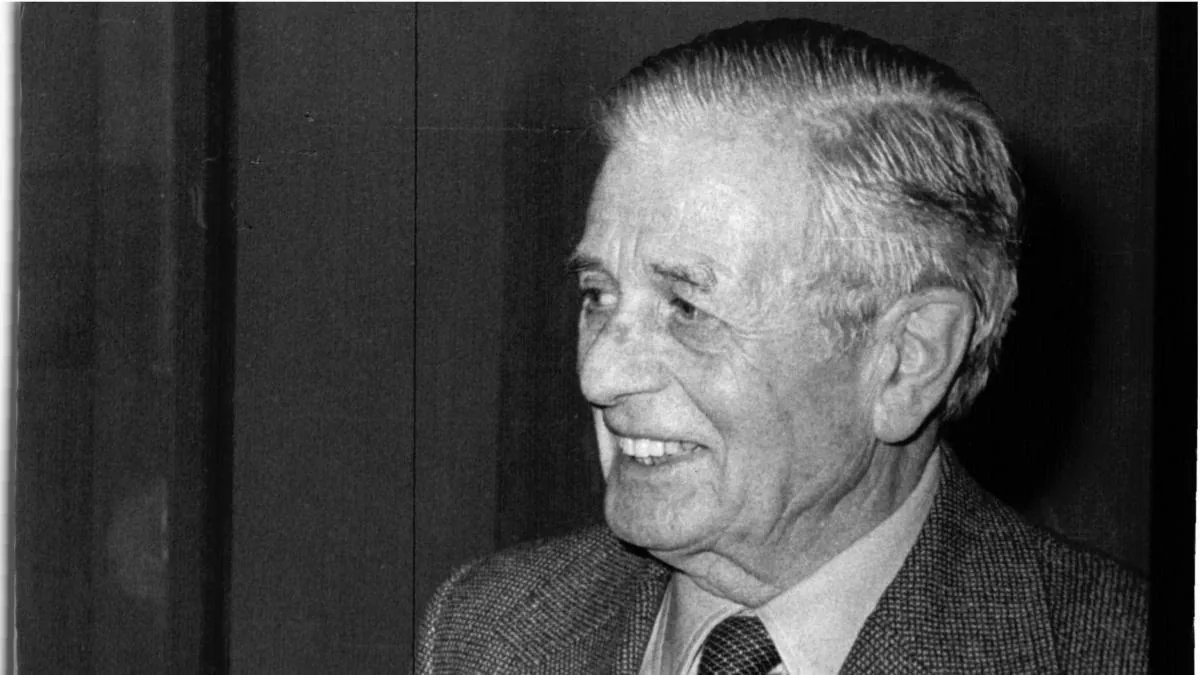
Florenci Pujol lived with growing anguish in the last years of his life. The use that his son, Jordi, made of Banca Catalana worried him greatly. This is evident from the unpublished entries of his son-in-law, Francesc Cabana’s diary, to which La Vanguardia has had access. Cabana, 91 years old, is the widower of Jordi Pujol’s sister. In 1988, the lawyer and economic historian published Banca Catalana. Diari Personal, a history of the entity of which he was secretary general, general director, and vice president. The volume included some entries from his diary during his time at the bank. However, Cabana’s personal diary contained more notes that were not included at that time.
In 2017, three years after Jordi Pujol’s confession about the alleged inheritance from Florenci, Francesc Cabana wrote the 600-page volume La meva història de Banca Catalana (1959- 1982). Una mena de Memòries. This one, twice as long as the previous, gave more details about the rise and fall of the entity and included new entries from his diary. As detailed in the introduction, Cabana intended to clarify his management and explain that, despite everything, he had been “a good banker.” Cabana considered publishing it, but after some editorial feedback and the possible emotional impact on the descendants of the protagonists, he put it away in a drawer.
The diary entries, accessed by ‘La Vanguardia’, are very relevant in the context of the trial of the Pujol family
This newspaper has accessed the volume. The new entries that appear are of great significance in the context of the trial of the Pujol family. This past week, the former president’s children have defended that the origin of the funds deposited abroad came from an inheritance from Florenci to the grandchildren and to Marta Ferrusola. A “resistance fund,” in the words of Oriol Pujol, that the grandfather would have devised to face an eventuality due to his son Jordi’s political activity, who in 1960 had already gone to prison following the Fets del Palau. The defendants’ justification is based almost solely on their word and on a textual piece of evidence. A letter found on April 26, 2017, in the judicial records at one of Jordi Pujol’s residences.
Between 1975 and 1976, Florenci wrote a letter to his son focused on the losses that Gran Enciclopèdia Catalana, El Correo Catalán, and Destino would cause them. At the time, it was analyzed by Manel Pérez. The stockholder expressed fear that the son would squander the family fortune using Banca Catalana for cultural and political purposes. The unpublished entries of Francesc Cabana’s diary point in the same direction.
On February 17, 1973, the lawyer notes, “the father [Florenci] is angry with Jordi because today he left for Geneva without telling him anything and a couple of days ago Marta [Ferrusola] went to Brussels without giving explanations. These trips are not very reassuring.”
When at the end of 1974, Jordi Pujol announced to Banca Catalana’s executive committee the purchase of El Correo Catalán, on October 30, his brother-in-law notes, “Florenci Pujol is fuming.” And adds, “the operation will cause a strong confrontation between father and son.” And on November 2 he notes, “the father [Florenci] and Jordi have clashed over the Correo matter. The father is at his wit’s end: ‘I haven’t lived for two years!’”.
On March 6, 1975, Cabana notes, “the father came in distraught to tell me that Jordi had bought Destino. Fifteen days ago I asked Jordi what was true about the rumors going around. He told me he had received an offer, but nothing more.” Months later, on September 5, a new entry says, “there was a clash between Jordi and the father in the executive committee. Maybe Jordi didn’t realize it, but afterwards the father gave me the repeated scene that ‘I will end with Jordi forever!’. I recommended calm and dialogue.”
Read more Fans, cynics, or crazy?
Later, on July 2 of the same year, Cabana notes, “the father again made a catastrophic assessment of Banca Catalana, calling for action. He is tired and out of shape.” And two days later, “the father is full of macabre ideas and has gone to buy a niche. David [Tennenbaum, friend and partner of Florenci] complains that the father blames him for many things and says he would have preferred not to have joined Banca.”
Florenci’s distress over his son’s actions grows progressively. On March 5, 1980, fifteen days before the first elections to the Parliament of Catalonia, Cabana notes: “The father has sold the shares of Laboratori Cuatrecasas [Fides], including those of Maria [the daughter] because he sees that BC’s operations will ask for more money. He only told me when it was already done. He is scared, poor man!” On the 20th, Jordi Pujol won the elections and on May 8 was sworn in as president of the Generalitat. An event that his father would have lived “with hope,” according to Cabana’s notes.
Despite everything, on September 30 of that year, Florenci died of a heart attack at 73 years old. On October 4, Cabana notes, “everything confirms that the father lived in a state of great tension. Two issues dominated: banking and politics. Regarding the first, he was pessimistic, contrasting his conservative spirit in business with the risky and daring politics of the bank. Politically, he suffered from the attacks Jordi received and planned to attend the political debate on October 1 in the Parliament of Catalonia.” It was a debate about the executive council’s policy that was postponed one day, precisely due to Florenci’s death.
A few days later, on November 10, Cabana writes that the widow, Maria Soley, told him that Florenci “before dying, had told her that he had been a coward for not confronting Jordi in BC and that, because of this fault of his, things could go wrong; that his whole life had revolved around his son and that he would not die satisfied. Truly, the father-son relationship was an example of high drama and extraordinary filial love on the part of my father-in-law, who personally sacrificed himself, and even his ideas, for those of his son.” Eleven days later, the president summoned his brother-in-law to the Generalitat, “to talk about the father’s will.”
Francesc Cabana concludes in his Memòries that Florenci “would have done whatever was necessary for his son and he did, even when he did not agree” and that he died “the day before a parliamentary debate that worried him. His heart, all the more reason, would not have withstood the Banca Catalana crisis.” The unpublished diary entries do not mention the inheritance, whose existence the brother-in-law of Pujol has always denied knowing. But they depict a Florenci very worried about his son’s actions. The full version of the diary is likely to add more context to this relationship.
Read more The Way of the Cross of the U.S.: the drone, the ‘mosquito’ and the industry