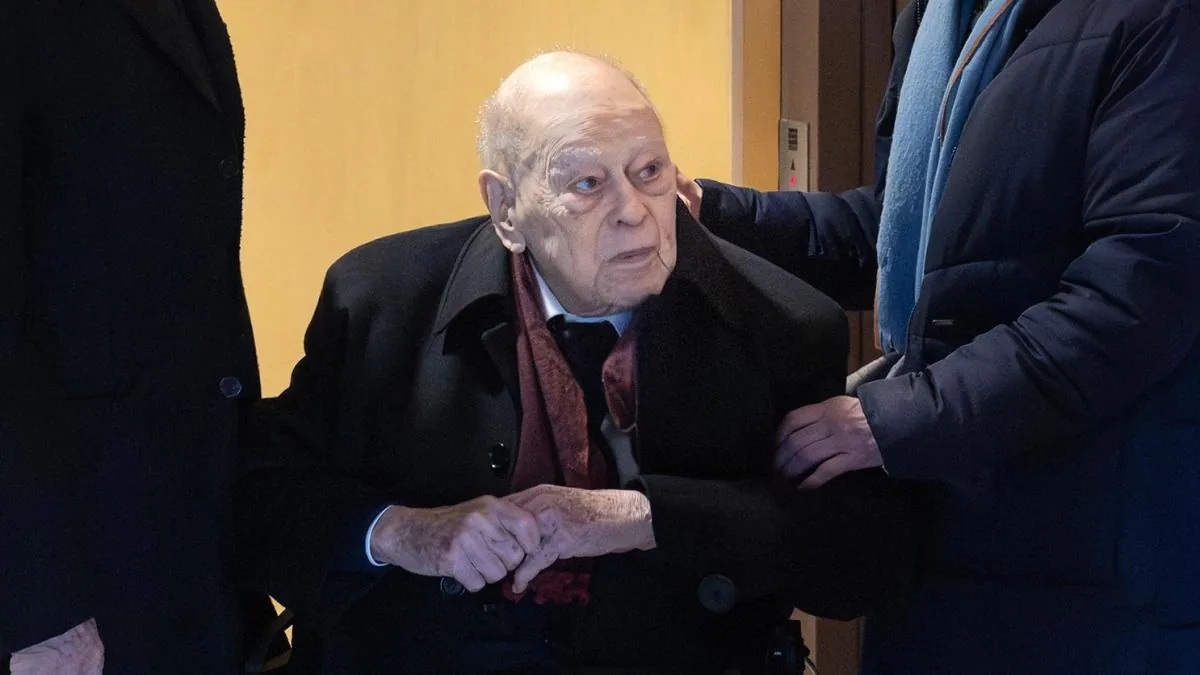
Jordi Pujol i Soley will be judged by history or time, but not by the courts. As of 10:55 AM yesterday, he is a man legally free in all respects, as the case against him and his entire family and nine businessmen for alleged corruption, being heard in the Audiencia Nacional, has been dismissed or dropped due to health reasons. The court summoned him yesterday for a medical and personal examination before deciding whether to keep him in the case and subject him to interrogation or, given his deteriorated state of health, to exonerate him. The president of the court, José Ricardo de Prada, issued a medical and judicial diagnosis, all in one: Pujol cannot be tried.
During the examination, Pujol expressed to the doctors his desire to testify. The same happened on November 24, at the start of the trial, when the great patriarch was subjected to an examination, though that time from his home; the court then decided to keep him, awaiting his turn to testify. Pujol was accused of illicit association and money laundering and faced sentences that could amount to up to nine years in prison.
De Prada justified summoning Pujol by stating his “very special interest” in having a personal interview. Such a decision “cannot be inferred” to forensic doctors, De Prada maintained. Pujol entered the Audiencia Nacional at 9:07 AM in a car with tinted windows, and left without being seen in public.
No one in his circle, nor people who have treated him in recent weeks, believe that Pujol is in a condition to coherently recount events from decades ago. Sources close to Pujol, in any case, explained to La Vanguardia that his defense lawyers’ intention was to invoke his right not to speak, given his neurological conditions.
Pujol has been involved in the judicial process for a total of 4,149 days. From December 16, 2014, when the head of Barcelona’s investigating court 31, Beatriz Balfegón, communicated his indictment and his summons to testify for the following January 27, 2015, until yesterday, April 27.
Pujol’s thesis was always that his father feared what might happen to him given his political activity
During this period, he testified as an investigated party in said court and subsequently, when the case was taken over by the Audiencia Nacional, he testified before the investigating judge, José de la Mata. He also gave explanations before the Parliament of Catalonia. In all of them, he offered the same version: the family money discovered in Andorra came from the inheritance of 140 million pesetas bequeathed to him by his father, Florenci Pujol. That the Pujols had money in Andorra was published by El Mundo on July 7, 2014, with data allegedly leaked by the “patriotic police.” On the 25th, Pujol confessed that he never knew how to regularize that money. The defense experts’ thesis is that good management between 1980 and 2000 – when the ‘deixa’ (inheritance) was subdivided among siblings – could have generated that monetary multiplication.
One of the documents in the judicial case is the Official State Gazette of March 3, 1959, with a list of tax evaders where Florenci Pujol Brugat appears.
Pujol i Soley’s thesis – of which his son Jordi gave abundant details yesterday in his awaited testimony at the trial – is that his father feared what might happen to him given his political activity (and what his numerous descendants might suffer because of it) and wanted to guarantee them means of subsistence.
The police investigation, in the years of the procés , maintained that the Pujol family amassed a fortune thanks to commissions paid to them by various businessmen in exchange for the Generalitat, under his presidency, granting them public works. Throughout the trial, no concrete evidence has appeared to support this.
Read more Pep Tosar inaugurates the new Raval theater, with two halls
With the father dismissed, the trial continued with the testimony of the family’s eldest son, Jordi Pujol i Ferrusola, the main accused. The prosecution is asking for 29 years in prison for him. In an interrogation – unfinished, continuing today – that lasted almost three and a half hours, he explained that his businesses were based on the use of “privileged information” and trust, which explains why many of them have no record or contract.
Pujol Ferrusola explains that the ‘grandfather’ left them the inheritance and showed them where they could flee to France
The prosecutor’s interrogation was kind and extremely detailed, with questions about dozens of operations, for which the accused gave complete explanations. At one point, the prosecutor inquired about a business whose owners Pujol did not want to name: “I’m not going to say the name because this is a shredder and it destroys everyone, we’ve been like this for fifteen years,” he criticized. When Pujol mentioned a banker with whom he had dealings, the prosecutor questioned why he was not prosecuted.
He also denied that his divorce agreement with his wife, Mercè Gironès, was a maneuver to hide his assets when, in 2014, he was already under judicial investigation.
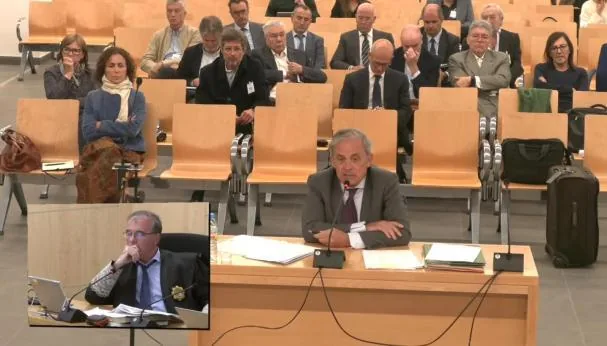
Pujol i Ferrusola presented his version of the origin of the family fortune: after Franco’s death, around 1976 or 1977, the avi Florenci had told him that the family would lack “nothing,” and he already knew then that he would leave them money. In 1990, Joaquim Pujol i Figa, cousin of former president Pujol, gathered the family and explained that since 1980 he had been the one managing the grandfather’s inheritance, but that from that moment on, Jordi Pujol i Ferrusola would do so. Jordi Pujol i Soley was not at that meeting, according to his son. Pujol i Figa transferred the management to the children at the moment he was appointed Secretary General of the Presidency of the Generalitat de Catalunya, replacing Lluís Prenafeta.
Pujol i Ferrusola added the context of the time: his two grandfathers, separately, had explained to them how one could flee to France from Darnius and from Queralbs, where they each had houses. Florenci “did not trust the country, he had lived through the war and the situation in Spain was not stabilized,” he said. “During the coup d’état [of 1981] we remembered him a lot.” For all these reasons, the inheritance left no trace. “Tax-opaque money never leaves a record,” said the eldest son.
There were brief moments of relaxation: he agreed to testify in Castilian if his “Catalanisms” were not going to harm him. “If we do it with translation, we’ll never finish,” he justified.
After almost three and a half hours of interrogation, his defense lawyer, Cristóbal Martell, suggested that the accused was tired and proposed that an interruption be considered. The prosecutor then announced that the next block of questions would be about the accounts in Andorra, to which the accused laughed: “Better we leave it, or he’s going to give me a
beating.”
Read more The Generalitat will stop reclaiming the aid granted once the dependent person has died