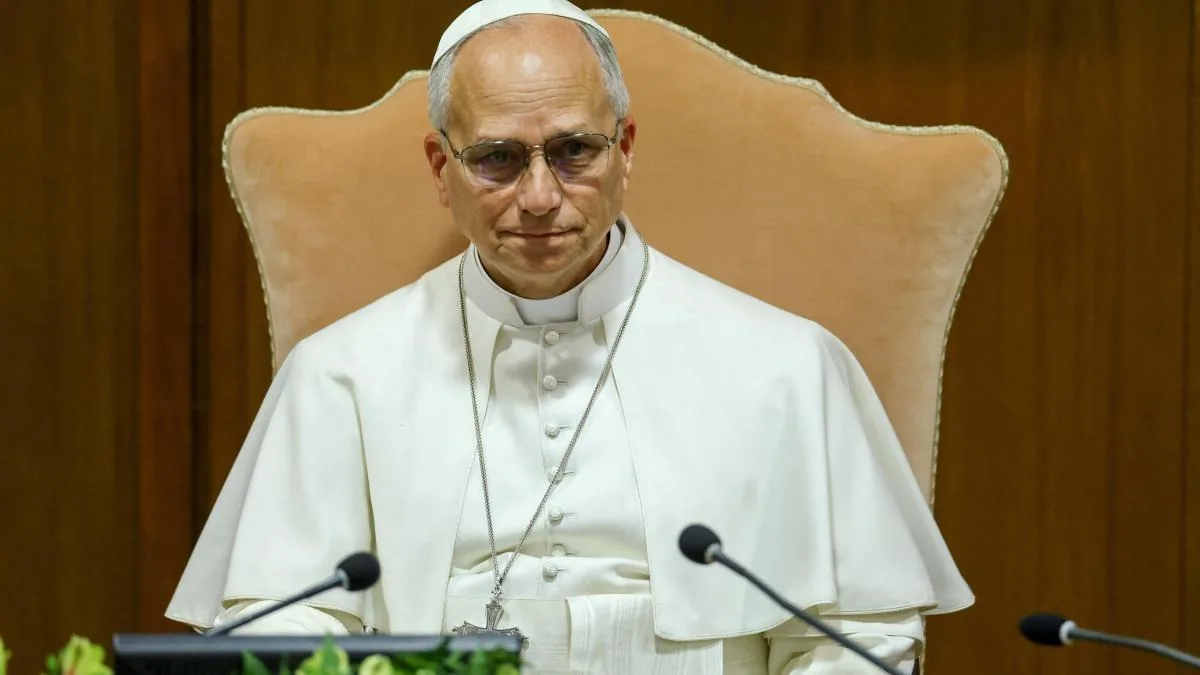
“I ask everyone to stop the construction of yet another Babel.” According to the Pope, humanity is at a crossroads in the face of the technological revolution: to be reduced to an object of a transformation guided by others or to continue being the subject of that change. In his first encyclical, titled Magnifica humanitas, the Pontiff uses a powerful biblical metaphor: the Tower of Babel versus the reconstruction of Jerusalem.
Read more The 210 references to Zapatero in the UDEF reports: how far is the former president surrounded?
The heart of the reasoning revolves around artificial intelligence, approached without prejudice, but also without concessions to its many gray areas. The thesis of the American Pope is that it is not enough to approve new regulations: the issue is also democratic, because it forces us to ask who today concentrates technological power and with what capacity to influence collective life. “We must realistically ask who holds that power today and to what ends it is directed,” he assures in the letter, which the Pope presented directly this Monday at a conference in which Christopher Olah, co-founder of Anthropic, a US company specialized in AI, participated.
In his letter addressed to Christians, Leo XIV fully enters one of the great debates of our time and claims the heritage of the social doctrine of the Church, with which his direct predecessor, Leo XIII, faced in 1891, with Rerum novarum, the first industrial revolution. Today, Prevost argues, the change is different but no less profound: it directly affects the dignity of work and, more broadly, the very conception of the human. As Leo XIII did in the face of industrialization, the new Pope places work at the center of his reflection. Automation and artificial intelligence do not appear only as a promise of efficiency, but also as a possible source of unemployment, precariousness, and loss of dignity. The underlying question again is who will pay the price of technological progress.
Artificial intelligence appears as a possible source of unemployment, precariousness, and loss of dignity
The issue challenges Catholics, but not only them. One of the most forceful axes of the encyclical is the concentration of technological power in private hands. “In the past, it was mainly states that drove and directed innovation,” writes the Pope. “Today, however, the main drivers of development are private actors, often transnational, endowed with resources and capacity for action superior to those of many governments,” he continues. The criticism of the big tech companies is one of the harshest lines of the text, because, he warns, that power “is not neutral, because it takes the face of those who conceive it, finance it, regulate it, use it.”
The encyclical also questions one of the underlying ideologies of the technological revolution: transhumanism, that is, the idea that technology can overcome biological limits and correct human fragility. The Pope clearly rejects that logic: “the desire for human fulfillment risks being diverted towards deceptive goals: the illusion of a technology that promises to free us from all fragility.” For the Pontiff, vulnerability is not a flaw to be eliminated, but a constitutive part of the human condition.
Read more Europe is suffocating under a historic «heat dome» for the month of May
If in his first speech from the central loggia of St. Peter he called for an “unarmed and disarming peace,” now Leo XIV takes up that intuition and projects it onto artificial intelligence. In the fifth chapter of the encyclical, he warns against its military application and against a technological logic put at the service of force and the progressive dehumanization of conflict. Artificial intelligence thus ceases to be only an economic or social issue to also become a geopolitical problem.
The encyclical is divided into five chapters, in addition to an introduction and a conclusion. In the first, Leo XIV traces the evolution of the social doctrine of the Church, from Rerum novarum to Francis, to argue that artificial intelligence is not an isolated technical issue, but a new great social question. In the second, the most doctrinal part appears: it reviews concepts such as the common good, solidarity, subsidiarity, social justice, human dignity, and the universal destination of goods as a basis for interpreting the technological revolution. In the third, the heart of the papal theses arrives, with a reflection on technological power, AI governance, the risk of digital domination, transhumanism, and the need to preserve the centrality of the human being. In the fourth, Leo XIV focuses on the impact of AI on democracy, information, and the collective imagination, warning about manipulation and the erosion of truth as a common good, as well as addressing work, new dependencies, and social control. In the fifth and final, he broadens the view to the international scenario, where AI appears linked to war, the logic of force, and the crisis of multilateralism.
The final message is clear: stop the construction, not to dismantle progress, but to decide what kind of civilization we want to build. Not a new Babel dominated by a few private actors with power difficult to control democratically, but a model in which the human being continues to occupy the center.
Read more The UCO concludes that Begoña Gómez’s chair was created in accordance with the regulations