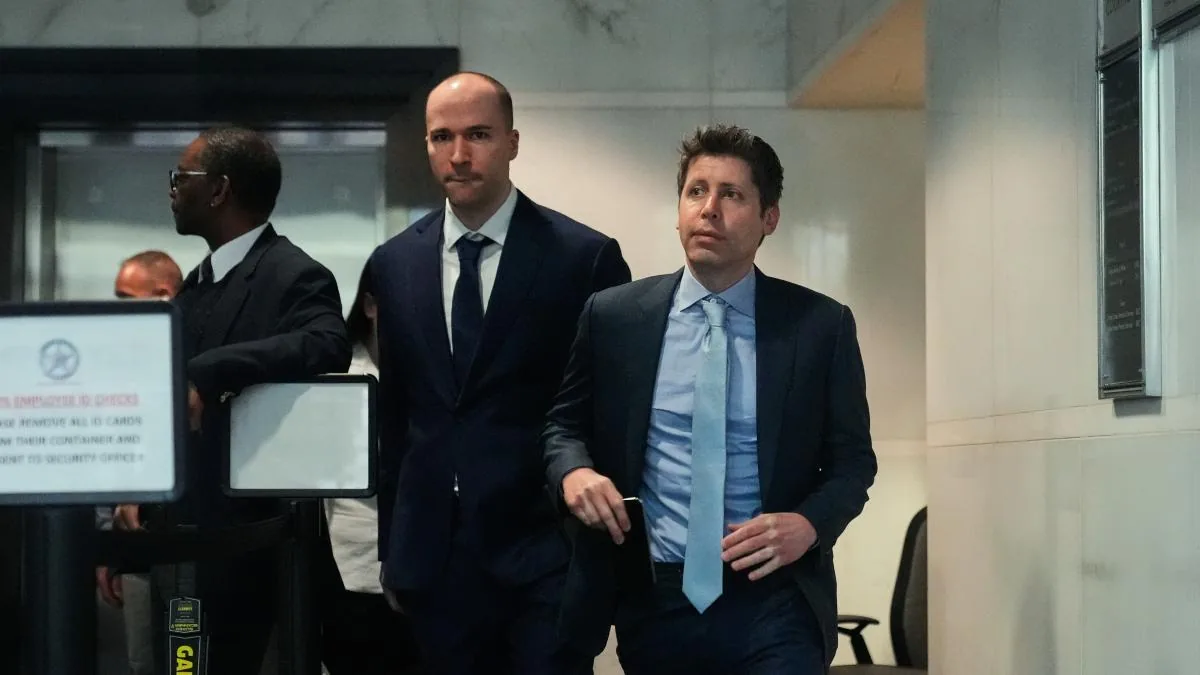
The so-called trial of the century ended with Sam Altman’s victory over Elon Musk, two old friends and collaborators now at odds in the artificial intelligence ring.
Read more Josep Rius resigns from being Junts’ candidate for the mayoralty of Barcelona
The nine members of the San Francisco (California) court jury rejected Musk’s claims against Altman, CEO of OpenAI, in just a few hours of deliberation, putting an end to a dramatic chapter of the bitter rivalry between the two tech billionaires after a hearing that captured the attention of the tech industry and threatened to redefine the race for artificial intelligence development.
Following the jury’s verdict, which was advisory, determining that Altman and OpenAI were not liable, among other reasons because Musk waited too long before taking legal action, the court, presided over by federal judge Yvonne Gonzalez Rogers, upheld that conclusion.
Musk sued Altman and OpenAI in 2024, alleging they had violated their commitment to keep the AI company as a nonprofit organization. Musk helped found OpenAI in 2015 but left its board three years later.
Microsoft, which invested in OpenAI since 2019, was also named as a defendant in this lawsuit, as Musk alleged that the software giant helped and instigated the alleged breach of the charitable trust by the startup that popularized AI three and a half years ago with the launch of ChatGPT.
Musk’s team wanted the court to force OpenAI and Microsoft to return up to $134 billion in “illegally obtained profits,” remove Altman and OpenAI president Greg Brockman from their positions, and undo the 2025 restructuring that allowed the growth of its for-profit division. Musk claimed any money should be returned to “the OpenAI foundation” and not to him personally.
At the heart of the case was Musk’s claim that OpenAI executives “stole a charity,” with Altman and Brockman abandoning the company’s founding mission for their own personal gain. Musk stated he donated approximately $38 million to OpenAI on the condition that it develop AI “for the benefit of humanity,” not to enrich a few individuals.
Read more José Vicente de los Mozos steps down as CEO of Indra
OpenAI’s lawyers argued that Musk’s donations were not restricted in any way and that restructuring the business was the only way to compete in a costly race against Google DeepMind. They also pointed out that Musk proposed a for-profit structure on the condition of maintaining control, even suggesting at one point that the company be integrated into Tesla.
In 2023, Musk created his own competing AI company, xAI, which is now part of SpaceX. OpenAI’s lawyers described the lawsuit as an attempt by Musk to harm a rival after failing to take control of the company.
During three weeks of testimony, jurors heard from Altman, Brockman, Microsoft CEO Satya Nadella, and Musk himself.
The verdict comes at a critical time for Altman and Musk. Both are pushing their respective companies toward public markets in what are expected to be record-breaking IPOs.
At the end of March, OpenAI raised $122 billion with a valuation of over $850 billion. Altman’s company competes to advance its models and continue expanding its consumer services while fighting against the rise of Anthropic with its Claude tool, increasingly popular and rated better than ChatGPT.
Musk plans to meet with investors ahead of a SpaceX IPO, which was valued at $1.25 trillion after its merger with xAI in February. SpaceX confidentially filed its IPO application in April and could make its form public this week.
Read more Florentino Pérez and Criteria invest 700 million in ACS to boost growth