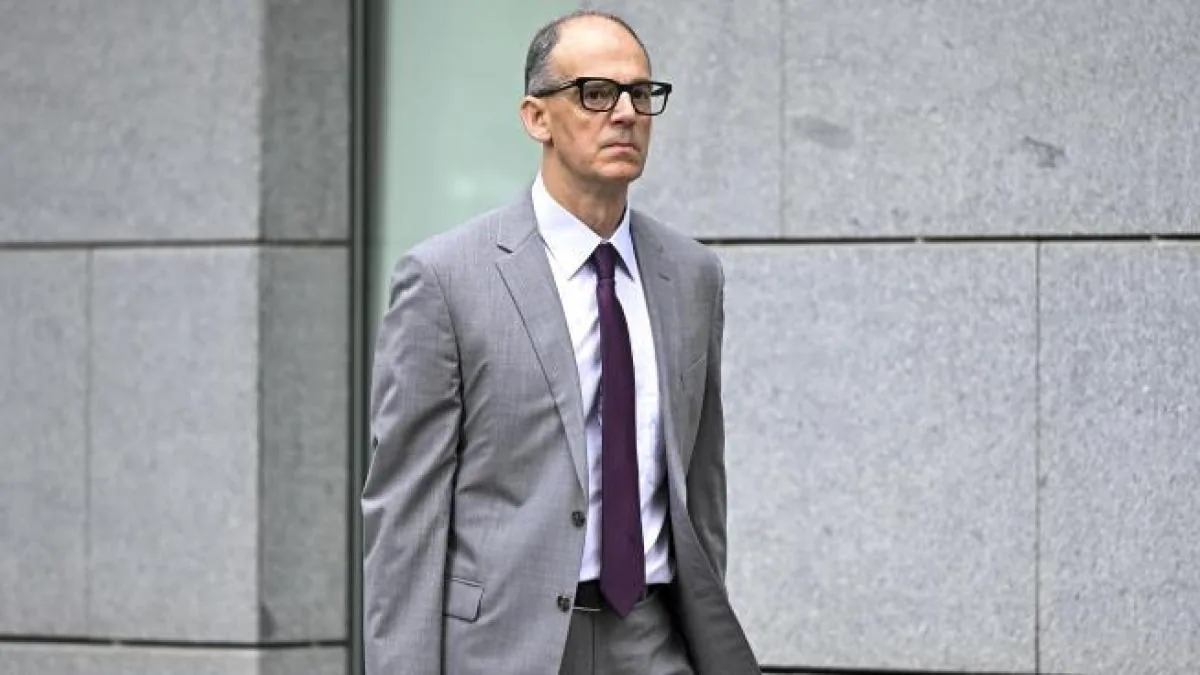
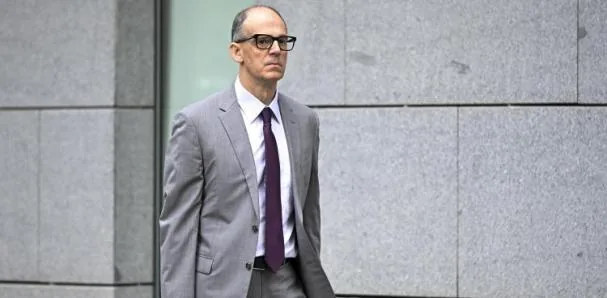
The chief inspector with professional ID 81,067 is not just another police officer among the line of uniformed personnel who have testified — or will testify — as witnesses in the National Court room where the Kitchen Operation is being tried. Until now, some — anticipating that their testimony would be brief — have answered questions about their knowledge of the parapolice device to monitor the former treasurer of the Popular Party, Luis Bárcenas, while standing. Others have preferred to sit down and get comfortable, uncertain about how long the interrogation would last. Agent 81,067 went further: he used a side table to carefully place stacks of reports and a laptop on which he could consult data down to the last detail. All this under the incredulous gaze of the court, which had to remind him that the oral hearing “favors spontaneity,” “what memory allows to reach.” The meticulous policeman is Manuel Morocho, the lead investigator of the Gürtel case, who struck at the defenses’ weak points by confirming that there was a parallel investigation into Bárcenas without judicial permission.
—When I opened it [an email for an information transfer by the Deputy Operational Directorate], a series of people, phones, vehicles, places, and companies [related to the former treasurer] appeared. It is the confirmation that there was a police operation without judicial authorization concerning Luis Bárcenas and his circle.
From the defendants’ bench, where the former top officials of the Ministry of the Interior and the National Police during Mariano Rajoy’s government sit, it is defended that Kitchen was a legal operation against Bárcenas, after his fortune in Switzerland became known. This is contrary to the version of the Anti-Corruption Prosecutor’s Office, which holds the thesis that the operation was orchestrated to prevent compromising material for the Popular Party that Bárcenas might have from ending up in the judicial process. This Wednesday, the one who led that investigation into irregular financing in Génova has dismantled the arguments of the former.
The chief inspector of the Economic and Financial Crime Unit (UDEF) explained, in line with other witnesses, that investigations launched by the National Police must be entered into the internal Gati registry to avoid overlaps. Although surveillance of the Bárcenas family was carried out in 2013, the Gati report was not registered until May 2015. It was then that he realized there was, as he called it, “a parallel investigation” that did not have judicial authorization. The group he led had the backing of the National Court. Morocho, in response to the Prosecutor’s Office, specified that when the “parallel” investigation into the former treasurer’s environment was registered, a summary procedure had already been ordered on the separate piece of Bárcenas’s papers. It was even after the oral trial had begun.
—Did the information [from the internal email about Bárcenas] prove relevant for Gürtel?
—No, it contributed nothing. Everything was already investigated. The information was in the files of Judge Pablo Ruz.
Throughout the first four weeks, it has been confirmed through the statements of agents from the surveillance unit that there were surveillances of Bárcenas’s wife, Rosalía Iglesias. However, this morning Morocho stated that in his investigation he never considered surveillance of Iglesias necessary. “I never motivated Judge Ruz to do it [request surveillance], neither in writing nor verbally.” Nor, according to their statements, was there ever knowledge that Bárcenas’s former driver, Sergio Ríos, had been recruited to obtain information that might be relevant. Anti-Corruption defends that it was the network, illegally, that offered Ríos a salary charged to reserved funds, a person who was then “completely trusted” by the Bárcenas, according to their own admission.
Morocho also recounted, in response to questions from the popular accusations (PSOE and Podemos), how some of his superiors urged him not to mention the name of the former Prime Minister, Mariano Rajoy, in a report on Bárcenas’s papers. “They told me these were papers that, who knows why Bárcenas made them, that it was Bárcenas’s invention, that they had no credibility, that who knows why he wrote them and that they were, in any case, his own things, but never of the political party he worked for, and that the accounting was the one regulated by the Court of Auditors and presented then,” he explained about how the pressures began. He also recalled how he was warned of the “serious mistake” he supposedly made by mentioning the former general secretary of the Popular Party María Dolores de Cospedal and her ex-husband, businessman Ignacio López del Hierro.