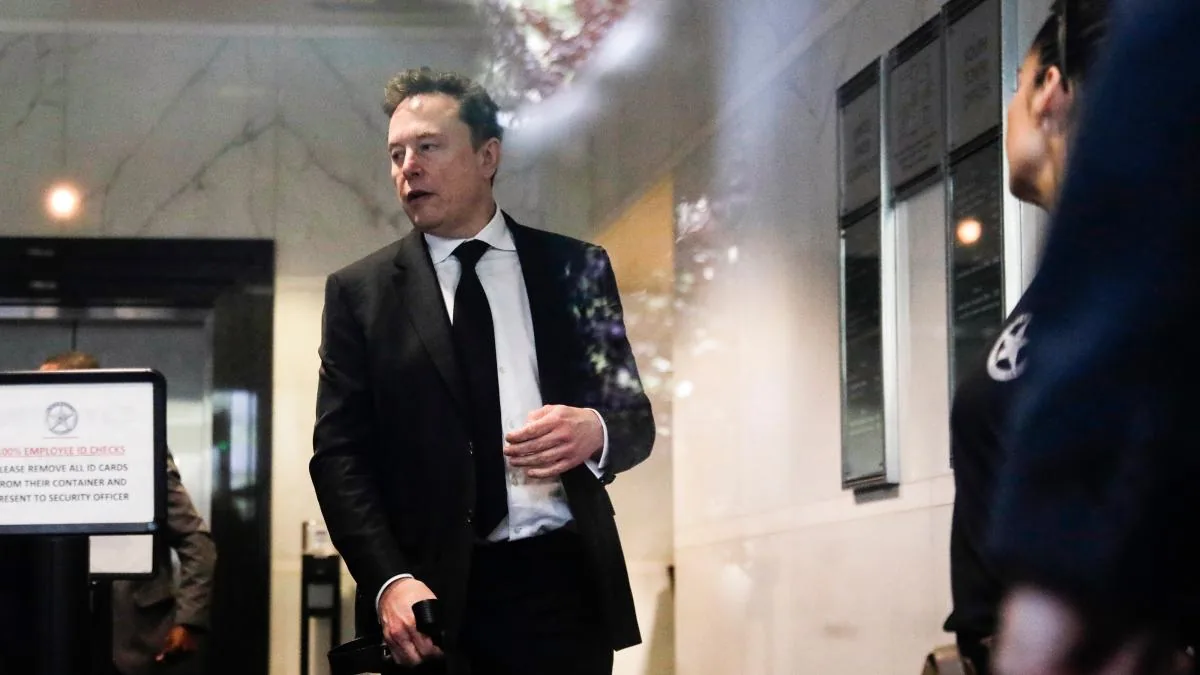
A federal court in Oakland, California, has become the new trial of the century. It is hearing the case of Elon Musk against Sam Altman over the existential meaning of OpenAI, the company that popularized the use of artificial intelligence with ChatGPT just over three years ago, an oral hearing that has the potential to reconfigure the AI industry.
Read more Two French guides beat the Mont Blanc round trip record by just two minutes
After the selection of the nine jury members on Monday, the trial itself began this Tuesday with the presentation of arguments, where Musk’s legal team, led by lawyer Steven Molo, emphasized that the case of the tech titan (Tesla, SpaceX, X or xAI) against OpenAI is a moral issue for the world’s richest man, rather than a strategic corporate move to curb a rival.
From the witness stand, Musk then explained that he sees the case very simply. “It’s not right to steal from a charity,” he proclaimed. And he lamented that if Altman and OpenAI win this lawsuit, it “would give carte blanche to plunder all charities in the United States.”
“The consequences of this case go far beyond me or everyone present here. The entire basis of charitable donations in the United States will be destroyed,” he warned.
He also resorted to talking about himself, reviewing his career as an entrepreneur, including his work “as a lumberjack” and his interest in physics and programming, his character as a dreamer (“life cannot simply consist of solving one miserable problem after another, there must be reasons to be excited and inspired by the future”) with the aim of strengthening his lawsuit, which focuses on how one of the most important companies in the tech industry was founded as a non-profit organization before transforming into a commercial entity.
This line of argument was previously expressed by lawyer Molo, who explained to the jury in the presentation of the matter that the firm led by Altman was created “for the benefit of all humanity.” But he clarified that “no one should be allowed to steal from a charity.” According to the lawyer, “stealing from a charity is absolutely wrong.”
In the room were Altman, Satya Nadella (Microsoft’s chief executive, also accused as OpenAI’s main partner) and Musk, the plaintiff, the first witness to be sworn in.
Then friends, Musk and Altman, along with other AI researchers, founded OpenAI as a non-profit organization in 2015, committing to freely share their technology with the rest of the world. However, Musk left the company in 2018 after a power struggle with Altman, and before the public launch of ChatGPT in 2022 which catapulted OpenAI to commercial success.
Read more Former FBI director James Comey charged again for an Instagram post
In 2024, Musk sued that company. He alleged that the non-profit organization he funded with large donations took advantage of his financial resources. He also argued that OpenAI breached its founding agreement by prioritizing business interests over the public good.
Musk’s lawsuit seeks more than $150 billion in damages from OpenAI and Microsoft. In addition to demanding Altman’s removal from the start-up’s board of directors and halting the change the company recently made to operate as a for-profit company.
Should Musk lose, Altman will most likely consolidate control of a company that has become synonymous with corporate dysfunction. And OpenAI, now valued at around $730 billion, will be free to pursue a data center expansion plan that could cost hundreds of billions of dollars.
William Savitt, the lawyer leading OpenAI’s legal team, countered in his argument that Musk’s initiative was not an altruistic effort. “We are here because Musk didn’t get what he wanted at OpenAI,” he said. He also noted that OpenAI’s original non-profit organization continues to oversee the for-profit company and was working to redistribute billions of dollars generated by the commercial operation.
“My clients had the audacity to go ahead and succeed without him. Elon Musk didn’t like that,” Savitt reiterated. Because of that success, “that’s when the bitterness appeared,” as he described the plaintiff.
Microsoft’s lawyer, Russell Cohen, presented similar arguments to the jury for why the lawsuit should be dismissed. He noted that Musk never objected to anything Microsoft did in relation to OpenAI until the research lab launched ChatGPT and became a success.
Read more United States is preparing exclusive passports with Donald Trump’s face