









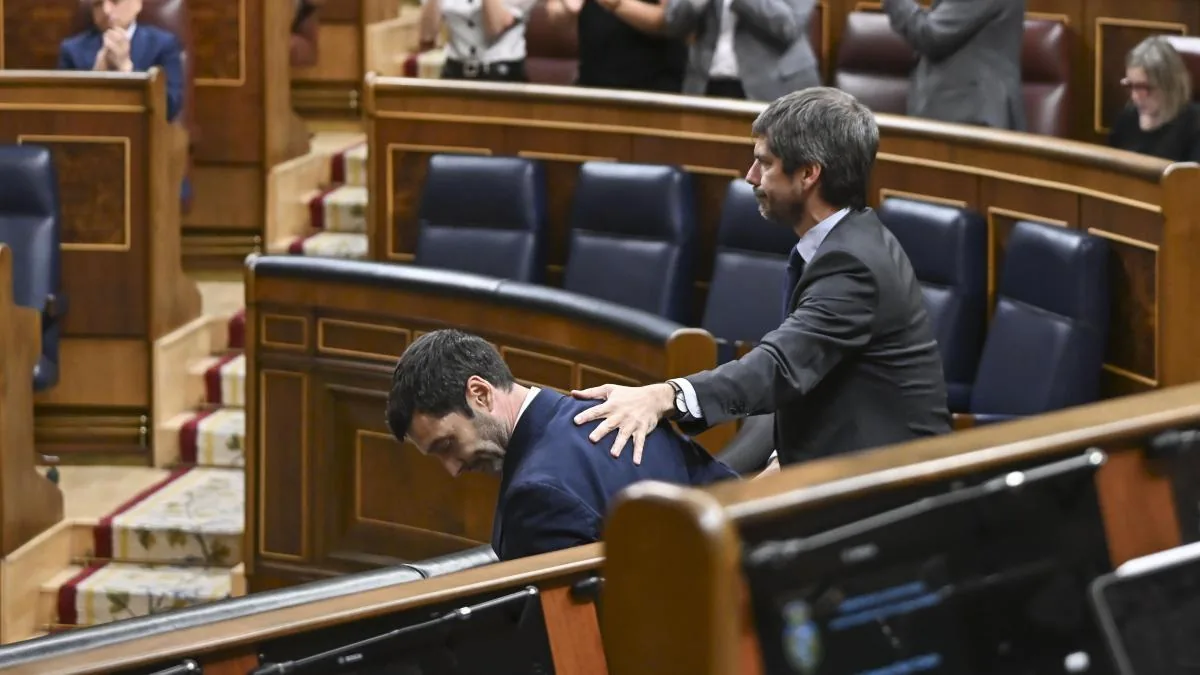
Junts inflicted a double defeat of enormous political significance on the Government in Congress this Tuesday by joining its votes with those of PP and Vox to overturn, with only minutes apart, two of the most sensitive initiatives of the legislature. The housing decree promoted by Sumar and the investment consortium agreed between ERC and the PSC to strengthen the participation of the Generalitat in state investments in Catalonia. The setback hits the coalition hard on the eve of the Andalusian campaign, with already very adverse polls for the left against Juan Manuel Moreno Bonilla’s PP, which aspires to revalidate its absolute majority.
Read more Gulf countries fear Hormuz will become a ‘frozen conflict’
The fall of the housing decree has also widened the distance between PSOE and Sumar within the Government. The two partners have not acted as a bloc during the parliamentary processing of a norm that Yolanda Díaz’s space had turned into one of its great political banners. The image of the debate has summarized much of that fracture: Yolanda Díaz and Ernest Urtasun have been the only ministers who have accompanied Pablo Bustinduy from the blue bench during the defense of a decree that Moncloa had practically given up for lost since Junts confirmed its rejection. The absence of the Minister of Housing, Isabel Rodríguez, has deeply irritated Sumar and has even been commented on by other parliamentary partners. “If the PSOE had put half the will it put into passing the Amnesty Law, we would be talking about a different result,” sources from the plurinational group summarized. During the debate, Gerardo Pisarello also reproached the socialists for not having been “sufficiently” involved in the negotiation, an accusation that PSOE deputy Ignasi Conesa responded to by asking not to “miss the mark” or confuse the adversary. In the PSOE, in any case, they downplayed the internal clash and attributed the criticism to “a Sumar tantrum.”
Sumar has opted for the Minister of Consumer Affairs, Pablo Bustinduy —one of the names with the most consensus for a possible future leadership of the plurinational left—, to defend the position from the rostrum, assuming the political cost of an already practically written defeat. The gesture has sought to underline a fundamental idea. To turn the defense of housing into an identity battle for the space, even in an adverse parliamentary scenario because, as they insist on asserting, “today a vote has been lost, but not the battle. Far from it.” The second vice-president herself, Yolanda Díaz, has assured that Sumar will study “all possible measures” to continue protecting tenants – including a hypothetical new decree – and has openly appealed to “social mobilization” as a political lever.
In the right-wing bloc, the PP has justified its rejection by arguing that the decree “increases the price of housing because it decreases supply,” in the words of Alberto Núñez Feijóo, although the immediate effect of its repeal may be precisely the opposite: an accelerated rise in rents in contract renewals.
Miriam Nogueras has flatly rejected the agreement on the investment consortium, considering that it meant “lowering Catalonia’s aspirations to limits that should make anyone who defends it blush”
The second defeat of the day came shortly after with the rejection of the investment consortium between the General State Administration and the Generalitat, an initiative promoted by ERC and agreed with the PSC to strengthen Catalan participation in the planning and monitoring of state investments. Junts once again aligned itself with PP and Vox, albeit for radically different reasons, and left the republicans politically isolated.
ERC deputy Inés Granollers directly appealed to the seven Junts deputies to act with “responsibility towards the country,” reminding them that “Catalonia unfortunately continues to be part of the Spanish State” and that its future “is also decided by doing politics in Madrid.” But Miriam Nogueras flatly rejected the agreement, considering that it meant “lowering Catalonia’s aspirations to limits that should make anyone who defends it blush.” The Junts spokesperson denounced that the consortium consolidated Madrid’s control over strategic Catalan infrastructures and summarized her party’s position in one sentence: “Catalonia does not need a consortium. Catalonia needs us to be transferred the money that corresponds to us. Either they pay or they pay.”
The double defeat has once again exposed the extreme parliamentary fragility of the Executive and Junts’ growing willingness to assert its own profile at the Government’s expense, even in votes with high political cost for the left. On the eve of the Andalusian elections, the blow also threatens to reinforce the image of an Executive incapable of guaranteeing parliamentary stability.
Uncertain future for tenants
The fall of the housing decree has also left a scenario of enormous legal uncertainty for thousands of tenants. The norm, promoted by Sumar after weeks of tension with the PSOE, allowed for a two-year extension of rental contracts expiring between March 21, 2026, and December 31, 2027, and limited annual rent updates to 2%. During the time it was in force, tenants could request the mandatory extension of their contracts via burofax, while landlords were forced to maintain the same rental conditions for two additional years.
From there, the main legal knot left by the parliamentary defeat now opens. The doctrine of the Constitutional Court establishes that the non-validation of a decree-law causes its immediate disappearance from the legal system, although it does not invalidate the effects already produced during its validity.
However, the interpretation is far from unequivocal. Some jurists argue that the rights acquired by tenants under the norm are consolidated at the moment they were exercised. Others, however, understand that the fall of the decree also entails the obligations of the owners, even in cases where the burofax request had already been sent.
The result is a scenario of high uncertainty that, according to union sources such as UGT warn, could lead to an “avalanche” of litigation in the courts given a regulatory framework without recent precedents.
Read more Rosa Peral had a plan to assault a prison official at the prison where she is serving her sentence