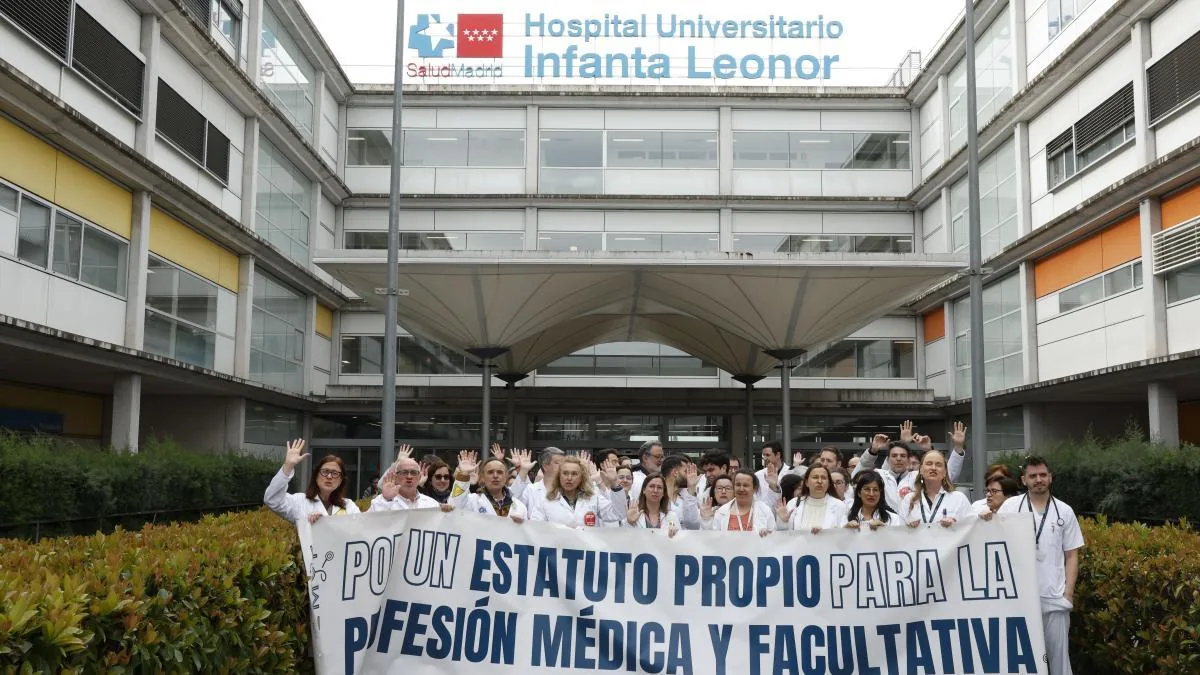
Doctors and medical professionals in the Community of Madrid resume this Monday the third week of an indefinite strike called to show their rejection of the Framework Statute agreement reached between the Ministry of Health and several unions and to demand their own text for the collective that recognizes the singularities of these professionals.
Read more The improbable reform of the Valencian electoral law longed for by municipalists
The strike, a continuation of those carried out in mid-February and mid-March, will begin this Monday, the 27th, and will last until Thursday, April 30th. The stoppages are intermittent, with one week of strike per month in a first phase that will extend until June: from May 18th to 22nd and from June 15th to 19th.
In this context, Amyts, the majority union for doctors in Madrid, has organized various concentrations for the upcoming strike days. They will begin on Monday with a concentration at the main entrance of the La Paz University Hospital starting at 10:00 a.m.
This will be followed by others at the same time on Tuesday at Gregorio Marañón Hospital, on Wednesday at Getafe University Hospital, and on Thursday at Hospital 12 de Octubre. The main event will take place on Wednesday afternoon, the 29th, with a concentration in front of the Ministry of Health, starting at 6:30 p.m.
175,000 medical professionals summoned in Spain
More than 175,000 doctors across Spain are called to the strike convened by the Spanish Confederation of Medical Unions (CESM), the Andalusian Medical Union (SMA), Metges de Catalunya (MC), the Association of Doctors and Senior Graduates of Madrid (Amyts), the Medical Union of Euskadi (SME), and the Union of Independent Medical Professionals of Galicia (O’MEGA).
In the case of the Community, the Medical and Faculty Strike Committee of the Community of Madrid is made up of Amyts, SIME, MUD, and AME. The strike call affects all doctors and medical professionals in the region, including Primary Care, Hospital and Out-of-Hospital Care, as well as MIR, FSE, and professionals from the Gómez Ulla Central Defense Hospital, Fundación Jiménez Díaz, and centers linked to Sermas (Fundación Alcorcón, Fuenlabrada, UCR, Villalba, Valdemoro, Rey Juan Carlos, and Torrejón). Regarding minimum services, the conveners have denounced them as “abusive.”
Since the previous strike call in March, four meetings have been held between the Ministry of Health and the state Strike Committee without an agreement being reached to avoid the mobilizations. In this context, both parties had planned a new meeting to address the creation of specific negotiation tables for the medical and faculty collective, with the participation of the Autonomous Communities. However, the Minister of Health, Mónica García, announced the cancellation of the meeting after accusing the unions of breaching what had been agreed.
For its part, the Strike Committee has accused the Ministry of “lack of real proposals” that respond to their main demands and has demanded the resignation of the minister, to whom it attributes continuous “manipulation of the narrative” and “lack of rigor” in the negotiations.
Failure with the mediator figure
On March 27, the Ministry of Health and the Autonomous Communities agreed in the Interterritorial Council of the National Health System (CISNS) that the Platform of Patient Organizations (POP) would act as an independent mediator to try to unblock the medical strike.
However, the Strike Committee asked the Ministry, through a letter, to withdraw this figure, considering it a “unilateral and non-consensual decision.” Thus, they criticized that the incorporation of the Platform of Patient Organizations (POP) as a mediator was “improper,” since, in their opinion, it was an affected party.
“Any attribution of mediation or interlocution functions must be accompanied by guarantees such as effective neutrality, recognition by both parties, and specific training in exclusively labor conflict resolution,” the Strike Committee points out.
Read more Valencian employers’ association: in favor of regularization and against «national priority»
The Strike Committee demands the creation of its own Framework Statute for doctors and medical professionals, in accordance with their training and professional responsibility. Likewise, it demands a specific negotiation scope, “with real legal guarantees and without dependence on other tables.”
Among their demands are also the implementation of a 35-hour working week, with excess hours recognized, remunerated, and computable for retirement purposes; a “fair” professional classification, in accordance with the training level and clinical responsibility; and a “flexible and penalty-free” retirement model, which recognizes the arduousness of medical practice.
The Strike Committee warns that the Ministry’s proposal does not offer sufficient legal certainty for its own negotiation nor effective commitments on key issues such as working hours, professional classification, or retirement.
Meeting with the Ministry of Health
In the case of the Madrid Strike Committee, it is expected to meet this week with officials from the Ministry of Health to address their demands, a second meeting between both parties after the one held last March.
The regional minister, Fátima Matute, already expressed her support for the creation of a specific Framework Statute for doctors in a meeting with officials from the Spanish Confederation of Medical Unions, conveners of the stoppages.
During the meeting, the head of Madrid’s Health system urged the Ministry to promote a “real” negotiation process with all professionals, including doctors, as direct interlocutors in the negotiation of their working conditions, enabling a specific space that includes their representatives.
Economic improvements requested in Madrid
In the case of the Community, the Strike Committee demands a new professional career model, “open and permanent, that includes specialized training, objective merits, a fifth level, and flexible homologation systems” or respect for the singularity and responsibility of medical performance, “with A1/A2 salary differentiation and maintenance of qualification and category requirements.”
Also, early retirement applying reducing coefficients for arduousness and occupational risks, an increase in on-call pay to 175% and extension of self-coverage, ensuring voluntariness and remuneration for complementary hours, the transitional supplement for the loss of the 2010 extra payment, paid in June and September.
They also demand equality in the valuation of services in all centers, equalization of Gómez Ulla Hospital with Sermas in remuneration and mobility, eliminating the exclusivity gap, salary improvements for residents (regional training supplement, progressive increase, inclusion in special programs and external rotation pool) and, for Primary Care Dentistry, quota limits, agenda sizing, minimum resources, and salary improvements for productivity, afternoon shifts, and overload.
Read more The TSJCV confirms its decision not to investigate Mazón for the management of the DANA