Predictive markets are experiencing a great boom. Platforms like Polymarket or Kalshi have gained enormous popularity and are increasingly occupying more space in public conversation and the media. A growth that has also caught the attention of regulators and legislators worldwide.
Read more La Sagrada Família recovers Gaudí’s workshop burned in 1936
However, what should be good news for their supporters has ended up generating controversy even within the community itself. The reason is the same one many have anticipated for some time: their growing link to sports betting and the risk of corruption.
But before going into detail, it is worth understanding what predictive markets are. These are open markets where users can bet on the outcome of practically any event. For example, it is possible to bet on the result of an election, the start of a war or when it might occur, or the arrival of an economic crisis and its magnitude.
They also allow betting on sporting events, the death of people, extreme weather phenomena or other catastrophes, as well as the outcome of judicial, scientific, or any other type of investigations.
For obvious reasons, the ethics of this type of market is controversial. Although, according to official statements from Elisabeth Dana, Kalshi’s communications manager, “profiting from death is not allowed on Kalshi, and that is a good thing,” other competitors do not share that view. Moreover, there are always ways to frame a market with wording that, without explicitly mentioning that objective, ends up allowing practically the same thing.
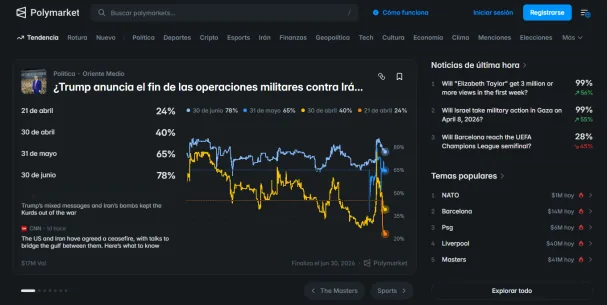
This is the case with Polymarket, probably the largest predictive market in the world. Due to its decentralized structure, the platform is not subject to the restrictions of U.S. legislation that prohibit betting on the death of people, even though it is headquartered in New York and its CEO, Shayne Coplan, is a U.S. citizen. An example of how much this type of market carries regulatory and ethical problems from its very conception.

An uncomfortable truth
What lies behind the sports predictive market
The problem predictive markets face is that, despite their efforts to establish themselves as a relevant tool to anticipate events, most bets on wars, deaths, or natural disasters barely move the market.
The same happens with those presented as especially useful for society, such as those related to the outcome of elections, the success of a scientific experiment, or the approval of a political measure. In the end, the ones that really concentrate interest and volume of activity are sports bets.
Profiting from death is not allowed on Kalshi
Elisabeth Dana
Kalshi communications manager
Most of these companies’ income comes from sports betting. On Polymarket, they represent 64% of the platform’s activity. On Kalshi, that figure reaches 90% of the volume traded during the sports season. The pattern repeats across the sector: their real business is sports betting, not predicting political, economic, or social events.
This poses a problem because, while predictive markets continue to operate with limited regulation in many countries, sports betting is subject to a much stricter regulatory framework in much of the world. A difference that could end up having consequences for these companies.
Read more New CUPRA Raval, the urban electric car made in Spain with more than 400 km of electric range
In April, Science magazine stated that “we see three main areas of concern regarding the structural features and rapid institutionalization of these commercial predictive markets: democratic manipulation, gambling-like design, and public health impact.”
In the first case, the authors warned that these markets can create incentives to manipulate democratic processes to obtain economic benefits. In the other two, they alerted that their similarities to sports betting and gambling can foster addictive behaviors comparable to those associated with gambling addiction, a risk they argue cannot be overlooked.

Are all these concerns worrying the people driving predictive markets? Not especially. Their main concern is that the growing association with sports betting ends up overshadowing the value they believe these platforms provide.
“If you are some kind of decision-maker or a high-level legislator in DC, and you have to do something about Israel or Iran, a betting market is plausibly useful,” said David Bensoussan, organizer of Manifest, a festival dedicated to predictive markets.
A boom that could end soon
The business of war
But what Bensoussan calls useful, Science calls dangerous. And we have recent cases that prove they are not wrong. Polymarket was able to predict a recent ceasefire or the capture of a head of state because it allows people with flexible ethics to profit from insider information. Something that, at the very least, should be debated whether it should be allowed.
Of course, that scenario is already starting to materialize. In the United States, the debate over whether predictive markets should be able to operate without greater restrictions has already reached the political arena. Republican Senator from Utah Blake Moore has introduced a bill to ban any bet considered contrary to the public interest, including those “related to sensitive matters such as terrorism, murders, wars, or elections.”
Therefore, although predictive markets are experiencing a boom, their growth does not seem to be due so much to their usefulness as prediction tools, but to their functioning as betting houses. They are a different variant, with more types of markets and with formulas that in some cases allow bypassing restrictions applied to sports betting, but their business logic is very similar.
This proximity makes them clear candidates for stricter regulation in the coming months or years. And although they have grown strongly recently, that does not necessarily mean they will become the next big business of the century.
Read more Japan celebrates the Enoshima Tenno Festival with a ritual in the sea