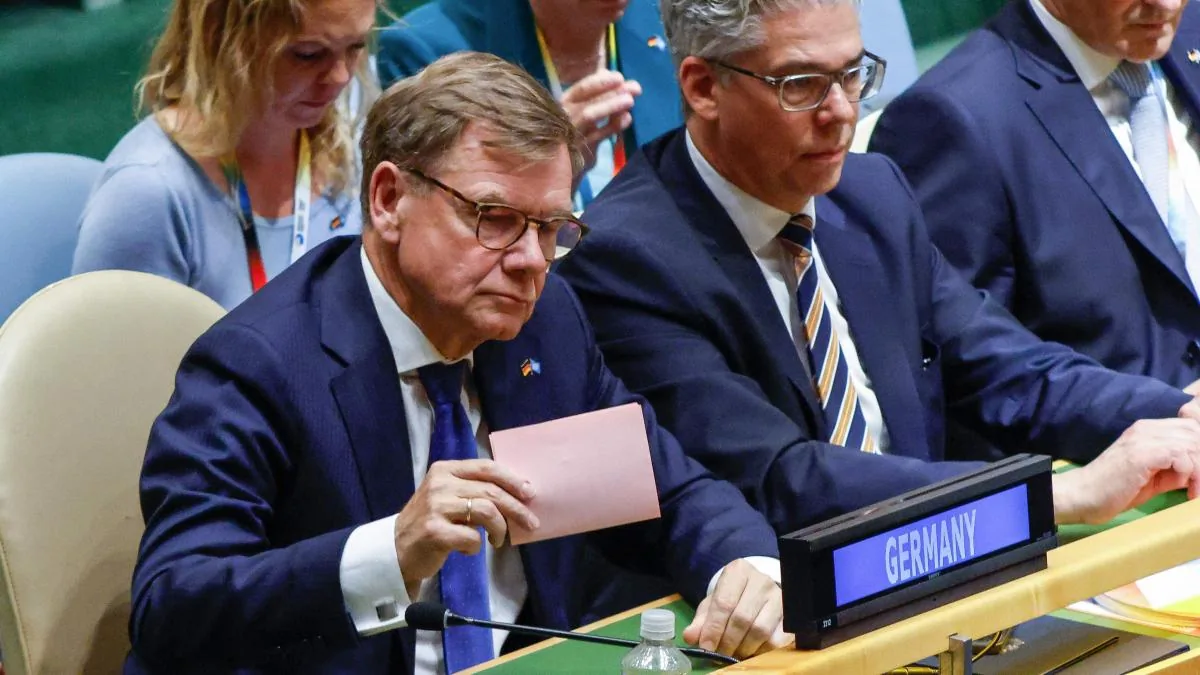
For the first time in history, Germany failed to be elected as a non-permanent member of the UN Security Council in the general assembly vote on Wednesday in New York, “a real disappointment, a bitter defeat,” according to its Foreign Minister, Johann Wadephul, who attributed the harsh setback to an adverse campaign by Russia. The chosen ones to fill the two European seats for the 2027-2028 period were Portugal and Austria.
Read more Miracle on Everest: missing Sherpa found alive six days ago at over 7,300 meters
The UN Security Council is composed of 15 members: the five permanent members (China, United States, France, United Kingdom, and Russia), that is, the victorious powers of World War II; and ten nations elected for two-year terms, according to geographical distribution rules. Half of these non-permanent seats are elected each year, and this year three countries competed for the two assigned to Western Europe.
In the secret ballot, Portugal and Austria already obtained the required two-thirds majority in the first round, with 134 and 131 votes, respectively. Germany, which had already held a seat on the Security Council six times and had always obtained it whenever it presented its candidacy, received only 104 votes this time.
UN General Assembly in New York
Portugal and Austria defeated Germany for the two seats being elected in Europe, and the countries chosen for other regions of the world were: Zimbabwe, Trinidad and Tobago, and Kyrgyzstan
Germany’s support for Ukraine and Israel could be the cause of the defeat, according to Minister Wadephul. “We have always maintained a clear stance on certain issues, and these are positions that not all member states share,” Wadephul told reporters after the vote at the United Nations headquarters in New York. “Our support for Ukraine is unwavering; it’s no secret that Russia doesn’t want that voice on the Security Council, and that it has campaigned against us,” the German minister stated.
“The fact that Germany must always assume a special responsibility for Israel in the Middle East conflict may also have cost it votes,” added Johann Wadephul, referring to Germany’s generic support for Israel for historical reasons due to the Holocaust against Jews perpetrated by Nazi Germany during World War II.
Germany has been repeatedly called upon to adopt a firmer stance against Israel over the massacres of Palestinian civilians in the Gaza Strip, a conflict theoretically in a ceasefire phase although it continues to cause fatalities. Wadephul assured that Germany will maintain its support for Israel, while expressing, as it has done on occasion, specific criticisms of Benjamin Netanyahu’s government.
Pending Security Council Reform
The veto power of the five victorious powers of World War II now prevents peace from being achieved in Ukraine, Gaza, and Iran, due to the vetoes of Russia and the United States
In a separate statement in Berlin, German Chancellor Friedrich Merz accepted the defeat, stating that Germany will remain a strong defender of the international system and congratulated Austria and Portugal. “We presented our candidacy with conviction. We did not achieve our goal. This result does not alter the tasks we face at the United Nations. Germany remains a fundamental pillar of the multilateral system.” Germany, a G-7 member, Europe’s largest economy, and one of the main contributors to the UN budget, continues to be an influential voice within the organization.
Read more Brussels expands the case against Spain over the laws used to block BBVA’s takeover bid
According to the UN Charter, the Security Council is mandated to ensure international peace and security, but the body is in a deep crisis, having so far failed in the three main current war scenarios (Ukraine, Gaza, and Iran) due to Russia’s veto power over Ukraine, and the United States, Israel’s closest ally, over Gaza and Iran.
Decades-long attempts to reform the Security Council to reflect the geopolitical realities of today’s world – not those of the post-war era 80 years ago, when the UN was established – have not worked. A new attempt is already being prepared.
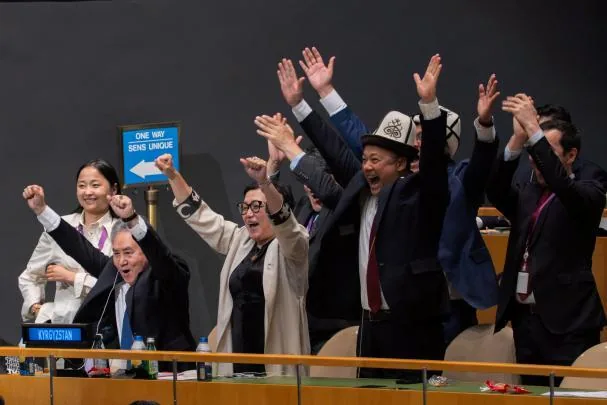
The other three newly elected non-permanent members were: Zimbabwe, Trinidad and Tobago, and Kyrgyzstan. Zimbabwe, the sole candidate for the vacant African seat, was chosen in the first round with 182 votes. Trinidad and Tobago obtained the seat for the Latin American and Caribbean group with 181 votes. A fourth round of voting was needed to decide between the two countries vying for the seat reserved for Asia; finally, Kyrgyzstan prevailed over the Philippines.
The five countries elected on Wednesday will replace Denmark, Greece, Panama, Pakistan, and Somalia starting January 1, 2027; and will join the current five non-permanent members elected for the 2026-2027 period: Bahrain, Colombia, Latvia, Liberia, and the Democratic Republic of Congo (DRC).
Although this German defeat can also be interpreted as some countries considering Germany and Austria too similar, which would have tipped the balance towards Austria, which also entered the race for the seat earlier, the head of German diplomacy insists on seeing it differently. Wadephul admitted Germany’s “late entry” into the competition but attributed what happened to Germany’s stances on Ukraine and Israel.
Read more Feijóo’s elephant… and Sánchez’s