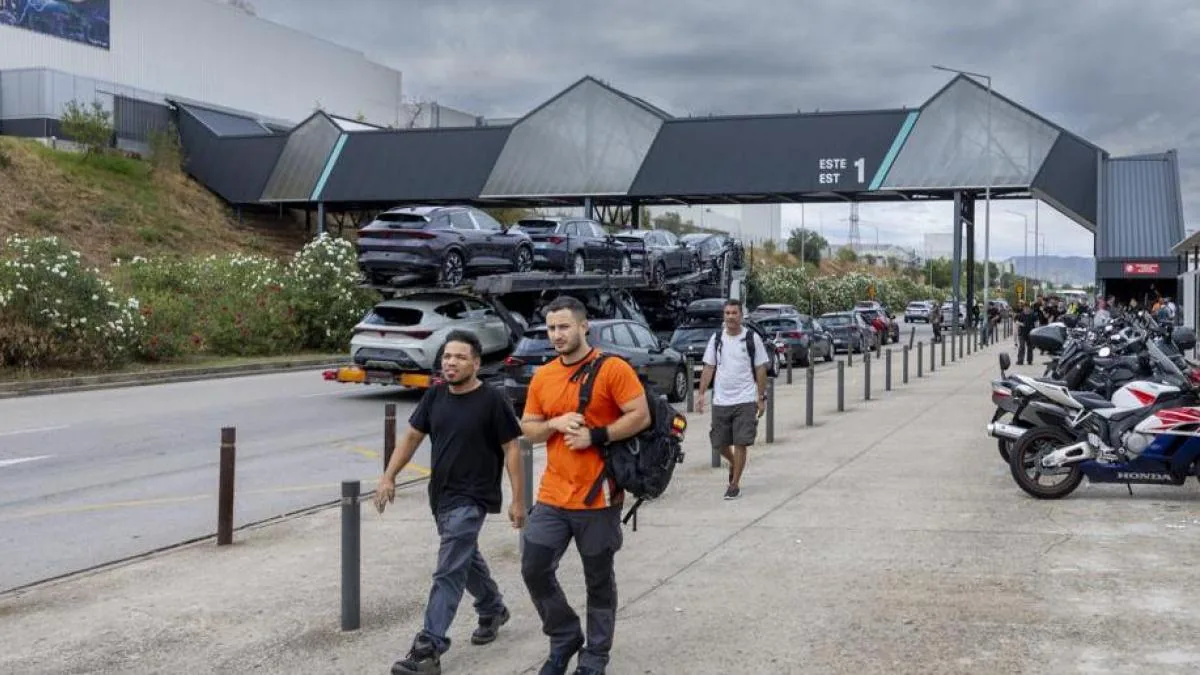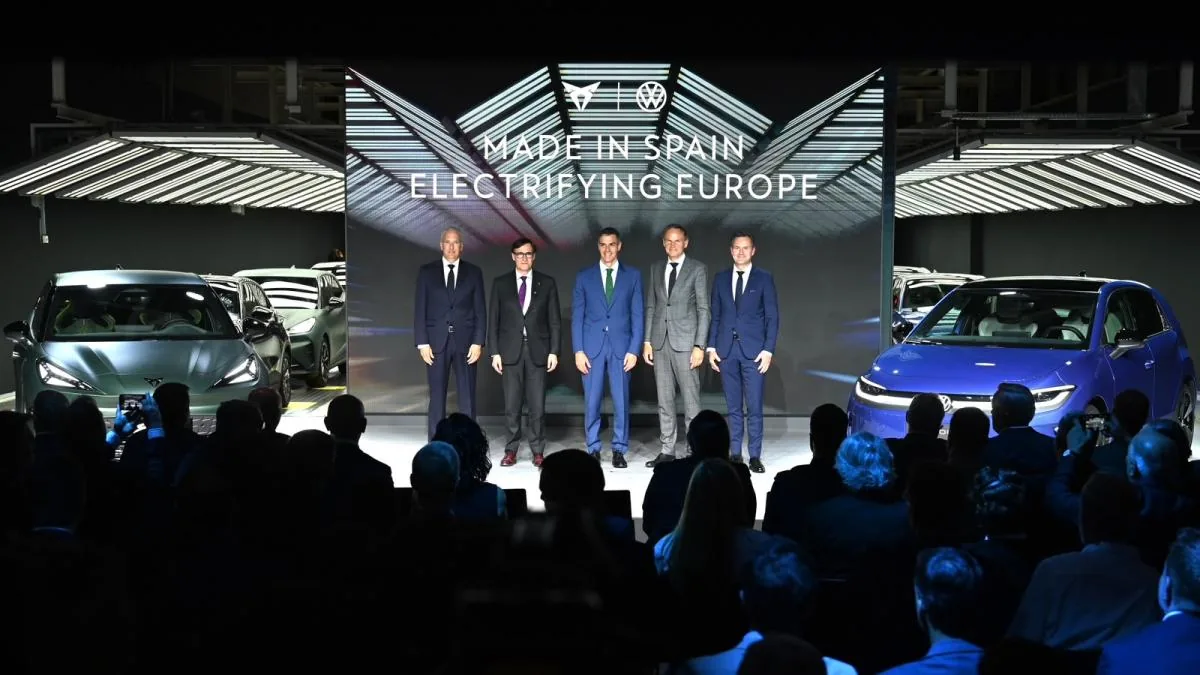
The Seat factory in Martorell enters the electric era. The owner of the Seat and Cupra brands started production this Wednesday of the Cupra Raval and Volkswagen ID.Polo models, the first electric vehicles to be manufactured at the Catalan plant, as part of the electrification plan of its German parent company. These compact cars are aimed at the economic segment, with prices around 25,000 euros. The Raval is expected to be a game-changer for the Spanish company, which has pushed its financial results to the limit due to investment in electrification and tariffs on the Tavascan, an electric vehicle made in China.
Read more Microsoft presents its new Majorana 2 quantum chip, with qubits 1,000 times more reliable
This milestone also marks the starting gun for a greater production rollout for Volkswagen’s family of urban electric vehicles in Spain, with Pamplona also on the order map. The launch took place with an official event attended by Volkswagen’s top management, led by CEO Oliver Blume, the Prime Minister Pedro Sánchez, the Minister of Industry Jordi Hereu, and the President of the Generalitat, Salvador Illa.
Forecast to produce 60,000-70,000 units this year
The Raval and the ID.Polo are produced on line 1 of the factory. It has a capacity of 1,200 units per day, for a total of 2,500 units at the plant. In this first phase, production is at a slower pace, with one shift in the morning and another in the afternoon, awaiting market response. Currently, about 400 people work per shift on the assembly of the electric vehicles.
Seat estimates that by the end of the year maximum capacity can be reached. Markus Haupt, CEO of Seat and Cupra, points to 60,000-70,000 units produced this year, of which 40,000 would be Raval. Blume has stated that “we have very good orders for these brands,” which are about double what was expected at this point. Deliveries of the Raval will begin in summer.
The start of production marks Seat’s entry into the electric car market. “We demonstrate our ability to shape the future of mobility. We are ready to electrify Europe from Spain,” Haupt highlighted. The executive noted that Seat is completing “the deepest transformation in its history.” “Today Martorell is the epicenter; thousands of electric cars will leave here to democratize mobility in Europe,” he stated. “The Raval is going to change the rules of the game, it is exceeding all our expectations,” he reiterated.
Martorell produced about 470,000 vehicles last year, and it is estimated that this year the figure will be similar, even including the new models, since models like the Audi A1 have ceased production.
President Sánchez pointed out that the models “will help democratize electric mobility.” The president highlighted the public-private collaboration to transform the automotive sector: “It has been key.” The Perte VEC, with public support, has mobilized 4 billion euros so far, he reviewed, with 1,900 investment projects. “We are playing for Europe’s prosperity,” he asserted.
Read more Data centers will emit as much CO2 in 5 years as Great Britain emits today
In a similar tone, Illa pointed out that this represents a triple commitment for Catalonia with the prosperity of Spain, Europe, and the democratization of electric vehicles. “Buying an electric vehicle made at home is a sign of responsibility and patriotism,” he assured.
Martorell and Pamplona, axes of Volkswagen’s electric rollout
Beyond Martorell, Spain is one of the key points in Volkswagen Group’s electric strategy, which has assigned the two mentioned models to the Catalan plant and two other SUVs to the Pamplona plant, the Volkswagen ID.Cross and the Skoda Epiq, which will start later. All share the same platform (MEB21), whose development is led from Spain. “We are investing billions to turn Spain into an electromobility hub. Although global competition intensifies, we make it clear that we believe in our local market. It is crucial to leverage this momentum with a clear Made in Europe strategy,” Blume stated.
The German executive says there is room for more models in Spain, but it will be important to differentiate them. By handing the plan’s baton to Spain, Volkswagen has managed to save about 600 million euros through synergies.
Volkswagen and its partners have committed an investment of 10 billion euros in electrifying their plants in Spain and in building the Sagunt battery factory. Seat has allocated 3.3 billion euros: 3 billion to adapt the plant and 300 million to a battery plant. For Blume, Volkswagen seeks to lead the sector’s transformation. “What is born here is a new industrial boost for Spain and Europe,” he said. The German executive calls for accompanying the rollout with “a made in Europe strategy that guarantees fair competition.” He also called for more flexibility with emissions policies: “Fines only slow progress; the market must be allowed to choose,” he denounced.
The models start at 25,000 euros, in an effort to democratize electrification, where price is one of the factors that most defines the purchase and the jump from combustion.
Cupra already manufactured an electric vehicle in China, the Tavascan, which caused losses due to tariffs when importing it to Europe. The start of electric vehicle production is seen as a way to recover profitability.
Read more Check the health risk temperature during a heat wave based on your location