
The environmental footprint of data centers already rivals that of some of the largest countries in the world, according to a report from the United Nations University, which also predicts what water and energy consumption will be. Emissions that warm the atmosphere will double in less than five years as the use of artificial intelligence grows.
Read more Check the health risk temperature during a heat wave based on your location
According to the document, by 2030, if data centers were a country, their associated electricity consumption would be at the level of France. And in terms of carbon dioxide emissions, which cause warming, they could reach 400 million tons of CO₂ equivalent per year, a figure comparable to the current total emissions of the United Kingdom.
The report highlights that AI, the engine of the fourth industrial revolution, is growing so explosively that it surpasses the capacity for global decarbonization.
According to the report, AI spending is expected to exceed 2.5 trillion dollars this year. The global market will grow from 189 billion dollars in 2023 to nearly 5 trillion dollars (with a t) in 2033, with growth supported by data centers, large energy consumers.
Data center consumption will double
In 2025, data centers—the backbone of AI—consumed approximately 448 TWh of electricity, a figure that could double by 2030.
This means that if these facilities were a country, that level of electricity consumption would place them 11th worldwide, roughly on par with France.
Furthermore, if the current trend continues, that consumption figure could reach 945 TWh by 2030, representing almost 3% of the projected global electricity consumption.
This is equivalent to nearly three times the combined annual electricity consumption of Pakistan, Bangladesh, and Nigeria, countries that together host more than 650 million people.
Moreover, producing that amount of electricity would have a strong impact in terms of greenhouse gas emissions to the atmosphere.
Specifically, the carbon footprint has been estimated at 399 million tons of CO2 equivalent, a figure comparable to the UK’s emissions across all sectors in 2025.
To balance and offset those emissions, planting 6.7 billion trees over 10 years would be required, approximately double the number of trees in the United Kingdom.
“If we look at these figures, we see scales comparable to those of nations,” said the study’s co-author, Kaveh Madani, director of the Water, Environment and Health Institute at the United Nations University in Canada.
Another impact is water consumption. The report notes that even when part of the extracted water is returned, “large-scale withdrawals can overload aquifers and river systems, especially in arid regions or those with groundwater scarcity.”
And the land area associated with this electricity would exceed 14,000 km², almost 10 times the size of Mexico City.
AI is now one of the main drivers of data centers
AI is now one of the main drivers of consumption growth in data centers. In 2025, AI workloads alone accounted for about 20% of total electricity spending in data centers, and if that proportion rises to 40% by 2030, as expected, its electricity demand could reach approximately 378 TWh.
Just this amount would be enough to cover the residential electricity needs of the entire population of sub-Saharan Africa for more than two years.
Read more The judge orders the appraisal of the jewels found in the search to Zapatero’s office
The environmental impacts of AI are conditioned not only by the growth of data centers and supply from mixed electricity sources but also by the increasing cost of building ever larger artificial intelligence models.
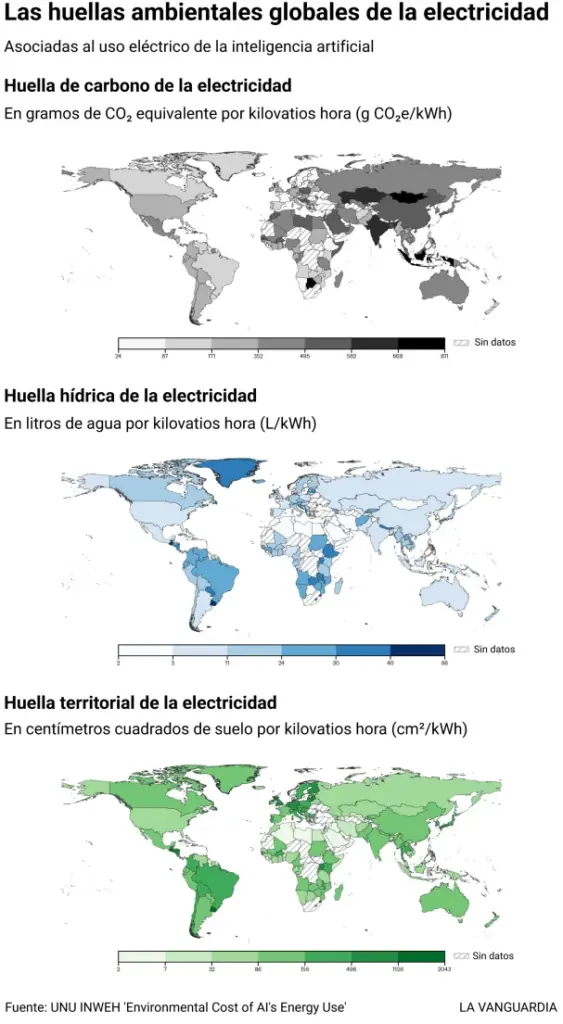
As the report explains, “each kilowatt-hour of electricity used to train or run an AI model generates an environmental footprint, including a carbon footprint derived from the energy matrix; a water footprint derived from electricity production and cooling; and a land footprint derived from energy infrastructure, reservoirs, and fuel extraction. These three footprints do not always vary in the same direction.”
For example, training GPT-3 consumed approximately 1.3 GWh of electricity over 34 days (which is what 340 families use on average over a year), while GPT-4 is estimated to have consumed between 50 and 70 GWh in 100 days, approximately 40 to 55 times more than GPT-3.
However, training is only part of the picture, as the operational footprint of AI is increasingly driven by so-called “inference” (the AI’s work to respond to queries). Once models are deployed, billions of daily interactions represent most of the energy consumption, and inference is estimated to consume between 80% and 90% of total consumption.
Training GPT-5… and especially its use
Training new AI models requires an enormous amount of energy. The 100 GWh of electricity needed to train Chat GPT-5 is roughly equivalent to the annual residential consumption of 770,000 people in sub-Saharan Africa (60% of the region’s population). The associated water footprint is estimated at 1 billion liters, and the land area occupied is 1.5 km², roughly the size of 215 football fields.
While these figures are significant, UN scientists warn that the footprint of daily AI use is much greater.
It is estimated that ChatGPT alone processes around 2.5 billion messages per day. With a conservative consumption of 0.42 Wh per message, this translates to approximately 383 GWh of electricity per year. The corresponding annual water footprint would equal the minimum annual drinking water needs of about 500,000 people in sub-Saharan Africa, and the land area occupied exceeds 800 football fields.
“The figures increase dramatically once AI integrated into massive platforms (such as Google Search) is included,” the report states. “It is crucial to highlight that energy consumption per use varies greatly depending on the mode and duration of output, so the product’s default settings and user choices are determinants of the energy footprint.”
Google processes approximately 5 trillion searches per year, and a conventional search consumes about 0.3 Wh. A generative AI search consumes up to 3 Wh, representing a tenfold increase.
Video generation as an emerging environmental crisis
Meanwhile, a single high-resolution AI video clip can require more than 415 Wh, making it a more energy-intensive process than creating hundreds of AI images. When resolution and frame count are taken into account, energy requirements soar. “And as video becomes integrated into widely used platforms, this quickly becomes a large-scale infrastructure problem.”
The report also highlights the growing generation of AI hardware waste. At the end of their life cycle, poorly managed electronic waste can expose the most vulnerable communities to hazardous substances. By 2030, AI infrastructure could generate up to 2.5 million metric tons of electronic waste per year, roughly equivalent to discarding 250 Eiffel Towers annually.
The findings demonstrate that responsible AI requires comprehensive governance of the value chain, from mineral sourcing to recycling and safe disposal.
Natural resources at stake
On the other hand, the minerals that power AI hardware are often extracted or exploited in ways that cause environmental and social harm, particularly concentrated in the global south and in regions with weak regulation or oversight.
At the end of their life cycle, poor management of electronic waste can expose the most vulnerable communities to hazardous substances. By 2030, AI infrastructure could generate up to 2.5 million metric tons of electronic waste per year, roughly equivalent to discarding 250 Eiffel Towers annually.
These impacts demonstrate that “responsible AI requires comprehensive governance of the value chain, from mineral sourcing to recycling and safe disposal.”
Spain, in a more favorable position
When addressing indicators on emissions and energy, the report highlights that Spain has a favorable energy mix for AI compared to the global average. Its electricity supply includes 51% renewable sources and 20% nuclear energy.
In the ‘sustainability ranking,’ which evaluates the top 20 data centers worldwide, Spain holds a mid-lower position regarding negative impacts: it ranks 15th in carbon footprint and 14th in water footprint.
The report cites the case of Ireland and issues a warning: data centers already consume 21% of the country’s total electricity and exceed the consumption of all urban households combined.
Unequal distribution and governance
To address these challenges, the report advocates for a responsible AI ecosystem based on six operational principles: transparency, efficiency by design, equity and environmental justice, lifecycle responsibility, global cooperation, and sustainable use.
On the other hand, there is structural inequality in the rise of artificial intelligence. Cutting-edge infrastructure is concentrated in a small number of locations. Countries lacking national processing capacity depend on external providers, giving them little control over access, prices, or data governance.
The result is a growing digital divide between nations that build and control AI systems and those that simply consume them and often bear a disproportionate share of environmental costs.