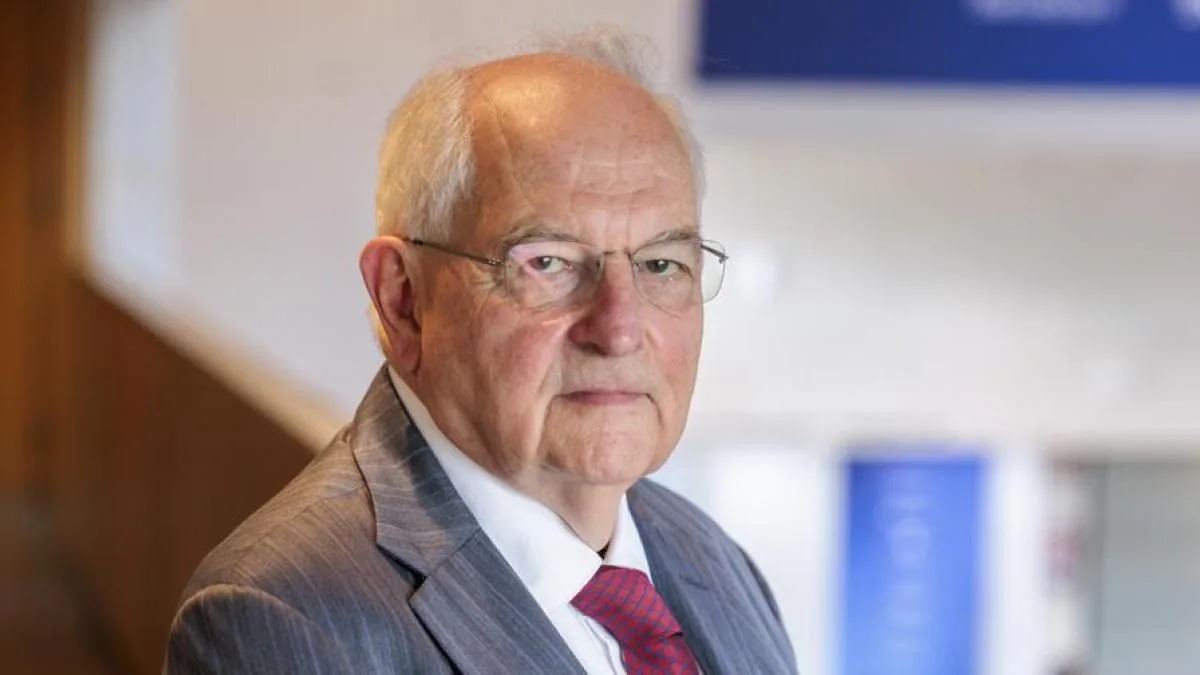
A critical Europeanist is defined. The British Martin Wolf (London, 1946) has received the European Construction award given annually by the Cercle d’Economia. His columns in the Financial Times have inspired the debate on the global economy for decades.
Technology
I am concerned that plutocracy will end up taking power by force from governments
Has Trump created a new economic order or is he the product of this change?
Trump’s presidency is the consequence. And it also makes things worse. It is anarchic, chaotic, and xenophobic. It destabilizes the economy, the world order, and now starts wars, something I did not expect. It coincides with what happened in the 1920s and 1930s in Europe, when anti-democratic politicians emerged who considered their opponents traitors, while they were the only ones embodying the true interests of the nation. Trump is destroying the rule of law, universities. He has created the most corrupt government in U.S. history, with a dictatorial megalomania in the purest style of Saddam Hussein. It is terrifying.
Where does the chaos we are living through now come from?
The fascist leaders of the interwar period in Europe were a consequence of the immense economic chaos that followed World War I. What has happened now is a radical change in relative economic power and competitiveness, associated particularly with the rise of China, which has been an unexpected consequence of globalization. No one in 1990 or 1980 expected this to happen on this scale and so quickly. This is associated with a wave of deindustrialization towards services as countries have become wealthier. Another decisive factor is significant increases in inequality in many countries, something related to technological changes, with skilled labor further undermining the position of people with lower educational levels. Then there have been some huge social changes, such as the complete transformation of the position of women and massive immigration.
And what is in common with the European interwar period?
And one of the things we know from experience — and the interwar period showed — is that when people feel uneasy, insecure, or worried, they tend to blame outsiders. We are tribal. Therefore, lower growth means, in an aging world, constant tax pressure because tax revenues do not increase, and governments are committed to the welfare state but fail to manage their budgets. And so the electorate opts for an opposition that has never had a role in politics and also says there is a simple solution. ‘It’s the foreigners’ fault, we will impose tariffs. It’s the immigrants’ fault, we will kick them out of the country. It’s the fault of transgender people or gays. We will kick them out of universities and return to how things were in the 1950s.’ That’s what MAGA is about. And other nationalist, populist movements.
And how will this end?
With a public finance crisis. The situation seems unsustainable. One of the differences between the 1920s and 1930s and today is that the parties leading now do not resemble, let’s say, fascists or the Nazi Party or the army. They are not militarized parties. They do not seek wars, in theory. But the Trump administration’s attack on the EU, on modern European values, has been quite a surprise.
Does Europe need to be refounded?
Europe was created within that postwar liberal order and starting from it. It was created to leave its history behind. Today it finds itself in a world with two destabilizing and threatening superpowers. Moreover, the European economy depends more on trade, on imported energy, and is less capable of guaranteeing its defense. These are existential changes.
Read more Iran responds to U.S. attacks by firing drones and missiles at Kuwait airport
Brexit
The last thing the EU should do is renegotiate a return of the United Kingdom: it would be a huge distraction right now
What should the plan be, in your opinion?
There is no plan with significant political backing. I mean people like Mario Draghi have presented plans. But if we look back to the 1940s and 1950s, the plans then came from figures who had the unconditional support of the leaders of Germany, France, and Italy. And so they built, founded, signed the Treaty of Rome, and launched the EU. Then it was the EC, but it became the EU. If we look at the 1980s, in response to stagnation, they created the single market with the enthusiastic participation of Thatcher and the single currency. And they did it within 10 years. What strikes me is that since Maastricht, there have been no political leaders with that authority. There is no De Gaulle, no Adenauer, no Kohl, no Mitterrand. And Von der Leyen is not Jacques Delors. There are many good reports, good documents, but no vision when the EU has to integrate more. Genuine fiscal competencies must be created at that level. You cannot manage a federation with a budget that represents 1% of GDP. You cannot have a common capital market if each country regulates its own capital markets. You cannot compete with the U.S. and China in new technologies if markets remain as fragmented and regulated as they are now. I am really, really worried about what the future of Europe will be and if the EU ends up opting for populist, nationalist, often racist politicians, deeply protectionist, very ignorant economically and very incompetent, like Trump, and who cause a lot of damage.
Is Brexit reversible?
I think it would have been better for Britain if we had voted the other way in the Brexit referendum, and that could easily have happened. It was very close. By now, of course, most Britons consider it a mistake, which is quite obvious. But why did it happen? Social change, deindustrialization, the collapse of the working class, or then the financial crisis, which was especially hard for Britain because finance was such an important part of our economy. Austerity made it worse, a huge mistake. So Brexit was a protest vote. Nothing to do with Europe. The only thing related to Europe was immigration, and most of the immigrants that really worried people were not European. But this was their chance to vote. And it happened that, due to the eurozone crisis, one of those accidents of history, there was a big increase in immigration from the EU. So they voted against immigrants. Now, I do not see a return in the near future. It would require an overwhelming consensus that we must go back because disputes would only drag on endlessly. In my opinion, renegotiating would involve even tougher negotiations than those we had to leave. And that would be very harmful to us, as well as a huge distraction for the EU. So if I were running the EU, given the crises we face now, I would say the last thing we want to do is renegotiate Brexit. What we can do is work to get closer to Europe on defense. And we are already doing that.
Should we fear technological plutocracy?
A lot depends on how real the impact of AI is. We can imagine a world where there are essentially pure private robotic armies that give individuals the power of states. And, in fact, if we look at what is happening in the war in Ukraine, if we look at Musk’s role as an internet and information provider, there is a shift from infantry warfare to drone warfare.
And?
One of the things that worries me is not only that plutocrats have enormous wealth, but that they could be able to control, individually or collectively, armies that are incredibly powerful. The coercive apparatus moves away from the state and democratic control. Now, this is a kind of science fiction, as if we said: ‘No, this is going too far,’ but we have to start thinking about it.
Read more Anthropic invites European Union governments to test the Mythos AI model