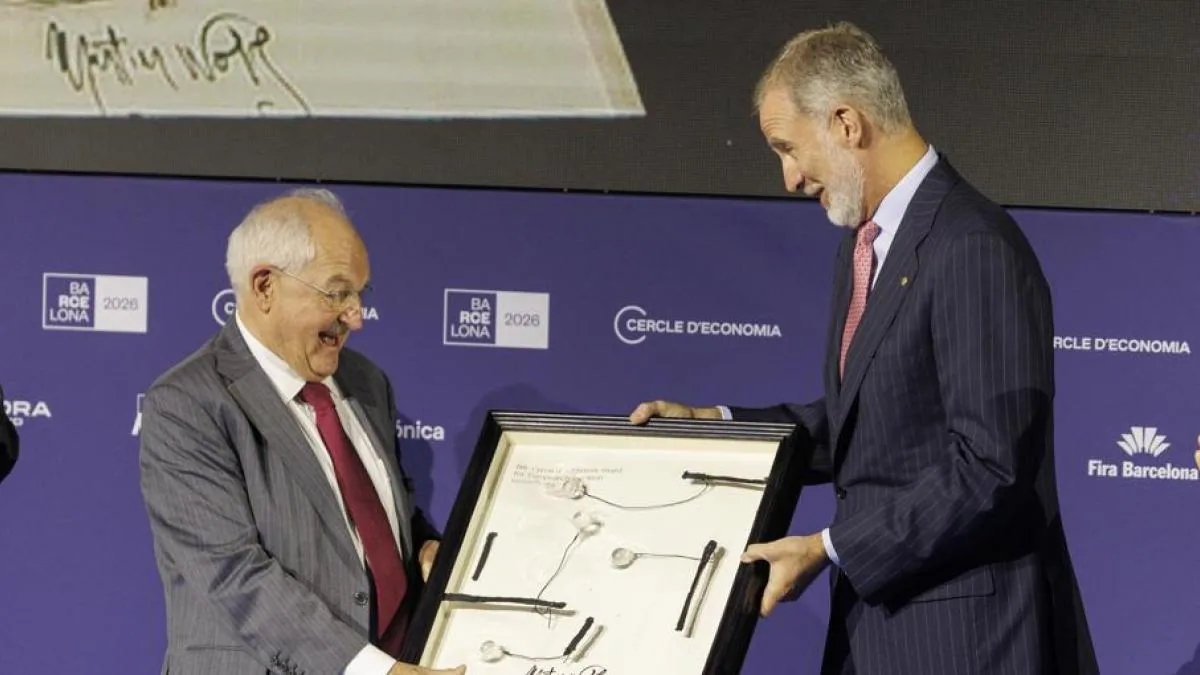
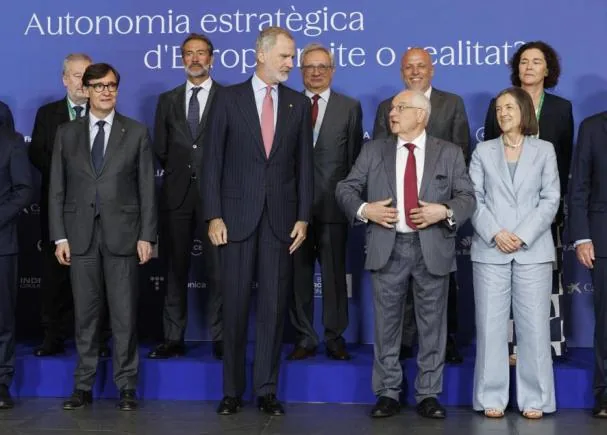
The King entered this Tuesday the plenary hall of the Palau de Congressos in Barcelona welcomed by applause, surrounded by the president of the Cercle, Teresa García Milà, and the president of the Generalitat, Salvador Illa, and urged Europe to wake up and regain its pride above the criticisms it receives in these turbulent times. “To the most skeptical, it should be reminded that one of the constants of the construction of united Europe has been to make real what seemed a distant aspiration, even a utopia. The whole integration process has been a journey from the improbable and extremely complex to the real and tangible.”
Read more Instrumental motion of no confidence or act of faith?
The monarch recalled, as an example, the European reconciliation between former adversaries after the war conflict; the construction of the common market; the creation of the single currency and the successive enlargements, which have allowed the creation of a space of prosperity in Europe.
Felipe VI recalled that Spain’s European vocation is one of the great political consensuses that endure
Likewise, at a time of rise of radical political movements and the resurgence of nationalisms, the King took the opportunity to remind the attendees that Spain “has a fully European vocation” and that this aspect is “one of the great political consensuses that still today endure with greater strength in Spanish society,” without forgetting that “Spain has also contributed and, in many areas, led the advancement of the common project.”
This defense of Europeanism served to accompany the award ceremony of the Cercle d’ Economia prize for European construction to Martin Wolf, chronicler and co-editor of the Financial Times newspaper. The award has previously been given to other prestigious names and institutions in recent European history, such as Mario Draghi or Ursula von der Leyen or the Erasmus program, among others.
Martin Wolf believes that after Brexit, without the United Kingdom, Europe now finds it easier to reach consensus for greater integration
The president of the Cercle d’ Economia, Teresa García Milá, described Wolf as “an unconventional Europeanist, but critical, from intellectual independence and rigor, who has never said what is comfortable, but what had to be said.” Milá considered that the famous journalist embodies “the type of public debate that Europe needs to make good decisions at a time when there are great challenges, because he himself has not been afraid to be unpopular.”
Read more The Government approves record advance payments of 157 billion for the autonomous communities
The journalist and regular contributor to this newspaper, John Carlin, in charge of presenting the awardee, dared to make a metaphor with the Barcelona football club: “Martin Wolf is more than a journalist. His articles are dedicated to the cause of freedom and truth. They hold a warm moral force behind the coldness of the data, against noise and childish populism, with the aim of serving his readers.”
Martin Wolf received the award visibly moved, saying he was living “one of the most overwhelming experiences of my life.” The journalist, showing English humor, said he was surprised to learn he had been awarded. “I thought they had made a mistake considering the level of the predecessors. And on top of that to a Brit, although pro-European.” He recalled the many times he was critical of the EU. “I said, for example, that the Maastricht treaty without fiscal and political unity would be very fragile. The award shows that you consider critics useful. And this is the sign of a democratic and liberal society.”
For Wolf, Europe is characterized by three elements: repudiating nationalisms like those that arose in the twenties, repudiating totalitarianisms, and third, democracy, freedom, and cooperation. He also took the opportunity to criticize his country, the United Kingdom. “Brexit was a big mistake, but this will make it easier for the rest of the EU to carry out the greater integration it needs.”
The journalist concluded with a warning. The EU is a great achievement, but what worked in the past will not work in the future. Europe is falling behind in technology, is in relative decline and aging, the friendship and relationship with the U.S. is gone. What can be done? “Europe must be defended from predatory China and U.S. protectionism. For this, a higher community budget is needed. Not deciding can be worse, in a world with the rapid rise of authoritarianisms.”
Read more Spain can withstand the energy ‘shock’ from Hormuz if it does not last too long