









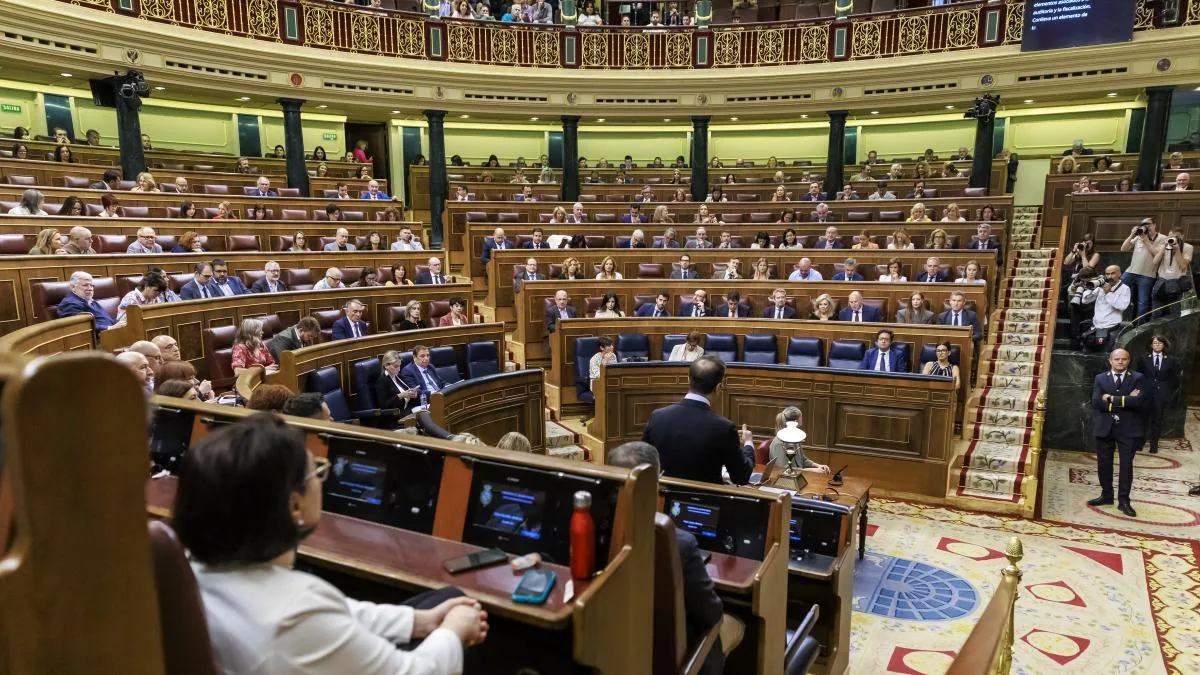
The Popular Party has been pressuring Junts and the PNV for months to join their votes with those of the PP and Vox and support in the Congress of Deputies an “instrumental” motion of no confidence, with Alberto Núñez Feijóo as the candidate for the presidency of the Government. The motion of no confidence is a mechanism that the law provides to withdraw confidence from the president, in this case Pedro Sánchez, and yesterday Feijóo specified his offer to the two nationalist parties: the motion would be to accelerate the call for elections and in the government appointed once he is elected president, Vox would not be included. But nothing guarantees that these two conditions – elections in the short term and a government without Vox – will be met. It is rather an act of faith requested from the two parties.
Read more The Government approves record advance payments of 157 billion for the autonomous communities
And this is so because, in fact, there is no such thing as an instrumental motion of no confidence as a parliamentary formula for deputies to withdraw confidence from one president and give it to another to call new elections. That’s clear. The commitment between the parties that these elections will be called only works as that, an agreement between politicians, which may or may not be fulfilled, as happens many times. Just like Feijóo’s offer not to govern with Vox. Once the president is elected, he has the power to appoint whoever he wants to his Council of Ministers, without the obligation to submit this decision to anyone else’s judgment.
The motion of no confidence in Spain is constructive in nature, it is not about simply overthrowing a president
The formula that does exist in Spain, for the Congress to withdraw confidence from a president and give it to another, is the motion of no confidence, nothing more. It is a constitutional mechanism, provided for in article 113, by which the Congress of Deputies, which once gave confidence to a president of the Government by voting in favor of his investiture, decides to withdraw it. Unlike the vote of confidence, an initiative that comes from the president of the Government, to confirm that he maintains the confidence of the majority of the Chamber, the motion of no confidence is initiated by the deputies and requires the support of the absolute majority of the Congress: 176 votes in favor, half plus one of the 350 deputies.
Feijóo needs the vote in favor of 176 deputies. He counts on those of the PP (137), Vox (33), UPN (1) and Coalición Canaria (1), which add up to 172. He is four short. Hence he seeks the support of Junts (7) or the PNV (5). He needs them to vote yes to his investiture, abstaining is not enough.
Read more Spain can withstand the energy ‘shock’ from Hormuz if it does not last too long
In Spain the motion of no confidence is constructive in nature. That is, it must include an alternative candidate for the presidency of the Government, in this case, Feijóo. It is not about simply overthrowing a president and seeing what happens. The motion of no confidence takes place in a plenary session of the Congress, in which this alternative candidate ideally must present his Government program. Because this formula is provided, if it passes, to invest a new president, who will appoint his government and implement the program he has defended. And he can maintain that government until the end of the legislature, in 2027. Then he would indeed be obliged to call new elections, just as Sánchez is.
This formula of the motion of no confidence provided in the Constitution can be labeled as instrumental, just as it could be labeled any other way, for example electoralist. It is said to be instrumental to indicate that it seeks a different objective than the one for which it is intended, that is, it serves as an instrument for another purpose. This purpose can be to call elections, but not only that.
Let’s see another example of an instrumental motion of no confidence. To be invested president, Feijóo needs the vote in favor of 176 deputies. He has 172 and hence seeks the support of Junts (7) or the PNV (5). He needs them to vote yes to his investiture, abstaining is not enough. But Feijóo could negotiate with Junts and the PNV their abstention. It would be more comfortable for both parties than voting against. Voting against Feijóo implies, by the mechanism of this formula, that they maintain confidence in Pedro Sánchez – and both parties have asked him to call elections, that is, not to end the legislature -. If the PP managed to get Junts and PNV to abstain, it would mean removing these 12 votes from the final result. Feijóo would still have only the support of 172 deputies, but that would be more than the remaining 166 who, by voting no to Feijóo’s candidacy, would be in favor of Sánchez’s continuity. It would also be an instrumental motion of no confidence, since it would serve to show that the PP leader has more support than the president, if that were the case.
Read more Barak Ravid, the Israeli journalist who dominates the exclusives of the Iran war