Bogotá —where the popular neighborhoods massively voted for the leftist candidate Iván Cepeda— woke up yesterday to the reality of the new politics of heart-stopping surprises, “ultra” presidential candidates emerging from nowhere, and snowballs driven by social networks.
Read more The witnesses say that the Sant Roc gunman shot the minors
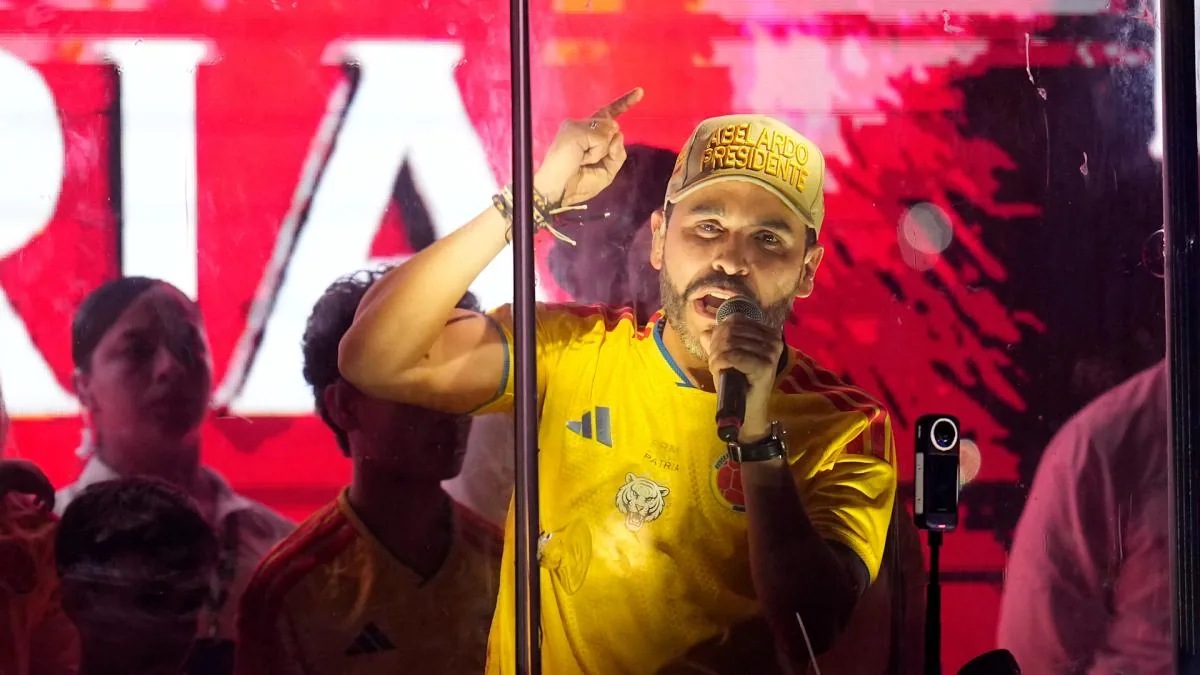
With 10.3 million of the 23.7 million votes cast, the hard-right candidate Abelardo De la Espriella, 47 years old, an outsider with incendiary rhetoric and some ties to paramilitarism from the dark past, achieved a surprising victory in the first electoral round on Sunday. The Trumpist billionaire lawyer, who lives between Bogotá, Miami, and Florence, secured almost 44% of the vote, well above the polls.
He will face Iván Cepeda, candidate of the progressive coalition Historic Pact, founded five years ago by the charismatic leftist president Gustavo Petro, in the second round of the presidential elections on June 21. Cepeda, who had led the polls and even considered winning in the first round, obtained 9.7 million votes, 41% of the quick count in a first round that, despite having 13 candidates, turned into a battle between two.
In what seemed like a political maneuver, Petro and Cepeda did not recognize the initial result due to a discrepancy regarding the count published before the official scrutiny. But consulted jurists accepted the results as valid. “Not recognizing the count has a political motivation, not a legal one,” said expert Rodrigo Uprimny.
In elections of enormous significance inside and outside Colombia, the three weeks before the second round will stage an epic confrontation of two worldviews.
On Cepeda’s side, a Gramscian philosopher whose father was murdered by anti-communist paramilitaries in 1994: the defense of social justice and a negotiated peace with armed groups still active in the Colombian countryside, a program already initiated with debatable results by Petro who, as his critics insist, has left a fiscal deficit above 6% and still endemic violence in parts of the country.
On the other, the hard hand and Darwinian capitalism defended by the billionaire lawyer, who has not refused to represent clients linked to drug trafficking, financial scandals, and organized crime.
“De la Espriella is already the favorite, but it is not guaranteed that he will win because both candidates can attract more votes,” said political scientist Alejo Vargas in an interview with La Vanguardia. With close ties to the Republican right in Miami, where he lives part of the year thanks to having U.S. citizenship, he will also benefit from Washington’s interference already occurring in these elections.
Read more Teachers, doctors, Rodalies and politics
Alejo Vargas: “De la Espriella is already the favorite”
More than Cepeda’s weakness, De la Espriella’s success is due to the poor result of Paloma Valencia, the candidate of the Democratic Center of former president Álvaro Uribe, who presented herself as the voice of the center-right with a more moderate discourse and a technocratic and gay vice-presidential candidate, Daniel Oviedo. Valencia got less than 7% of the votes.
Although this is defined in the media narrative in Colombia as the “defeat of Uribismo,” it does not take much Machiavellianism to think that Uribe has bet on two fronts. Valencia gave a speech on Sunday that seemed victorious. “I support Abelardo de la Espriella to end communism and neo-communism!” If the plan works, and Valencia’s 1.6 million votes transfer to De la Espriella, a victory for Cepeda will be almost impossible.
Petro and Cepeda did not recognize the initial result, but jurists consulted by ‘La Vanguardia’ accepted the results as valid. “It has a political motivation, not a legal one,” said expert Rodrigo Uprimny
De la Espriella has created a new Colombian franchise of the flashy ultra-populism brand by copying elements from Donald Trump, Jair Bolsonaro, Javier Milei, Nayib Bukele, and Daniel Noboa: aggressive use of social media, patriotism with yellow football team jerseys, exaggerated military salutes, incredible promises to build mega-prisons for criminals in the Amazon jungle, and an aspirational discourse aimed at young people of the new Uberized economy.
But for voters in popular neighborhoods and peripheral areas of the country benefiting from the 23% minimum wage increases, more than a novelty, De la Espriella represents a sinister past. “In the TransMilenio (rapid bus) this morning there was total silence,” says Karolina, a young resident of the Bosa neighborhood, in the working-class south of the city, where hundreds of thousands of low-income Colombians live, many displaced from guerrilla and paramilitary violence zones. “I am not a leftist, but I am from Montes de María (area of paramilitary massacres) and that man will take us back to the past,” she added. De la Espriella spent his childhood and youth in a municipality near Montes de María,
Cepeda has two paths to a difficult victory. First, mobilize those who did not vote. Record participation —almost 24 million, 57% of the electorate—in a country of 50.5 million is expected to increase even more in the second round. The bad news for the Historic Pact is that De la Espriella, who created a new subject of “never voters” to try to attract voters disconnected from the system, seems to have benefited from the high turnout.
The other path would be to take advantage of the enormous rejection De la Espriella generates in a significant part of the electorate. Bogotá —according to campaign organizers, who commented on the result with worried faces on Sunday night— will be the main ground for seeking the necessary votes. The Petro candidate won in the capital with 42% of the votes against 37.5%, and is expected to win the 200,000 votes of former mayor Claudia López. The million voters of Sergio Fajardo, former mayor of Medellín, will also be negotiated. “Cepeda has only made a speech for his people, the working classes; he has to offer something to the middle class, people like me,” said Vargas.
Read more The first witnesses deflate the accusations against David Sánchez