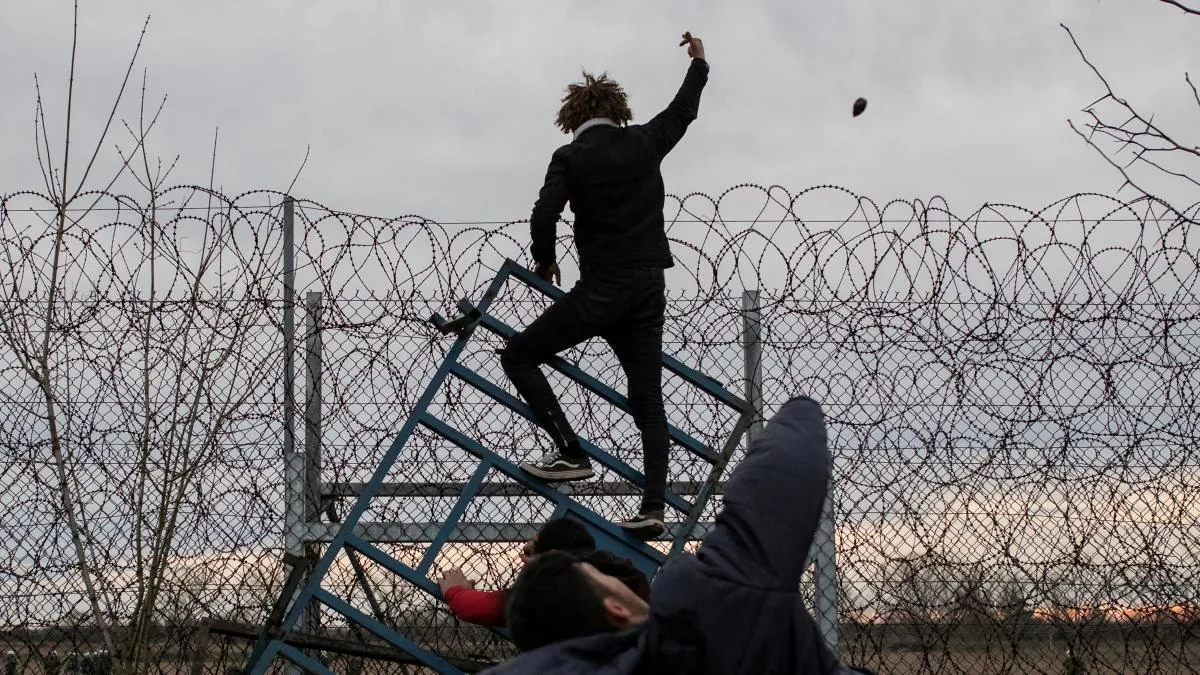
Europe confirms its new tough migration policy. While the European Parliament and the European Council have just given the green light to the final EU returns regulation that endorses the creation of migrant deportation centers in third countries, some European countries do not want to waste any more time on bureaucratic processes and have gotten to work. Following the lessons of the Italian Giorgia Meloni in Albania, several capitals are grouping into small teams within the Twenty-Seven to probe other countries in Africa, the Balkans, or Central Asia where they can create agreements similar to the one between Rome and Tirana.
Read more Trump pressures Netanyahu to “postpone” attacks on Beirut
For now, this is not an initiative at the level of the Twenty-Seven, but they are moving at lower levels, between two and five countries favorable to the so-called “innovative solutions,” diplomatic sources told La Vanguardia. The intention is to start exploring with those who are most willing to implement this system, which is heavily criticized by humanitarian organizations. In other words, to follow the philosophy of a two-speed Europe, but this time to speed up the returns of migrants who are considered not to have the right to asylum. The European Commission has created the legal framework to support the centers, but it will be an individual matter for each Member State to reach agreements to implement them.
The Meloni route
Italy, with its Albanian solution, remains on the sidelines for now
Italy is on the sidelines, as it has its own initiative in Albania awaiting the judiciary to allow Meloni to continue with her plan across the Adriatic. But the leader of Brothers of Italy is not the only one leading the heads of state calling for tougher immigration policies. Alongside her, when organizing meetings of like-minded countries on the margins of the European Council, is always the Danish Mette Frederiksen who, despite being a social democrat, vigorously promotes this type of policy among her counterparts in Brussels.
Germany, the main European economy, initially hesitated about these types of centers, but now views them favorably. Austria and Greece are also very interested in this formula. The case of the Netherlands is interesting, where the progressive liberal Rob Jetten has just formed a government but maintains a restrictive approach to migration similar to the previous one, although with a less hostile approach to Brussels.
Also read
Last week, its Minister of Migration and Asylum, Bart van der Brink, sent a letter to the Dutch Parliament, published by Politico, where he gave the green light for the Chamber to approve these “solutions” to process asylum applications outside European borders and assured that deportation centers have proven to be “legally viable.” The Dutch government has not yet announced where it wants to place a camp to process asylum applications, but it is already working hand in hand with Denmark, Sweden, or Malta.
Read more Starmer’s name does not appear at all in Mandelson’s papers
Countries interested in the new “innovative routes” want to seek an approach that is attractive, offering in return visa facilitation or even greater trade cooperation. The problem remains, to date, finding places willing to follow Albania and host these structures. In Brussels, no one dares to mention a name directly, for fear of burning it. Some European political leaders have indicated that the centers could be located in Africa, without specifying particular states. Tunisia has been mentioned in some reports, and Uganda was considered in previous Dutch ideas, although Jetten seems to have abandoned this project.
Devastating figures
Arrivals have dropped by 40% but 1,200 people have died in the Mediterranean in 2026
The Spanish position is completely opposed to this migration approach, but the viewpoint of Meloni and Frederiksen is already predominant in Europe, with a majority of conservative countries and a European Parliament more to the right than ever. After Monday’s approval, the new returns regulation, still pending formal ratification, will not only endorse centers in third countries but, according to humanitarian organizations, will further tighten the conditions for asylum seekers.
According to the text agreed upon tonight, countries will have up to twelve months to apply some of the more complex rules of this new regulation, which introduces “a European return order” to facilitate coordination between states in deportations. Another novelty is the extension of detention times, up to 24 months plus an extension of another six.
The argument of supporters of this regulation is that only 28% of migrants who do not have the right to remain on European soil are effectively deported, so the EU wants to improve these statistics. However, according to Frontex, in the first months of 2026 irregular migration has decreased by 40% across Europe due to a combination of factors, including greater cooperation with countries like Tunisia, “preventive measures in key departure states,” and difficult weather conditions. The total number of irregular arrivals is reduced, but the human cost remains devastating. According to the International Organization for Migration, more than 1,200 people have lost their lives in the Mediterranean so far this year.
Read more Trump says negotiations with Iran are underway again after Israel’s commitment not to attack Lebanon