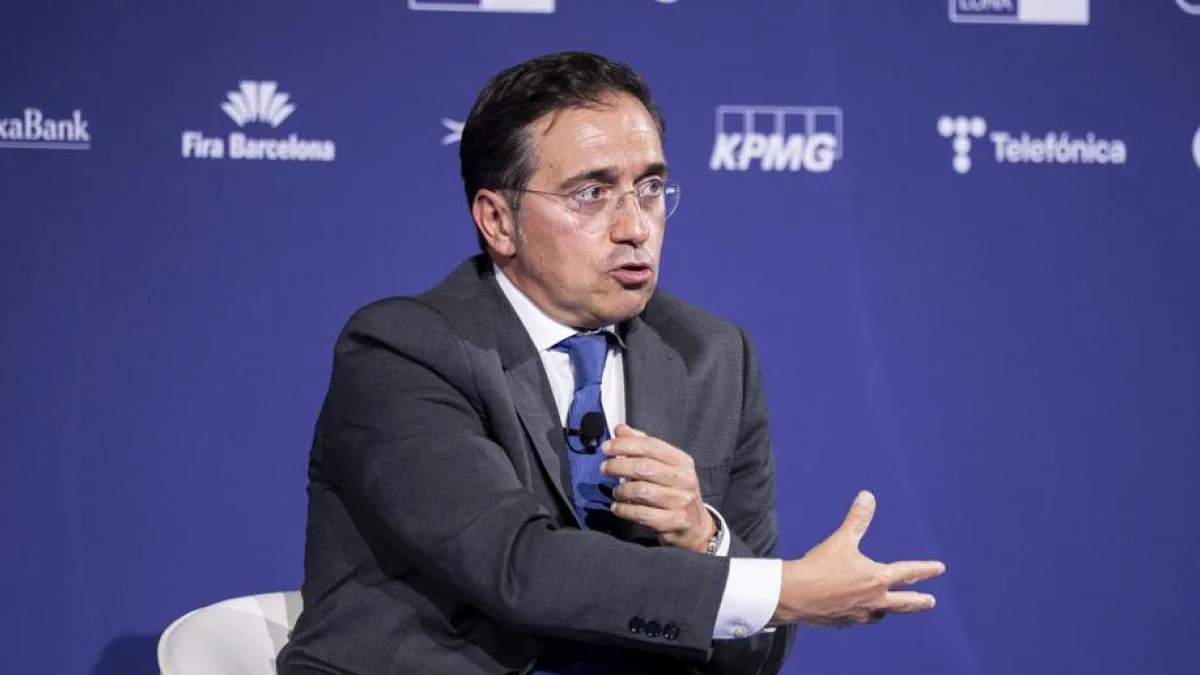
“We are at a decisive moment. We must go beyond autonomy and move towards sovereignty.” This was expressed by the Minister of Foreign Affairs, José Manuel Albares, on the occasion of the first day of the Annual Meeting of the Cercle d’Economia. According to Albares, “Europeans must guarantee security in a broad sense, and for that, a federal leap is needed. It is not ideas that we lack, but the will to put them into practice. We must remove obstacles from the internal market, particularly the capital market, and finance innovation in Europe so that it is not in the hands of foreign companies.”
Read more Finance summons the autonomous communities to meetings to agree on the reform of financing
The union of the capital market and common European defense must become an economic priority
Radoslaw Sikorski, Deputy Prime Minister and Minister of Foreign Affairs of Poland, also expressed the urgency of developing a European economic fabric in the military field, especially in a context where the United States threatens to disengage from NATO. “European strategic autonomy must be developed in harmony with that of the U.S. But the reality is that we still do not have sufficient capacity to produce. Poland spends 4.8% of GDP; we need a national industry not only for drones but also for technological software. Napoleon already said that if you do not feed your industry, you will feed that of another country. Therefore, it is time for a large part of contracts to start being transnational. And not only with drones, but also with missiles.”
At the institutional level, both Spain and Poland believe that the veto right must be reformed
In this regard, the two ministers, moderated in a roundtable by IESE professor Jordi Gual, cited the example of the European industrial model of Airbus, a European consortium of different companies that can serve as a breeding ground to launch a genuine pan-European defense sector on a large scale.
Still in the military field, both Albares and Sikorski stated that the conflict in Ukraine is taking a toll on the Russian economy. He thought it had the second-largest army in the world. “They are losing ground. 30% of their refining is blocked. Today the war is governed by different people than at the beginning,” said the Polish diplomat. “Oil prices are high, but you have to bring the oil to the market. Today we are controlling the Russian fleets in the shadows. Iran was an ally of Russia and now is a weaker country. The alliance is in question. Russia is unable to help Iran. And Iran also cannot export goods to Russia,” he added.
Read more Abelardo De la Espriella, the controversial tiger who has made a swipe in the elections of Colombia
“The war in Iran has had the effects of raising the price of oil, which has benefited Putin, in addition to the consequences of the Strait of Hormuz effect. These circumstances may prolong the status quo of the war in Ukraine. But we have twenty sanction packages that have structural damages that cannot be compensated by these factors,” Albares indicated.
Both politicians welcomed that Hungary’s new political course has been able to unblock aid to Ukraine. At the same time, they agreed that, looking ahead, it is not only necessary to overcome the veto rights blockade but also to implement mechanisms that prevent a member state from stopping decisions without a genuine national interest justifying it. According to Albares, this would apply to the veto on Catalan as an official language in Europe, but also to other European matters.
“Requirements for permanence must be established to avoid using unanimity against EU values. European values of tolerance and pluralism are even more important than the deficit rule,” said Albares. Sikorski was even clearer: “We need mechanisms that apply to member countries if they break the rules they agreed to when joining.”
Read more Illa offers 3.3 billion in infrastructure investments with concession systems