After two months of high-voltage community drama, billions in European eurobonds can now begin to reach Ukraine. The EU formally unblocked this Thursday the 90 billion loan that had been held up until now by the still Hungarian Prime Minister, Viktor Orbán. With the elections lost and Russian oil flowing to Budapest, Hungary has raised no further objections, and European leaders are now beginning to turn the page, now facing the next challenge: opening the first round of negotiations in Ukraine’s EU accession process.
Read more Trump says he will keep Hormuz “sealed” until Iran gives in to a deal
The good news was celebrated in Ayia Napa, a coastal town on the southern tip of Cyprus. “Now is the time to look to the future and prepare the next step, and the next step is to officially start the first rounds of negotiations for Ukraine’s accession to the EU,” said the President of the European Council, António Costa, at the port where European leaders are already gathered for an informal summit that was supposed to focus on the crisis in the Middle East, but which ended up being the scene of the resolution of a blackmail with high repercussions.
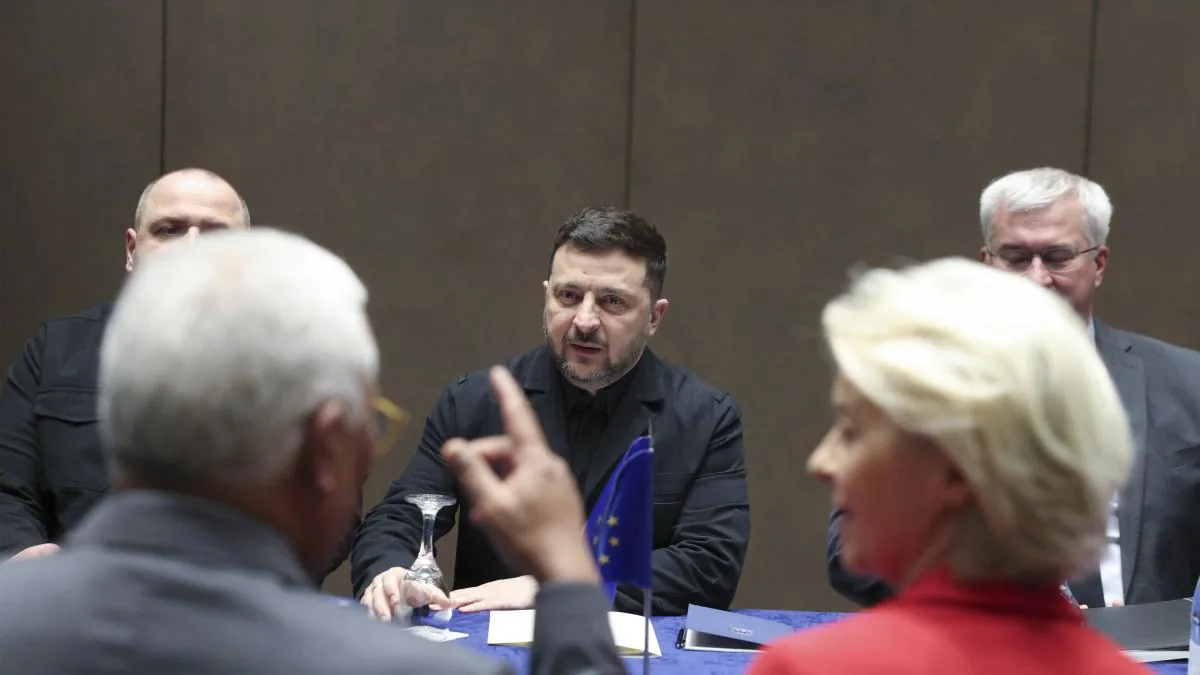
After seeing the last-minute developments, Ukrainian President Volodímir Zelenski, who was scheduled to participate in the first session of the summit via videoconference, decided to come in person. “These funds will allow us to boost defense production and protect the energy system for winter,” celebrated the leader of the war-torn country after a meeting with Costa and the President of the European Commission, Ursula von der Leyen. “I said we were going to deliver the loan one way or another, and we have kept that promise,” applauded the German.
Without Orbán among the Twenty-Seven —the acting prime minister decided to snub his counterparts at his last summit and stay in Budapest—, there is also, a priori, no objection for Ukraine to advance in its accession process as a candidate country to join the bloc. The Hungarian prime minister, Vladimir Putin’s best ally in the European Council, had also blocked the opening of the first chapter of negotiations, something that must be agreed upon unanimously.
Read more Portal de l’Àngel in testing phase
Orbán’s departure
“With new circumstances, perhaps we can move forward with other things previously blocked,” Kallas celebrates
“We now have new circumstances, so perhaps we can now move forward with other things that have been blocked before,” said the EU High Representative for Foreign Affairs, Kaja Kallas, before the meeting.
Now, Ukraine, and some allied countries like the Baltics, are asking for a fast track. “We must seize the momentum and pressure Russia,” said Estonian Prime Minister Kristen Michal. “Countries that have made a great effort should be EU members as soon as possible,” launched Lithuanian Gitanas Nausėda. However, others are not so clear and ask to follow the merit-based process like the rest. Luc Frieden, Luxembourg’s Prime Minister, was blunt: “Ukraine belongs to the European family, but to be an EU member, a series of conditions must be met,” he warned.