The “Spain case” continues to make headlines worldwide. A few weeks ago, the firm stance of the Spanish Government against the start of the Iran war became a reference point. It seemed like the brave culmination of a calculated strategy to distance itself from the postulates and demands of the President of the United States, Donald Trump. The head of the Spanish Government, Pedro Sánchez, was on the rise, seeming to dare to say what other European politicians keep silent about.
Read more How did we get to Zapatero?
A year ago, Sánchez said no to increasing military spending to 5% of GDP. Trump flew into a rage, and the leading European power, Germany, took it badly, since rearmament is its main strategic and industrial bet. Sánchez’s pacifism could inflame young Germans reluctant to military service. Sánchez was outlining an autonomous doctrine in foreign policy whose only conservative line was and is maintaining an excellent relationship with the Kingdom of Morocco.
A series of police and judicial actions breaks the cultivated image of progressive Spain
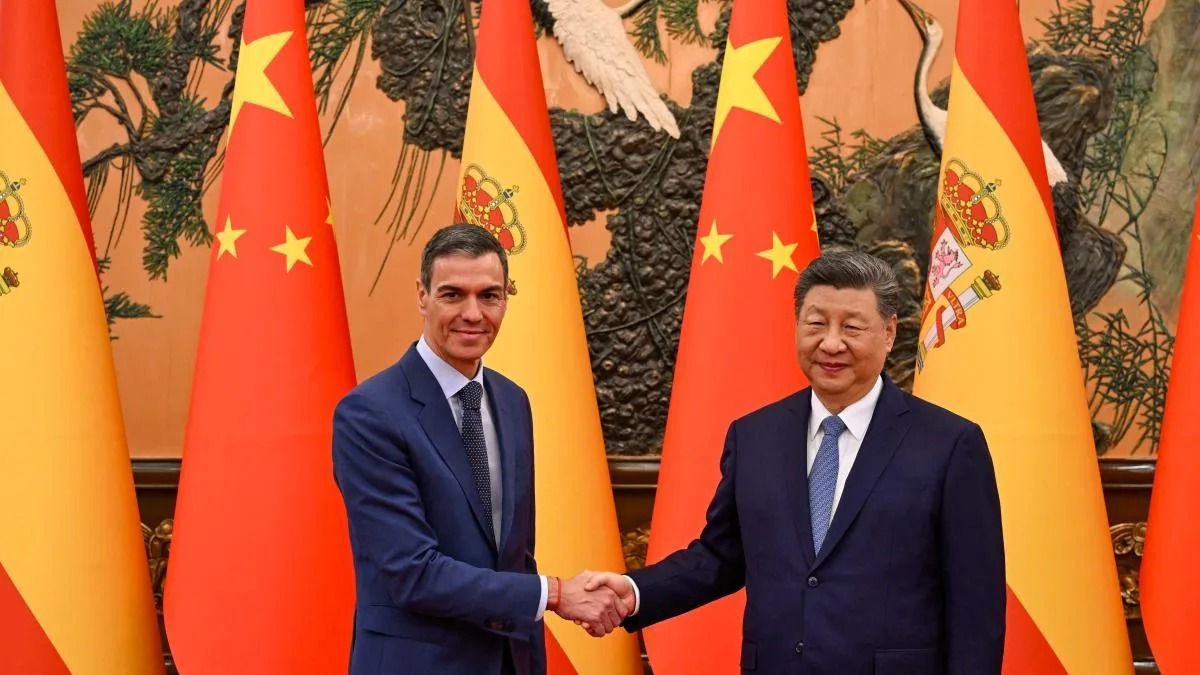
They said no to Trump on key issues, economic and trade relations with China intensified – China is the key chapter of everything that is happening –, GDP growth was showcased as a distinctive credential, a global summit of progressive leaders and parties was convened in which Pedro Sánchez and José Luis Rodríguez Zapatero appeared alongside the two main exponents of the Latin American left, Claudia Sheinbaum, president of Mexico, and Lula da Silva, president of Brazil, in Barcelona.
A real festival, until the catacrock that was heard even at the other end of the world arrived. A moral setback that will be very difficult to overcome. Leading figures of the Spanish progressive left could end up in jail depending on how ongoing police and judicial investigations evolve.
Spain’s commercial opening to China is at the center of tensions with the United States
The Zapatero crater and the amazing story of Leire Díez, a young journalist from Bilbao apparently ready to move a counterattack cell, resorting to the immense audio archive of Commissioner José Manuel Villarejo, a true enriched uranium processing plant in Spain. Whoever approaches Villarejo loses their hair. “In that archive, there is material to bring down the Spanish political system three times,” a relevant person who had some knowledge of the documentation accumulated by the former Police commissioner told me more than seven years ago.
Every time the PSOE crosses a dangerous line, it falls flat. It never fails. It happened in the 1990s and could happen now with consequences more adverse than in the final phase of Felipe González. There are scenes and energies these days that recall those moments. Coffee, lots of coffee.
A U.S. federal security agency opened the Zapatero case, giving valuable clues
Today we are not talking about state terrorism, however. We are talking about Venezuela and China, especially China; about energy; we are talking about the relations that the PSOE maintains with the elite units of the National Police and the Civil Guard. We are talking about the party that accelerated the end of ETA, the Spanish Socialist Workers’ Party that has granted pardons to Catalan politicians imprisoned for the events of October 2017 and that later transformed the pardon into an Amnesty law. All forgiven, all inside.
What is happening in Spain?, many foreign journalists sent to Madrid to try to understand something ask these days. Answer: Spain has been governed for the last eight years by a more or less stable alliance of the Socialist Party, a party of subordinate classes with contacts with the State, with mesocratic groups speaking Catalan, Basque, and Galician. How long can Spain be governed without the active support of Madrid DF? Answer: eight years, maximum.
Read more ZP, between the ‘sagacity’ of the UDEF and the love of money
Meloni did not want to receive Sánchez this week; in Italy they remember the Craxi case in 1993
It is public and not a footnote. A U.S. federal intelligence service has opened the Zapatero case. The Homeland Security Investigations (HSI) managed to decode the mobile phone of a suspected Venezuelan businessman and provided fundamental clues to the Spanish police. All European foreign ministries have taken note: Trump’s United States can carry out intelligence actions that take down previously targeted European politicians.
Former President Rodríguez Zapatero is politically dead today, and Sánchez has the legislature in flames. Milanese readers of Corriere della Sera have thought that Zapatero is a jewelry thief upon seeing photos of the material seized from his safe, whose origin has not yet been proven to be criminal. In Italy, these days they remember the lynching of Bettino Craxi in 1993. The Italian Socialist Party ended up dissolving.
Reverberation in Portugal; police raid against PS cadres for alleged corruption
What is a socialist party in Europe today? The PSOE was refounded in 1974-1977 to stabilize Spain in the final stretch of the first Cold War. If the PSOE acts as an autonomous agent in the second Cold War, it may suffer serious setbacks. Here they are. Last Thursday, the U.S. ambassador to Spain, Benjamín León, gave his first lecture in Madrid. He lamented that Sánchez has not yet received him and stated that Spain is conducting commercial transactions with China that are dangerous for Western security. He referred especially to the technology company Huawei. Clearer than water.
As a reverberation of what happened in Spain, a police raid has just taken place against cadres of the Portuguese Socialist Party accused of corruption. In 1976, when Portugal’s stability depended vitally on the PS of Mario Soares, that raid would not have happened. Are European socialist parties ceasing to be functional to the new needs of the system? If so, they can fall like little birds.
Also read
Last Wednesday, Sánchez traveled to Rome to be received in audience by Pope Leo XIV, who will soon visit Spain. He had time, and his services sought an interview with Prime Minister Giorgia Meloni, who ultimately did not grant it, as reported by Francesco Olivo, correspondent of La Vanguardia in Italy. Meloni was politically sunk a month ago; today she does not want to see Sánchez so as not to upset Trump.
Socialist Party cadres cannot feel protected as they did twenty or thirty years ago. We are in a new world. This is not rhetoric.
Read more Former politicians active in the private sector rise sharply in two years