No, I also did not read the 42,300-word encyclical from the Pope on artificial intelligence, 40 times longer than this column, for the love of God. Yes, to my surprise, if I end up spending eternity in heaven, I promise, Holy Father, that I will. But for now, I have limited myself to reading distilled versions of the papal message in various newspapers.
Read more PSG also serves in agony
That is enough for me to wonder if the day will come when history will remember Magnifica humanitas as today we remember Marx’s Communist Manifesto, a call for the revolution of the masses. Here are a couple of quotes from the document of Leo XIV. First, the subtitle: “On the custody of the human person in the time of artificial intelligence.” Second, the incendiary phrase: “When a power of such magnitude is concentrated in few hands, it tends to become opaque and evade public control, and the risk of a distorted development that causes new dependencies, exclusions, manipulations, and inequalities grows.”
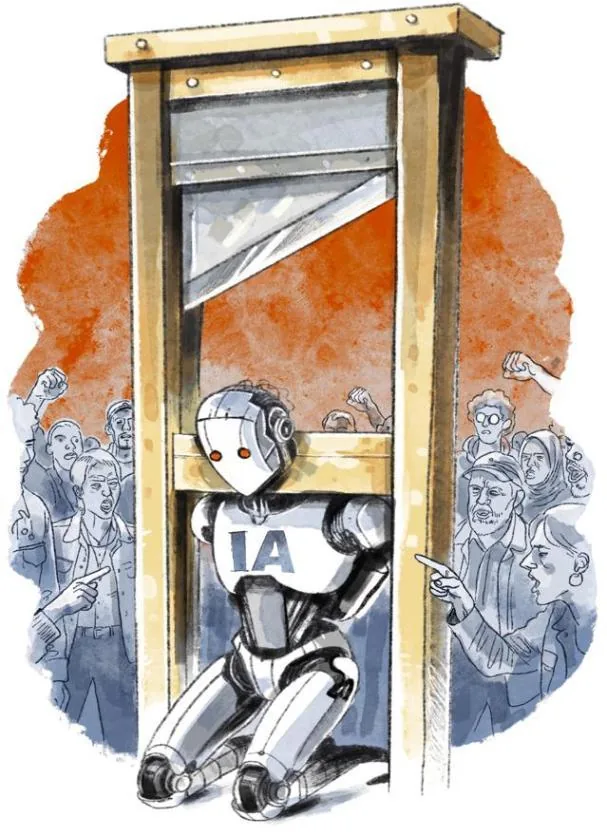
More and more people are becoming aware of the risk that AI entails in concentrating the world’s wealth in a small group of techno-oligarchs and heartless entrepreneurs, while most of humanity is left without work and sinks not only into a life without purpose, which would cause a pandemic of mental disorders, but into the vilest poverty. In other words, the risk the Pope warns about is returning to an inequality as painful as the one Marx saw in England in the Victorian era or, worse, as the one in France before the reckoning with the aristocracy through the guillotine.
In April, a 20-year-old threw a Molotov cocktail at the house of Sam Altman, the CEO of OpenAI. If the mega-millionaire Altman does not have nightmares thinking that one day he will end up like Louis XVI and his wife, Marie Antoinette, he should. And not only Altman, but – among several other kings of the universe – Eric Schmidt, the former head of Google, and Bill Winters, the president of Standard Chartered bank. Schmidt was booed during a speech to students at the University of Arizona when he said that the “technological transformation” represented by AI will be the “largest, fastest, and most consequential ever seen.” A few days earlier Winters caused a scandal in the media and on social networks when he announced that his firm was about to lay off 8,000 employees whose work AI would do better. But no problem, Winters explained. The affected would represent only “low-value human capital.”
Low-value human capital may end up being the phrase that defines almost all of us, from the middle class to the proletariat. And the middle class and proletariat are already beginning to rebel. In the United States, the laboratory where, for better or worse, the great trends of humanity are brewed, a new phenomenon is detected that, everything indicates, will grow: resentment towards AI and its bosses, people whose philosophy, with few exceptions, puts the profits of their companies above planetary well-being.
In the U.S., a new phenomenon is detected: resentment towards artificial intelligence and its bosses
The most immediate object of growing anger is data centers, massive energy consumers on which the expansion of AI depends. Last month someone fired thirteen times at the door of a city councilor’s house in Indianapolis who had just given the green light to a new data center in his district. Four other city councilors, this time in Missouri, were removed from office by voters for having approved the installation of a data center whose construction would cost about 6 billion dollars.
Read more Vandalism and police charges in Paris
Protests work. Last year they blocked the construction of 48 data center projects and another 20 have been canceled so far this year. According to national surveys to which the U.S. is so prone, the AI issue is rising every day in the lists of collective concerns. Half of Americans believe that AI will reduce our ability to create intimate human relationships and three out of four think that AI’s evolution is advancing at an exaggerated speed.
The Wall Street Journal quoted last week the CEO of a company dedicated to consulting in the field of infrastructure required by AI. The businessman predicted that the movement against it would multiply on a large scale. “People hate AI,” he explained. “AI is more unpopular than politicians.” Which is saying a lot, in the United States and beyond.
They might be less unpopular, perhaps, if they spent less time on their internal battles, mostly focused on gaining or staying in power, and more on applying their minds to the task the Pope recommends of “custody” of AI and seeking how to minimize the devastating impact it can have on the most basic notions of what the human person has been until now.
Given the possibility that some politicians do wake up, companies like OpenAI are investing hundreds of millions of dollars in supporting candidates favorable to their goals in the congressional elections to be held in the United States in November. Oh, surprise, these candidates belong almost without exception to the Republican Party, led by the current president of the nation, absent from the debate on the technological future that awaits us. In other words, tacitly in favor of the techno-oligarchs, who on top of that complain about paying too much tax.
Companies like OpenAI invest hundreds of millions of dollars in favorable candidates
I leave the last word to Rick Wilson, a brilliant political strategist, conservative by nature, who recently left the Republican Party: “The purpose of AI companies is not to cure cancer. It is not to solve climate change. It is not to prevent Alzheimer’s. The purpose of AI companies is to transfer unimaginable wealth and power to a few companies, forever. Layoffs are coming, warrantless surveillance is already here, and the only real question is whether AI policy will be drafted by sensible adults in 2027 or by a furious mob and a panic-stricken Congress in 2029.” “Human and national sovereignty is at stake. If AI companies think that 100 million unemployed Americans will not resort to guillotines, gallows, and torches, they are in for a surprise.”
Read more Barcelona 2026: Historic low in births and record number of foreigners and centenarians