Eight years ago, the deliberation and voting on the motion of no confidence against President Mariano Rajoy took place in the Congress of Deputies. The first and so far only successful motion of no confidence in democratic Spain.
Read more The investiture partners distance themselves from the Government and put pressure on Sánchez
The parliamentary initiative was presented by the PSOE on May 25, 2018, shortly after the first guilty verdict was announced in the Gürtel case. The President of the Congress, Ana Pastor, from the Popular Party, set a very short deadline to bring it to the plenary. Less than a week. Express motion. The socialist candidate Pedro Sánchez would appear on May 31, the discussion would open, and the first vote would take place on June 1. Following Rajoy’s instructions, the President of the Congress wanted to shorten the times to hinder a political agreement from the opposition. The numbers existed but the trauma experienced in Catalonia made it difficult for the party of Carles Puigdemont to join the initiative. They believed that the time factor was very important under those circumstances; the Basque Nationalist Party, for example, had just given its vote to the 2019 State general budget. They could not imagine the PNV changing its mind in such a short time.
They were wrong. The speed of the processing facilitated the initiative’s success. If they had set a longer deadline, greater dissensions in the opposition bloc would likely have occurred. Neither the Constitution nor the Congress regulations establish a deadline, but the regulations indicate that at least five days must be waited after the presentation of a motion of no confidence. Mariano Rajoy was always criticized for his tendency to delay times and leave decisions for tomorrow that he could have made today. That time he was wrong. Let’s explain it.
Rajoy’s Farewell
Rajoy wanted Sánchez’s motion of no confidence to be voted on immediately, believing it would hinder it… and he was wrong
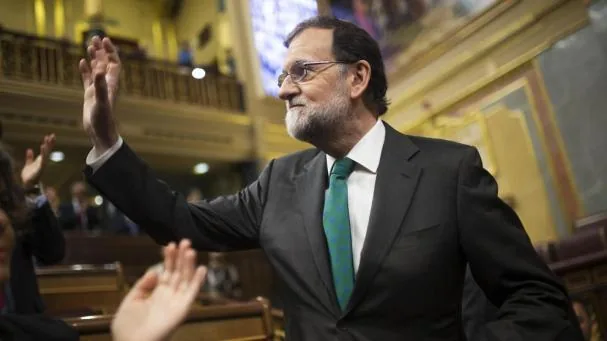
The vote of the Basque Nationalist Party (five seats) and the Partit Demòcrata Europeu Català (PDECat, successor party to Convergència Democràtica, with eight seats) would be decisive. The Basque nationalists initially hesitated: they had just voted in favor of the budgets presented by the Popular Party government. Senator Marta Pascal, then general coordinator of PDECat, took charge of the negotiation in Madrid and conducted it very skillfully. The ‘Marta Pascal moment’ was crucial those days, since Puigdemont was initially not in favor of voting yes. Versions suggesting that Puigdemont was enthusiastic about the motion of no confidence to ‘take revenge’ for the application of Article 155 of the Constitution in Catalonia are false. Puigdemont did not want at that time a pacification of the Catalan issue and feared that such pacification would end up causing his political marginalization, being outside Spain. His ‘exile’ could be eternal. That was and remains his fear.
It is worth explaining that passage better. Puigdemont feared that a PSOE government would try to anesthetize Catalonia with kind words and the promise of a pardon to the Catalan politicians who had been imprisoned for their direct involvement in the events of October 2017. The Supreme Court had not yet issued a verdict on those events. The trial had not yet taken place. Puigdemont, who at that time did not yet fully control the party refounded by Artur Mas, feared that a gradual pacification of the Catalan tension would cause a greater division of the already very fractured independence bloc, and a greater social desire to ‘turn the page’. He feared losing control of his parliamentary group in Madrid. The general coordinator of PDECat, on the contrary, believed that the approval of the motion of no confidence could open the way to a new political phase that would pacify Catalonia and help the old/new Convergència to reemerge as a centrist and moderating force.
With that approach, Pascal made the PNV believe for a few days that PDECat’s support was practically decided, while communicating to Puigdemont that the PNV had practically made a decision. Also, Pablo Iglesias, main leader of Podemos, spoke several times by phone with Puigdemont those days to give him the impression that the situation was leaning in favor of the motion. The man from Waterloo did not want to do the PSOE any favors, but he also did not want to be left alone supporting Rajoy. The Basque Nationalist Party, with EH Bildu close behind in the Basque Country, also did not want to be left alone supporting Rajoy. If the Popular Party had delayed the vote by a couple of weeks, things might have become complicated in PDECat. We can say, without risk of error, that the motion of no confidence against Mariano Rajoy passed thanks to the efforts of a moderate Catalanist (Pascal), who considered the way the so-called ‘procés’ had ended to be a mistake. Alongside her, temporarily, was the leader of Podemos, eager to have a decisive role in Spanish politics. Iglesias already knew that his next step would be to propose the entry of the Unidas Podemos coalition into the government, as happened throughout 2019. Pascal and Iglesias played a key role in one of the most relevant political chapters in recent Spain.
Also read
The motion was voted on June 1, and on July 21 of that same year, Marta Pascal resigned as general coordinator of PDECat, facing Puigdemont’s veto to her reelection. The man from Waterloo had learned the lesson: he had to firmly control the parliamentary group in Madrid. In the 2019 general elections, he ensured this was the case. When the electoral platform Junts per Catalunya became a party, absorbing and sidelining PDECat, Puigdemont perfectly controlled his deputies in Madrid. The current spokesperson of Junts in Congress, Miriam Nogueras, is absolutely loyal to Waterloo.
Eight years have passed, a period equivalent to two legislatures, and Spanish politics is again at a crossroads that could lead to a motion of no confidence to topple Pedro Sánchez and then proceed to call general elections. Again, the vote of the PNV and the Catalan nationalists who have adopted the title of independents appear decisive. Aitor Esteban has replaced Andoni Ortuzar as president of the PNV. Marta Pascal has withdrawn from active politics—although she retains the ideas that motivated her to act eight years ago—Puigdemont maintains control of Junts, with some internal dissensions, and Miriam Nogueras obeys him. Pablo Iglesias has also stepped back from the forefront of politics, although he maintains strong influence over Podemos, reduced to four deputies in Congress after the split with Sumar. Those four deputies would also have weight in the event of a motion of no confidence. History does not repeat itself, but it rhymes.
Coffee Days
The Popular Party does not know what to do; PNV and Junts play it safe
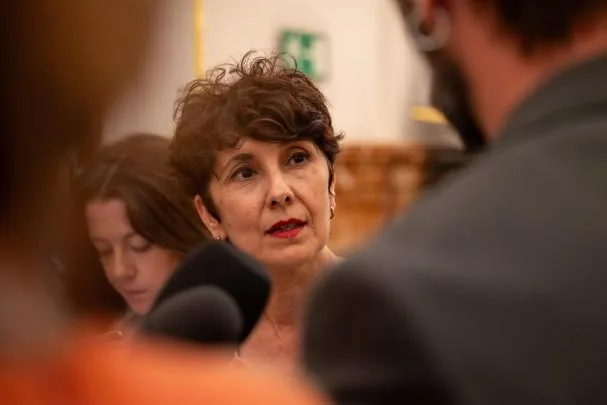
These are coffee days. The acceleration of judicial cases looming over the PSOE and the serious accusations against José Luis Rodríguez Zapatero for his alleged role as a commission agent in Venezuela have the country on edge. The Popular Party does not know what to do. It demands the immediate calling of general elections but does not dare to present a motion of no confidence, fearing to lose it. Alberto Núñez Feijóo looks at PNV and Junts and pressures them, accusing them of complicity in a general corruption scheme. A general scheme in which people from the PP still have reserved places in the dock. These days the trial against the former Ministry of the Interior leadership is taking place, accused of having used the police to try to stop investigations into the Gürtel case, the so-called Kitchen case. Alleged use of the police to hinder a corruption investigation. This is not a minor matter. A slow investigation into the activities of the former Minister of Finance, Cristóbal Montoro, is still ongoing. The former President of the Presidency of the Community of Madrid, Francisco Granados, faces a corruption trial along with 40 other defendants (Púnica case), while his former mentor, Esperanza Aguirre, participates in demonstrations against socialist corruption. The general Spanish picture these days is impressive, with Valle-Inclán-like notes.
‘Puigdemont to prison!’ was chanted just over a year ago at six consecutive demonstrations called in Madrid by the PP to express their rejection of the amnesty for Catalan independents convicted by the Justice system. Puigdemont to pressure, the current moment tells us. Are there underground negotiations between the PP and Junts? We can only confirm that communication channels between both formations are open after the amnesty. We knew this moment would come. We have written about it on several occasions.
Read more Ukraine, the armed wing of the EU?
Eight years have passed and Puigdemont remains in Waterloo, awaiting the application of the Amnesty law to his case. The Court of Justice of the European Union (CJEU), based in Luxembourg, must rule on a request for clarifications made by the Supreme Court, using the consultation right called preliminary ruling. That ruling is delayed and could be known in October. At first, it does not seem that Puigdemont wants to risk a PP and Vox government having the final say on his future if the application of the Amnesty law is not clarified first. If they have not changed their minds, both parties want to see him in jail.
Junts is playing it safe these days: it says Sánchez should call elections and at the same time states it does not intend to support a PP motion of no confidence with Vox’s support. The PNV also states that the legislature should be considered over and emphasizes that elections should be held before the end of 2026. Immediately after, the Basque nationalists clarify that they do not intend to vote for a motion of no confidence promoted by the Spanish right. PNV and Junts especially do not want the next general elections to coincide with the municipal elections scheduled for May 2027. Organizing a big ‘super Sunday’ election in May 2027 could be one of Sánchez’s options: putting everything at stake in one go.
The PNV does not want very polarized municipal elections between right and left. Remember that in the Basque Country municipal elections, the General Assemblies of the three provincial councils are also voted on, which hold the Basque Treasury. Junts also does not want a municipal campaign overshadowed by the general elections. Junts will face Aliança Catalana, a new-type formation defending far-right positions on immigration and security, quite in line with French Le Penism. Polls suggest Aliança Catalana could get 20%, stealing many votes from Junts, especially in the inland counties. Aliança Catalana is today the great mystery of Catalan politics. The mayor of Ripoll, Silvia Orriols, swears that her nascent party, theoretically radically independentist, will not run in the general elections because it has nothing to do in Spanish politics. With those elements, Sánchez would not oust Rajoy today. Will they oust him?
The PP does not know what to do with the motion of no confidence. If it does not present it, the fury and discontent of the most irritated voters by the situation, the vote of the most excited by a media mobilization of enormous voltage, could channel in favor of Vox. Vox has grown two points again in the latest CIS barometer, prior to the latest scandals, known yesterday. If Feijóo stays still, he could benefit Vox. If he moves, if he presents the motion and loses it, some Popular Party members believe they could end up benefiting the PSOE given the evidence that Sánchez has no alternative today, despite the difficulties that beset him.
The Socialist Party, Against the Ropes
Sánchez’s margin narrows and the PSOE tries to fix the idea that it is being subjected to a destabilization campaign
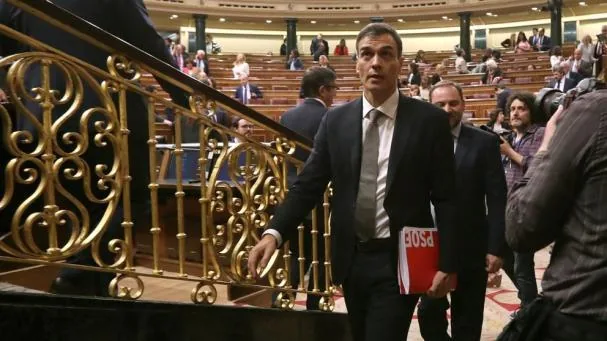
We recalled it last week. Felipe González presented a motion of no confidence against Adolfo Suárez in May 1980 knowing he would lose arithmetically, with the ambition to win politically. And he won politically. The young Felipe González of 1980 made it clear that he was the alternative. Is Feijóo in a position to emulate González at this moment? Both characters have developed a certain friendship. If Feijóo is the future president of the Government of Spain, we can be sure that the octogenarian González will defend that the PSOE helps him govern on key issues—without entering the Executive—to isolate Vox. This requires Sánchez’s political death. González has thought this since he saw how Mariano Rajoy’s PP lost the absolute majority in December 2015 and Podemos entered Parliament at a gallop. González holds that the two major parties must alternate in power, letting the most voted govern. National concertation politics, without large coalitions.
This is the point we are at today, eight years after the first successful motion of no confidence in Spain. The PSOE tries to break the siege by focusing on the suspicion of many citizens that they are facing a deep campaign to radically discredit the last socialist party governing a large country in the European Union. (A corruption raid shook the Portuguese Socialist Party yesterday, a formation in opposition but which has contributed to approving the budgets of the center-right governing party through abstention. The model desired by Felipe González).
Almost no one today puts their hand in the fire for Rodríguez Zapatero, there are doubts about some of his activities in Venezuela, but many people suspect that something more is going on, since the United States National Security Department handed over to the Spanish police data from a mobile phone belonging to a Venezuelan businessman that could incriminate the former president. At one point, almost all seven judicial investigations affecting the PSOE in one way or another accelerated. Someone wants to say something. These are very coffee days.
What margin does the Government have left? Trying to agree on a minimum program to finish the legislature within a year with the parties that gave Sánchez the investiture, a program that could include presenting a budget. Does that margin exist?
Read more Why has Trump drowned in Hormuz?