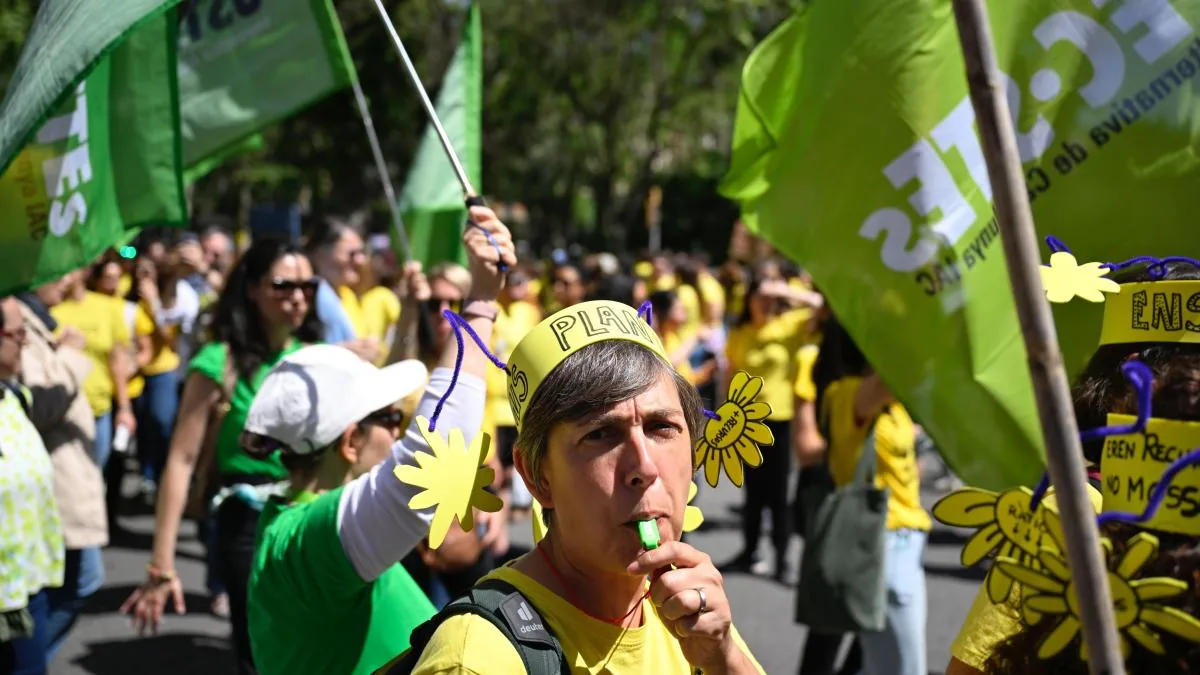
On February 11, thousands of teachers took to the streets to protest against working conditions in schools. The strike, called by all educational unions, reached 54% of the entire workforce. Teachers expressed their frustration over the complexity in classrooms, the system’s demands regarding their responsibilities, and the salary freeze. That was the start of a yellow wave that has continued to be visible. It is now June, and the conflict remains unresolved. What has happened since then?
Read more Open negotiations with a prospect of an indefinite teachers’ strike starting June 8
February 11: Massive demonstration
Union action unity in a demonstration of tens of thousands of people. The latent frustration and apparent lack of response from the socialist Govern – this one will organize the sector, it was heard – explodes. There are insufficient resources for classrooms overwhelmed by complexity and lack of social recognition. More poverty, immigration, mental health, disability in classrooms without adequate resources. Purchasing power has also been lost. Up to 25%, say the unions.
February 27: Negotiation
After that strike, the Govern and unions sit at the negotiating table almost daily. Ratios, inclusion, salaries. On February 27, the unions left the meeting hopeful. “The new salary improvement proposal came after we reached consensus on most issues such as inclusion, ratios, workload, and other points on the table,” explained Iolanda Segura, spokesperson for Ustec but representing all unions. “But the stumbling block is the salary increase,” she added.
Educació proposed a 25% increase on the regional specific supplement (about 180 euros per month). “It is insufficient, salary is a red line,” Segura said. The unions had called for a cycle of strikes in March.
March 9: Educational pact
The Govern signs a pact with CC.OO. and UGT (23% union weight) that the other unions disagree with. It is a flexible framework agreement that includes improvements in ratios, inclusive schooling, and 30% of the regional supplement, about 270 euros over four years. This is an unprecedented amount, about 2 billion euros, 25% of Educació’s budget. Follow-up meetings are established to specify improvements. The salary increase over four years along with improvements for educational staff take 65% of the budget. The reduction of ratios and attention to diversity take the remaining 35%.
February 20: Massive strike
Ustec, Secondary Teachers, CGT, and Intersindical see the signing of the pact as a betrayal of union unity. They believe more could have been done. They maintain mobilizations and the March strikes. These are successful. Three out of ten teachers protest. The strike called for all schools on February 20 is followed by 44% of the workforce. The pact contains a key point that generates discontent among school management: the profiling of teaching staff positions. From the possibility of selecting personnel for 50% of the workforce, the Govern and unions agree that directors can only select 3%. This is a controversial demand strongly advocated by all unions. With it, Educació loses the support of management, essential in times of conflict.
May: Cycle of strikes
The consellera, absent due to illness since early February, returns on April 7. The non-signatory unions call for 16 days of strikes (17 counting the strike of 0-3 year educators), including territorial strikes and three general strikes. The last is scheduled for June 5. The participation is irregular but clearly lower (yesterday it was 14%), but the general strike reaches 35% participation. Demonstrations also thin out but become more radical. Roadblocks and more visible conflict actions. In public centers, manifestos circulate to renounce colonies and educational outings. For the first time in a decade, they are remunerated again, but at 50 euros per night, up to a limit of two teachers. Already 1,228 centers have signed out of 2,500 in total.
May 11: Mossos
In May, two issues also affect the conflict. The pilot plan of police officers in education centers with problematic students and families, and the infiltration of two Mossos d’Esquadra agents in a workers’ assembly enrages the sector, which feels intimidated. The Govern explains that the purpose of incorporating police is to mediate and prevent conflicts. The pressures are enormous, and of the 25 centers that had accepted, half withdraw. Meanwhile, the Interior consellera Núria Parlon and the general director of the Mossos, Josep Lluís Trapero, apologize for the infiltration.
May 13: New sectoral table
The consellera calls a sectoral table to unblock the conflict given the strength of the movement and after insisting she would not move from the agreement. Iolanda Segura tells the newspaper Ara that with a 400 euro monthly increase she could consult the bases and call off the strike. The salary increase is almost double that agreed in March but less than the 700 euros initially proposed. Meanwhile, the Generalitat budget agreement is being negotiated, which would give the Govern room to improve funding. The weekend before ERC and Comuns show their support, Ustec asks these parties, which had supported their demands, to refuse to agree if sufficient increases are not included for Education to meet union demands. The budgets continue forward, and these groups commit to signing a complementary increase if the Govern needs it.
May 29: Eight negotiation tables.
The Govern’s first proposal is a commitment to increase inclusive schooling only specified for the next school year and a salary increase that does not satisfy. Additionally, it links the salary raise to a new special supplement for those profiles with the greatest responsibilities: tutors, directors, and coordinators. This covers 60% of the workforce.
The unions refuse and want a linear increase for all, a higher salary increase, and more detail on other measures.
The Govern reformulates its proposal: 30% of the regional supplement (3,000 euros) will be incorporated into salaries one year earlier than agreed, after 3 years instead of 4. Additionally, it commits to paying the backlog of seniority bonuses, one of the unions’ demands, especially from Secondary Teachers. This union clearly states that resources should be allocated to salaries and teaching posts, not to inclusive schooling, whose model it does not believe in.
At Thursday’s meeting, the agreement seems close. However, aspirations are dashed, and after six hours of meeting, the smoke is black. The Govern yields to almost all demands: improves inclusive schooling (more than 6,000 professionals), schedules the return of the backlog over five years (250 million), commits to calling 5,000 teaching posts (14.6 million), and increases teachers’ salaries by almost 400 euros monthly over four years. This figure is disputed by the non-signatory unions, who believe the increase is much smaller. Also, the framework of the pact signed with CC.OO. and UGT is preserved, and the new offers are included in an annex. The pact is not signed. Overall, it represents an injection of 300 million euros extra to the initial 2 billion agreement.
The unions lock themselves in the department and sleep in the building to show they are willing to continue negotiating. They are not sure the bases, which they will consult after the agreement, will say yes. These bases consist of assemblies of teachers who have kept mobilizations alive in the streets thanks to high expectations. They warn them: “we will not accept a false closure.” Union elections are in spring 2027.
At Friday’s meeting, consellera Niubó maintains she will not move from the last offer, there are, she has expressed, some loose ends, but it cannot be stretched further. The unions, who entered convinced of winning more in salaries, want to renegotiate ratios, whose reduction is already contemplated in the pact, and curricula, to eliminate the ability of centers to dedicate part of the schedule to projects and reinstate time dedicated to sciences. The unions have already registered strike calls in June for when next week’s strikes end.
Read more This is Barça’s economic plan to sign Julián Álvarez