The Prime Minister, Pedro Sánchez, made a passionate defense of the “just” energy transition this Monday and announced the Government’s willingness to allocate 9.1 billion euros to reduce CO2 emissions with social aid in transport and housing, according to the proposal of the Social Plan for the Climate launched by the Government. The proposal of this social plan was presented in Madrid at an event where he was accompanied by the ministers for Ecological Transition, Sara Aagesen; Transport, Óscar Puente; and Housing, Isabel Rodríguez.
Read more Mango reorganizes its powers and strengthens internal controls
These investments are pending, however, on the Congress transposing the new European directive on emissions trading (ETS2) into Spanish law, from which these aid funds will be financed and channeled, requiring the EU’s green light. For all these reasons, the president has asked the groups to unblock its approval.
The creation of this Social Plan for the Climate arises from the need to facilitate a just transition to certain sectors that may be affected by future measures derived from the increase in energy costs when the new directive comes into force.
The EU included road transport and buildings in the new cycle that regulates the EU emissions trading system. This implies an increase in fuel prices for road transport and heating from 2028, which explains the need for this social plan.
Sánchez defended this emissions trading directive because it has already been shown to help reduce greenhouse gas emissions.
“The directive is now under parliamentary processing and we hope it will have the support of the vast majority of parliamentarians, because ultimately what we are proposing is to protect the planet and protect families,” he said.
“It is important to talk about a just transition, it is important to talk about that commitment to the climate. And that is the spirit of this plan: that there should be no need to choose between making ends meet or reaching the end of the century,” he said in his speech during the closing of the Plan presentation event.
The Social Plan for the Climate was supposed to come into force on January 1, 2026, according to European regulations. Previously, Spain should have submitted a draft to the European Commission (no later than June 30, 2025). But all this has suffered a huge delay in the drafting process while the green light in Congress is not guaranteed due to the indecision of PP and Junts.
Poverty in transport
Sánchez says the Plan “allows free urban and metropolitan public transport” for millions of people
Of the total budget, 6.824 billion euros will come from the European Social Climate Fund and 2.275 billion euros must be contributed by Spain for the 2026-2032 period.
Pedro Sánchez announced that of the total amount, 4.7 billion euros should be allocated to housing aid for vulnerable sectors, support for self-consumption, and energy communities.
A large part of the money will be used for the rehabilitation of homes and even entire neighborhoods, so they consume less energy, reduce their emissions, and above all, lower electricity bills, as the intention is to act on energy inequality in the most vulnerable households, as well as to boost new social housing with the “highest” energy standards.
Meanwhile, 4.3 billion should go to decarbonizing mobility and strengthening it in rural areas in collaboration with autonomous communities.
Sánchez has defended the possibility of launching the social single pass, “which will allow practically free urban, metropolitan, and interurban public transport for millions of citizens.”
He also announced aid for self-employed workers, microenterprises, and SMEs to renew their vehicles and adapt to “cleaner and cheaper” mobility, and to accelerate the electrification of heavy and commercial transport.
Read more Sánchez and Meloni will not finally hold their meeting in Rome due to «scheduling conflicts»
Parliamentary support requested from the groups
The president asked the parliamentary groups for their support for this plan, which means they should ratify the new European directive on emissions trading. Junts, for now, continues to refuse to show its cards.
In his speech, the president defended that the energy bill “must be fairly distributed,” and criticized that “the far right is questioning the European emissions trading system as if it were just another tax,” when from there will come the economic resources “needed to make the ecological transition a just transition.”
The far right is questioning the European emissions trading system as if it were just another tax, when it provides the key resources to achieve a just ecological transition
Pedro Sánchez
Prime Minister
Sánchez said it has been shown that “greenhouse gas emissions can be reduced while creating jobs and growing”; but he lamented that the push for decarbonization “is losing momentum” as a result of the advance of what he called “denialist” and “flat-earther” discourses, far from science.
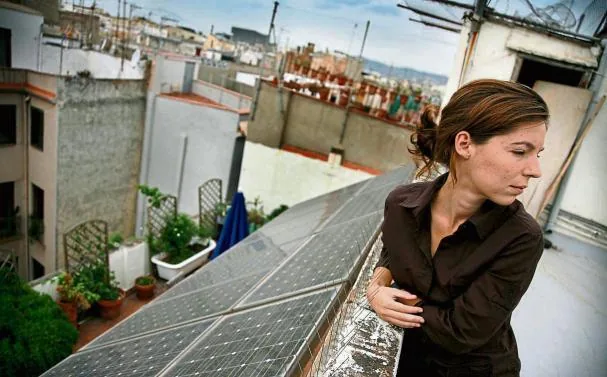
In view of the war in Ukraine and the conflict in the Middle East, “we better learn lessons from all these events,” he stressed. The president argued that at a time when sovereignty is being discussed, and “how to defend the interest of a society, a country, a nation like Spain,” we will make Spain “freer and more independent if we install a solar panel in our homes, when we have a clean bus, when we have a rehabilitated home.”
Depend less on gas and oil
In his opinion, “this is also a way to depend less on gas and oil,” something that “makes us less vulnerable to situations of international volatility as we are seeing,” he added.
“Dependence on fossil fuels not only pollutes, but also makes us more vulnerable and makes us, if you allow the expression, more vassals of foreign interests,” he added.
The proposal of the Social Plan for the Climate will be under public consultation until the end of June. In addition, according to Sara Aagesen, during that month a “second wave of workshops” will be held on the matter.
“What we want is that before the end of this year we can send a proposal to Brussels that reflects the collective intelligence of our country,” she added.
The Minister of Transport, Óscar Puente, recalled that 77% of the urban population has guaranteed the right to mobility while this figure only reaches 6% in rural areas, which seems to indicate their priority proposals.
“Therefore, the challenge is to ensure that mobility becomes an element of social and territorial cohesion. And this is where the first opportunity lies in the Social Plan for the Climate.
Carlos Bravo, spokesperson for civic entities
“The measures included must be consistent with the European regulation”
“The announcement of the presentation of the draft Social Plan for the Climate is great news, which we had been waiting for almost a year. The measures included in it must be fully consistent with the provisions of the European regulation [where those economic distribution criteria are given], which means effectively benefiting vulnerable users,” says Carlos Bravo, coordinator of the Alliance of 27 entities working on the transport part of the plan. “Furthermore, we hope that all political parties express their support for the transposition of the new ETS2 directive [EU directive 2023/959, adopted in May 2023], whose parliamentary process has been stalled for months, and whose approval is necessary to start receiving European money from the Social Climate Fund.”
Also read
European plan
The push for the Social Climate Fund derives from the European Union’s measures approved to reduce greenhouse gas emissions and advance compliance with international commitments under the Paris Agreement against climate change. The EU included road transport and buildings in the EU emissions trading system (known as ETS2). This implies an increase in fuel prices for road transport and heating from 2028, which explains the need for this social plan.
To minimize the impact of the new directive on the most vulnerable social sectors (in households, transport users, and microenterprises), especially those affected by energy poverty or transport poverty, the European Union has created the Social Climate Fund (SCF) for the 2026-2032 period, which will have a total of 65 billion euros.
Investments from the Social Climate Fund must allow vulnerable citizens to renovate their homes, adopt energy-efficient technologies, and access renewable energies and sustainable means of transport. This will reduce their dependence on fossil fuels in the medium and long term, while direct income aid will mitigate possible negative short-term effects. The mentioned fund can finance investments in energy efficiency and building renovation, clean heating and cooling, as well as zero or low-emission mobility and transport, including public transport; or provide temporary direct income aid to vulnerable households.
Read more De la Fuente: “I know what kind of person Eric García is and Gavi is the toy of the whole team”