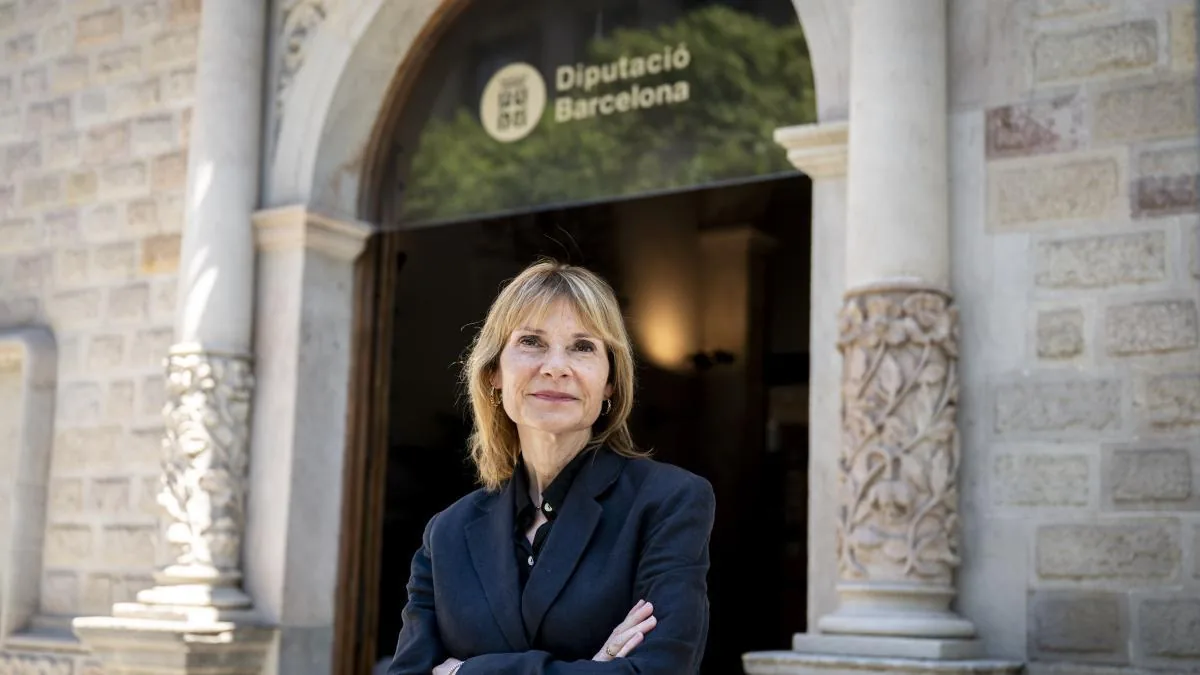
Lluïsa Moret (Barbastro, 1965), in addition to holding the vice-first secretary position of the PSC and serving as the mayor of Sant Boi de Llobregat, which she hopes to renew in the elections on May 23, 2027, presides over the Diputación de Barcelona, an institution that seems to inhabit a world very different from the rest of the public administrations, immersed in permanent stability.
With three quarters of the term completed, she faces the final stretch more convinced than ever of the usefulness of provincial corporations as support for municipalities and the need to address, in the medium term, once the issue of Generalitat financing is resolved, the convenience of providing local entities with more resources.
There is only one year left until the municipal elections. What is your assessment of the three years of the term and what do you expect for the remainder? It seems that things happen more smoothly at the Diputación than in other institutions
We make the work seem easy and indeed, things flow. We have a government with four different political forces that requires very good predisposition and willingness from all parties to generate a positive climate that allows us to work in favor of the municipalities. Together we have been able to promote public policies, projects, and innovative initiatives and generate a very important local cooperation system in a very complex context.
Diputación without noise
“We generate a positive climate, we make the work seem easy and things flow”
Without noise and with budgets for this year approved last December. A real rarity these days…
At the beginning of the term, we defined our priorities and that has helped us work together. At the Diputación, although different parties govern, we agree because we have the same problems in the municipalities, the demands of our neighbors coincide and relate to daily life. At the beginning of the term, we approved the budgets with the vote of 50 of the 51 deputies (the Vox representative was the exception). That says a lot about the work done and the response we give to all town halls, regardless of which political force governs them.
In the Generalitat, on the other hand, it was necessary to wait until mid-year to approve the budgets for the current fiscal year.
We came from a very complex and difficult period, but I believe the results of the May 2024 elections were clear: the citizens of Catalonia indicated that there was a progressive majority led by the PSC. We were able to agree on the investiture pact and now on the budgets. They are now on the right track and this is very good news. The dialogue that led to the budget pact opens a good path in the sense that it generates trust and allows us to move forward together. There is no alternative.
When you visit the 311 municipalities of the province of Barcelona, what do the mayors ask for the most?
There are coinciding problems, but priorities depend a lot on location and geographical, economic, cultural, demographic differences…
In small municipalities, the challenge is to avoid depopulation.
Exactly, and that is why they must be well connected, have access to telework, educational centers, basic health services. At the Diputación, we are attentive to the demands of the mayors at all times. When we started the term, the number one problem was drought. We signed an agreement with the Catalan Water Agency (ACA) and created an extraordinary fund of 100 million to help municipalities that have low network competence to make investments and repair leaks.
You are also trying to rescue industrial parks.
We have very aged and deteriorated economic activity parks and often municipalities cannot invest in their improvement. We work on two very clear lines, social and territorial cohesion, making the principle of equal opportunities for access to basic services a reality. The same happens with sports and cultural facilities built in the late 80s or early 90s that need to be renewed, or with infrastructures. We also have a great demand in energy self-sufficiency issues. We have invested almost 75 million in the implementation of photovoltaic renewables, bioenergy, and biomass.
Read more Abuses against the flotilla open a new rift between Europe and Israel
Also read
For many years the debate about the continuity of the Catalan diputaciones was on the table. What has changed so that nowadays no one questions them?
The Diputación has always been a very useful institution for town halls, very powerful, with many resources both economic – ours is the fourth most important budget in Catalonia at the institutional level – and technical. And we make policies based on the needs of each territory. We are very operational and the funds we create respond to the demands of the municipalities. We manage to make administrative procedures agile, fluid. I believe the fact that the Diputación is not questioned has to do with the empirical verification of its usefulness.
An institution that is no longer questioned
“The fact that the Diputación is not questioned has to do with the empirical verification of its usefulness”
When talking about public administration financing, municipalities are the eternal forgotten ones.
I believe that when regional financing is properly resolved, and now with Pedro Sánchez’s government a great opportunity has opened, municipal financing must be addressed. We are very happy with the Generalitat Government, which is very open to town halls, very attentive to their demands, but we need more resources because the demands of the neighbors are increasingly important and there has been very significant demographic growth. The Catalonia of 8.5 million people needs to update its service systems. Therefore, municipal financing is a challenge we must address and dedicate more resources to institutions that work from proximity.
Have you managed to avoid duplications with other institutions such as county councils or the Metropolitan Area of Barcelona?
We have been able to collaborate and not compete, nor duplicate nor overlap. We have been able to identify priorities and coordinate. For example, we were very clear that drought was a country problem and that to solve it everyone had to contribute.

In terms of tourism, is any step forward planned so that the rest of the province better leverages the weight of the Barcelona city brand?
We are already working jointly with Turisme de Barcelona. The purpose is to leverage that Barcelona brand to decentralize the tourist impact in the rest of the province, to de-seasonalize and bet on sectors such as sports tourism, cultural, gastronomic, historical heritage, or natural environment tourism.
Tourism
“The purpose is to leverage the Barcelona brand to decentralize the tourist impact in the rest of the province”
For the PSC, the positive news of recent days has been finally getting the Generalitat budgets on track. The negative, due to the impact it may have, is the Rodríguez Zapatero case. How will you handle this new blow?
These events are always shocking, no one likes them, especially if they affect people we know and trust. Initially, we trust the former president and also trust that justice will clarify the situation
Read more The night Kyiv trembled