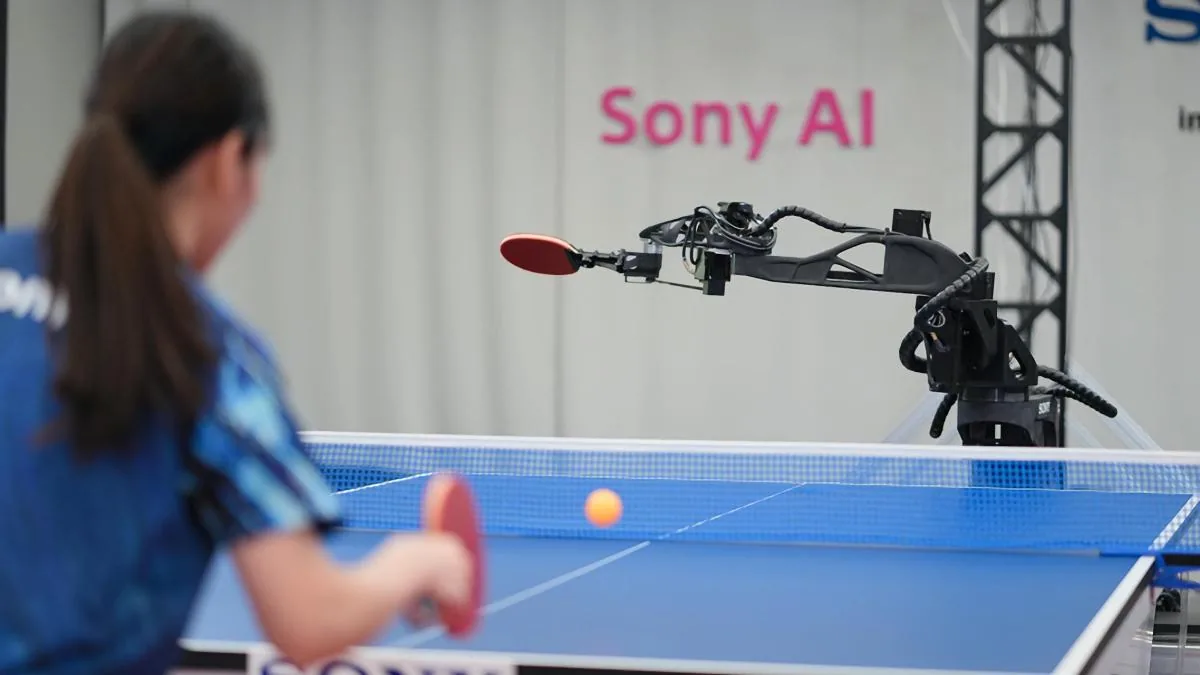
One of the areas where artificial intelligence performs worst is the real world. Until now, AI systems have offered performance capable of surpassing humans in the digital environment, such as in chess or certain video games, but the physical world is a complex challenge where perception, planning, and millisecond speed must be combined. That’s why so few robots compete well in human physical sports. Until now. The journal Nature publishes research on Sony’s Ace project, a robotic arm capable of playing table tennis with elite amateur and professional players and, on occasion, beating them.
Read more Russia will suspend oil shipments from Kazakhstan to Germany starting May 1st
Ace is the first known autonomous system that operates in the real world and faces off against expert human ping pong players, whom it can beat in some matches. The researchers in charge of the project highlight that it is the first time a robot has reached an expert human playing level in a complex competitive sport in the physical world, which is why they consider this achievement a milestone for research in artificial intelligence and robotics.
The artificial intelligence team of the Japanese company, Sony AI, has combined in this work novel advanced sensor technology from the brand itself, reinforcement learning, and precision hardware. The goal was to reach an expert playing level in a sport that demands very fast, precise interactions with human players, close to obstacles, and at the limit of human reaction.
To develop Ace, Sony researchers started from previous work, their AI agent Gran Turismo Sophy, used in their acclaimed car racing simulation video game Gran Turismo. What they did for the new project was to bring this technology to real-world environments, where they had to determine how robots can perceive, plan, and act with the speed and precision of a high-performance human in a very dynamic field.
The results of this project cannot be interpreted as an achievement confined solely to the world of sport. Ace enables the machine to solve a problem that requires very fast detection and great real-time control of the situation, laying the groundwork for AI systems that act very precisely in physical environments where they must interact with humans.
Peter Dürr, director of Sony AI in Zurich and head of the Ace project, observes that “this research has shown that an autonomous robot can, in fact, win in a competitive sport, matching or surpassing human reaction time and decision-making in a physical space.” “Table tennis is a game of enormous complexity,” he points out, “requiring split-second decisions, as well as speed and power.”
“This research breakthrough highlights the potential of physical AI agents to perform real-time interactive tasks, and represents a significant step towards creating robots with broader applications in fast, precise, and instantly executed human interactions,” he adds.
Read also
Table tennis is one of the sports that presents the most difficulties for an AI in the real physical world. It forces the machine to make very quick decisions, with extremely accurate execution of movements, in addition to having to adapt to interaction with an opponent who can always be unpredictable, the human player. The ball in ping pong not only moves fast, but it is also used with spin and complex trajectories.
The Ace project includes a high-speed perception system composed of nine Sony-proprietary active pixel sensor (APS) cameras that determine the precise position of the ball in a three-dimensional environment.
All of this is combined with three gaze control systems (GCS) that use cameras with event-based vision sensors (EVS) and pan-and-tilt mirrors to measure the angular velocity and spin of the ball in real time.
Read more The myth that young people don’t read: 80% of Generation Z makes books «sexy» on social media