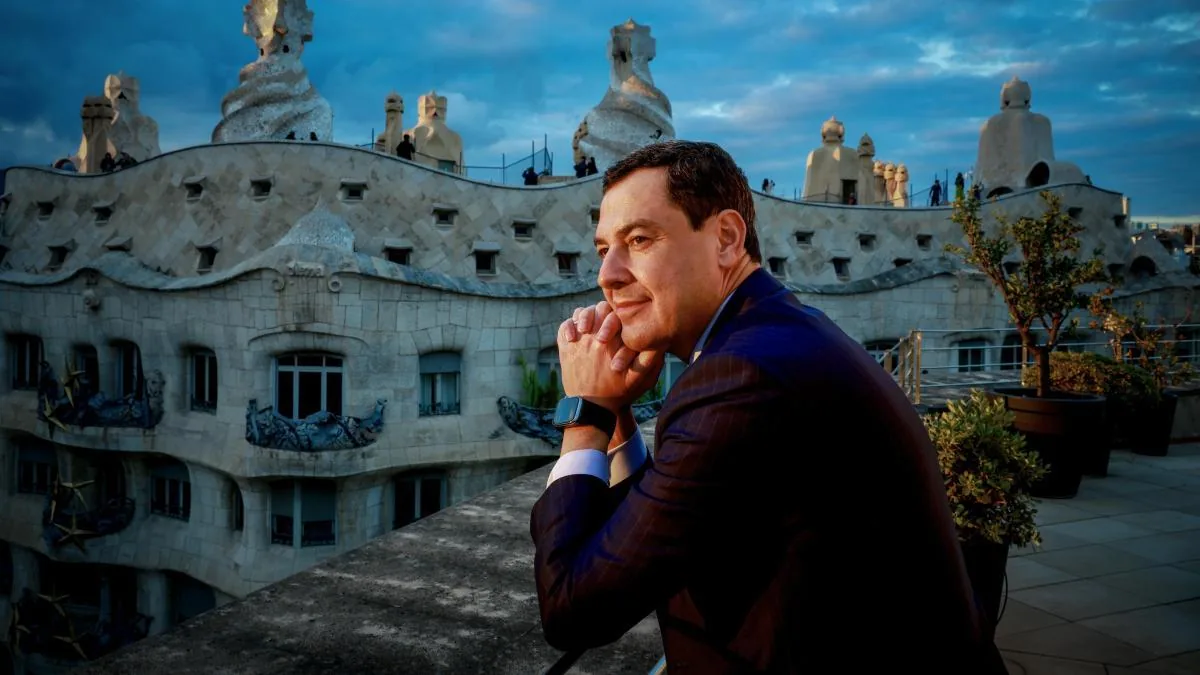
Once the election results in Andalusia are known, that absolute majority lost by a narrow margin, due to adverse quotients in the application of the d’Hondt law in the provinces of Seville, Málaga, Cádiz, Córdoba, and Huelva, the question is whether Juan Manuel Moreno Bonilla will stand firm against Vox to point out those points on which he is not willing to compromise, with the warning of going to a repeat election if they pressure him too much. A line in the sand on the beach of Sanlúcar de Barrameda: “I won’t cross this line.”
Read more Alícia Romero appears to explain the details of the budget agreement
It would also be a way to pressure the PSOE to grant abstention in the investiture, since María Jesús Montero does not seem to be in a position to face a repeat election. It was a very bad idea to present the Minister of Finance as the lead candidate. To date, the initiative of presenting ministers at the head of the PSOE’s regional lists has been catastrophic. The spokesperson minister Pilar Alegría also crashed in Aragon. The prospects for Diana Morant, Minister of Science, Innovation and Universities, in the Valencian Community are not very promising at the moment, despite the objective weakness of the Valencian PP after the Mazón scandal. The current Minister of Digital Transformation and Public Function, Óscar López, also does not seem very enthusiastic about the Madrid battle, despite the mistakes being made by Isabel Díaz Ayuso. Ayuso has entered into a spiritual contact with Hernán Cortés to prevent Vox from breaking her absolute majority in Madrid, and she drew her own caricature in Mexico before a solid ruler like Claudia Sheinbaum, who was waiting for her, one might say eagerly. Mexico is the most important country in Hispanic America.
Also read
The tactic of mobilizing ministers has not been a good one. Never since 1977 had a Minister of Finance led a high-level electoral battle in democratic Spain. Josep Borrell, Secretary of State for Finance under Felipe González, never challenged José María Aznar for the presidency at the polls. The Popular Party under Mariano Rajoy would never have thought of presenting the Jaén native Cristóbal Montoro as a candidate to preside over the Andalusian Government. Ministers of Finance do not attract the masses; they repel them. Pedro Sánchez has undeniable talent in foreign policy, but he is not always a silver fox in domestic politics. Too tactical. More than winning in Andalusia, he wanted to keep the Andalusian PSOE under control. That objective is likely to be achieved, at least until 2027. Sacrificing pieces until the final battle is won. This seems to be his tactic. It is a Russian general’s approach.
Moreno Bonilla threatening with a repeat election that María Guardiola could not even dream of proposing in Extremadura when things got tough with Vox a couple of months ago. That dance step will not be seen in the coming hours or days. Institutional liturgy has its timing. It would be a risky step. The PSOE could have a very hard time, but who knows what the voters’ reaction would be. Andalusia is a lot of Andalusia.
Vox also knows that the Andalusian negotiation will not be like that of Extremadura or Aragon, much less that of the Valencian Community, so they have already stated that they do not want seats in the future regional government. The most logical thing is that they moderate their demands to preserve their main achievement this past Sunday: the social perception that Vox still counts, despite internal dissensions, despite their unwavering loyalty to the figure of Donald Trump, no matter what the left, the old liberals, and the social Catholics say. It is worth voting for Vox to turn the tables and make the left go home for a long time. This is the mental framework that Santiago Abascal will want to preserve, even if he has to hit the brakes in Seville.
We are talking about the possibility of generating a new long-lasting political and cultural hegemony in Spain. A new hegemony that refocuses the economy, modifies social rules, further divides the Catalan nationalists – already happening with Aliança Catalana – and invites the PNV to maximum pragmatism. Vox would be the guardian of that different Spain, in direct line with Washington. It is no small thing.
The Popular Party has almost everything in its favor. It has a lot of artillery. It is clearly above 30% of the vote in all estimates, very strong in the South, leads the Madrid DF power system, governs the majority of the autonomous communities and provincial capitals, has the support of the traditional middle classes in almost the entire country, and enjoys the sympathy of the German CDU. It is, ultimately, the main pivot of the dominant bloc. The PP has almost everything in its favor, but its leader does not inspire enthusiasm. Alberto Núñez Feijóo needed the absolute majority in Andalusia to project power, to anchor the idea that the future victory of the Popular Party is inexorable, even if he is not the most likable in the repertoire. Victory by demolishing the opponent, through political and judicial means. Demolishing the opponent with cannon fire until nothing remains standing. This is a rather obsessive tactic for Feijóo. He already practiced it in Galicia. It is also a Russian general’s idea.
The Andalusian result tells us that the party remains open because a gap has appeared on the left side that was not expected. A gap suitable for breathing. That 16% combined by Por Andalucía and Adelante Andalucía means something. That 16% is above the 13.8% obtained by Vox. It means there is a current of air. There will probably not be a unified candidacy to the left of the PSOE, it is almost impossible, since they have burned the trust among their cadres. Four thousand cadres throughout Spain. Four thousand people with a certain accumulated political culture and a certain capacity for influence. Maybe there were more. They have all ended up fighting. A good part of that social space that Gabriel Rufíán sketches with charcoal pencil could end up voting for Sánchez depending on how the dice fall. The results of the next general elections could break patterns. With the PP watching Vox in Andalusia, it will be harder to discipline the Spain that doubts, drawing an inexorable destiny.

There are incentives for everyone. The Popular Party has the right to feel strong because 41.6% of the votes in Andalusia and 43% in Extremadura is no joke. Wow, that is a lot. The PP controls southern Spain today.
Vox also has an incentive: it continues to grow despite Trump and the interviews given by Iván Espinosa de los Monteros. There is a Vox audience that has already crystallized, with its own political culture, its system of signals, its networks, very impermeable to what the major conventional media say.
The PSOE would face a very bleak prospect today if Moreno Bonilla had renewed the absolute majority. His result is bad, the worst in his historical series in Andalusian regional elections, but it could bounce back upwards in a general election. Can it go beyond 35% in a general election with an autonomous base of 22.7% in Andalusia? Ten years ago, the answer would have been categorical: no. But political and social dynamics have changed. Networks have electrified electoral results. We are in a phase of great elasticity. A decade ago, the PSC was almost dead in Catalonia; today it governs its main institutions as a moderate manager of a society exhausted by the procés, but if it neglects commuter trains and is burdened with new and old grievances, it could return to a subordinate position. In short, everything moves faster.
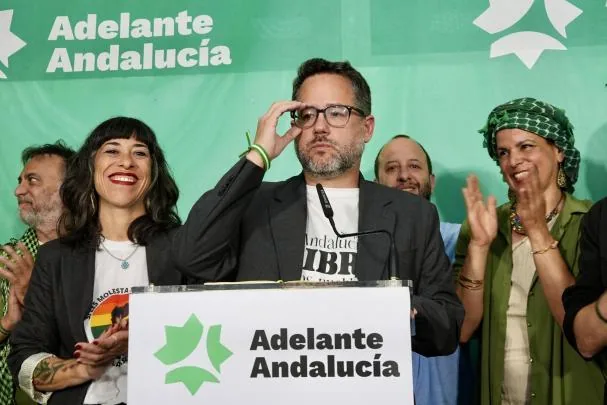
Podemos put the political system in check twelve years ago, managed to win the general elections in Catalonia and the Basque Country, and today sees how its former anti-capitalist comrades from Adelante Andalucía, whom they considered somewhat marginal due to their Trotskyist affiliation, succeed thanks to a skillful return to political craftsmanship: proximity, simplicity, radicalism with very concrete proposals, all adorned with the emotional appeal of Andalusianism. Adelante Andalucía is a reverberation of Podemos, with a character correction: less arrogance and more sentimentality. They will want to run alone in the general elections, following the trail of the Andalusianist Alejandro Rojas Marcos in the transitional years.
There are incentives for everyone, and therefore it will be more difficult to discipline Spanish politics in the face of the major European questions posed by 2027, the year when elections will also be held in France, Poland, and Italy. No favorable dynamic emerges from the Andalusian elections for a future entente between PP and PSOE. Both can win by absorbing their extremes. They face a year of tough tactical combat ahead.
Will Moreno Bonilla have the audacity to propose a repeat election if they pressure him too much?
Read more The Mossos arrest Jonathan Andik, son of Mango founder Isak Andic, for homicide