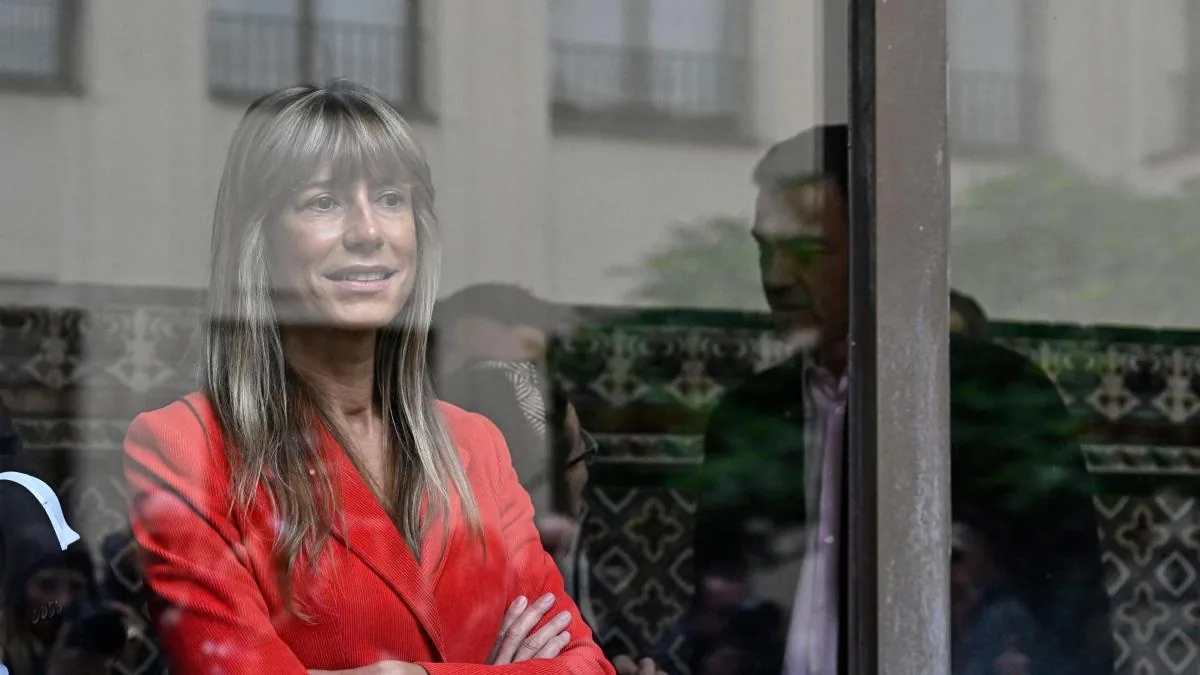
The defense of Begoña Gómez, wife of the Prime Minister, has requested the Provincial Court of Madrid that, if the case goes to trial with a jury, she be acquitted of the four crimes charged by Judge Juan Carlos Peinado, since “the facts presented do not constitute any crime.”
Read more Barcelona will include the «intercultural perspective» in its public procurement clauses
This is the provisional conclusions document for the possible future trial with a popular jury, accessed by EFE, in which lawyer Antonio Camacho recalls that he has maintained this position throughout the process and therefore the appropriate action would be to dismiss the case.
Judge Juan Carlos Peinado rejected earlier this month the appeals requesting the dismissal of the investigation against Begoña Gómez, her advisor Cristina Álvarez, and businessman Juan Carlos Barrabés, and insisted on sending them to a jury trial, as he proposed at the end of the investigation phase last April. The Provincial Court will have to decide on this matter.
Now, in the procedural provisional conclusions document for a future trial, Gómez’s defense argues that she did not commit the crimes of influence peddling, corruption in business, embezzlement of public funds, and misappropriation, emphasizing that the Prime Minister’s wife began her collaboration with the Complutense University in 2012, “a time when her spouse, Mr. Pedro Sánchez Pérez-Castejón, held no public responsibility.”
And it requests that the accusations be condemned to pay costs, including those of this defense, for having acted “recklessly and in bad faith,” by insisting on the process despite the “absolute absence” of evidence, with the aim of using the case “as a mechanism of pressure and to cause reputational damage.”
The defense claims that Gómez began her collaboration with the UCM when Sánchez had no public responsibility
Thus, this defense proposes an “alternative factual narrative,” starting by explaining that Gómez began her collaboration with the Complutense University of Madrid (UCM) in 2012, when Pedro Sánchez had no public responsibility: she was co-director of studies on fundraising and later co-director of a master’s degree in Public and Private Fundraising Management in Non-Profit Organizations.
At the same time, she continued her professional activity at the company Inmark, which she left when her husband was appointed president in 2018 “with the express purpose of avoiding any conflict of interest arising from his institutional position.”
Read more The hardest blow for Fermín López: he goes through surgery and misses the World Cup
In 2020 Begoña Gómez was appointed co-director of the extraordinary chair Competitive Social Transformation, a position offered to her by the Complutense, the document specifies.
Gómez’s lawyer insists that “the Extraordinary Chair did not involve receiving any remuneration,” that it is not necessary to have a university degree to co-direct it, and that the software created within it had the collaboration of various companies that contributed different amounts “which were deposited into the UCM’s assets.”
The software was not completed and was never used, so those amounts “remained in the UCM’s assets,” which “has not suffered any patrimonial damage.”
After ruling out other alleged illicit activities at the Complutense, Begoña Gómez’s defense also dismisses irregularities related to the work of advisor Cristina Álvarez, recalling that all wives of presidents have had this assistance and insisting that Álvarez only occasionally sent “a very limited number of emails to help Ms. Begoña at specific moments,” all without “any detriment to public resources.”
Regarding the relationship with Juan Carlos Barrabés, who according to the accusations helped her in the chair in exchange for her signing letters in favor of his projects, the defense explains that the businessman participated in Begoña Gómez’s master’s “giving some classes” and “had no involvement either in the genesis or in the development” of the investigated chair.